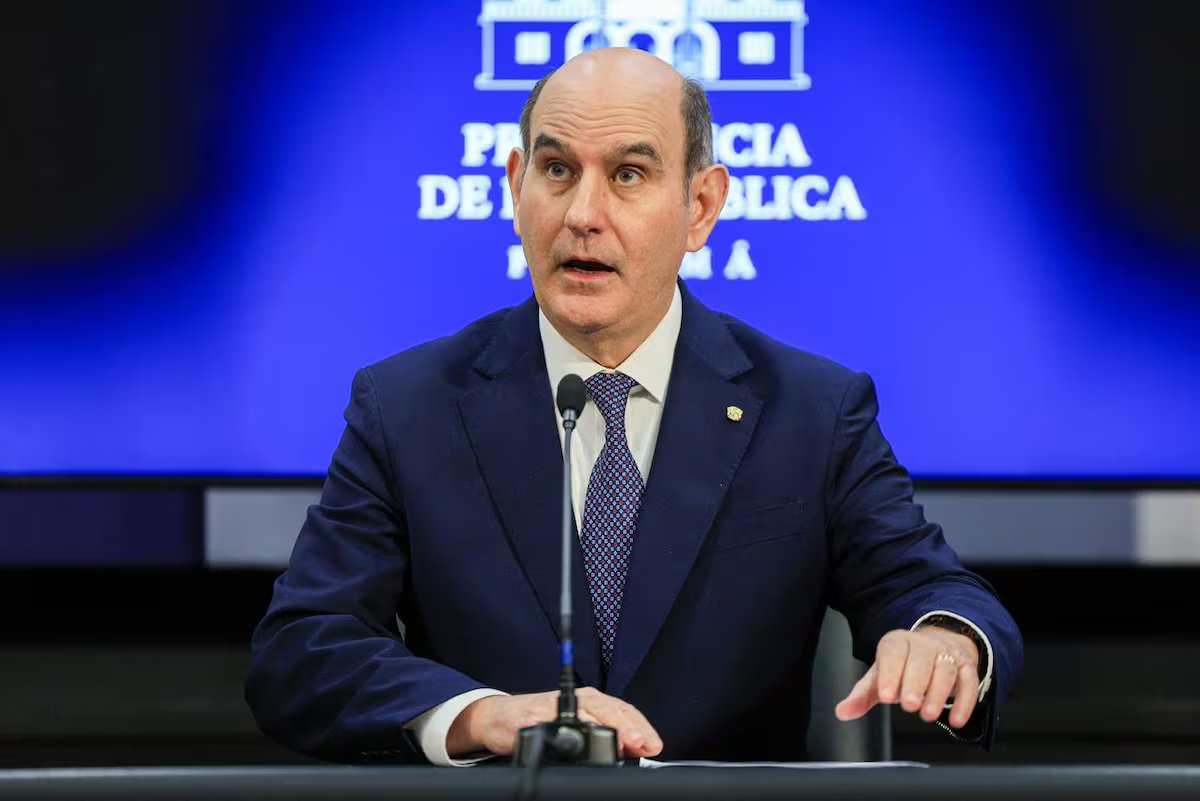
Minister Felipe Chapman assured that the MEF will evaluate the housing sector’s proposals regarding the 2% ITBI, as long as they do not affect tax collection.
The Minister of Economy and Finance, Philip Chapmanstated that he is willing to analyze the proposals of the National Housing Council (Convivienda) on the impact of the Real Estate Transfer Tax (ITBI) that applies to new homes, as long as they are technically supported.
“We have not analyzed it with them… they have not provided me with the study, I would love to see it”said Chapman, as he left the swearing-in of the new board of directors of the Chamber of Commerce on the night of Wednesday, April 8.
The representatives of Convivienda indicated that the application of the ITBI will increase the cost of homes because it will generate an additional charge that buyers will end up paying with the initial payment. In addition, they specified that the collection of this tax is low compared to what the treasury could fail to receive if works are paralyzed and construction activity is discouraged.
Specifically, the study of Cohabitationpresented on Wednesday before an audience — among whom were the director of the General Directorate of Revenue, Camilo Valdesand the vice minister of Economy, Fausto Fernandez—, points out that the application of The 2% ITBI rate on homes could affect around 6,700 mortgage loans that would be delayed and 762 that could be lost.
This would imply $526 million less in financing and a drop of up to $1.3 billion in economic activity, in addition to a reduction of more than $120 million in tax collectionwhen considering Income Tax and ITBMS (sales tax).
While the ITBI could only generate $37 millionwell below the negative effect that would be produced on the economy with fewer credits, sales and a drop in construction.
More information: Tax on new homes suffocates buyers and builders
In that sense, Chapman reiterated that the ministry maintains “open doors” to evaluate initiatives that add value, as long as “Help us understand it with proposals that help solve this and do not affect tax collections.“He specified that he does not yet know the Convivienda study but is willing to discuss the issue.
Furthermore, the minister @FelipeChapman He clarified that the tax on real estate transfers is not new, what expired was the exemption that existed for new homes. Video Anel Asprilla. https://t.co/mMqQChOjdD pic.twitter.com/Cq8aXjRQ1g
— La Prensa Panamá (@prensacom) April 9, 2026
Chapman clarified that this is not about the creation of a new tax, but rather the expiration of an exemption. “The tax already existed; What there was was an exemption to pay the tax“, he explained, referring to the ITBI that now also applies to the first sale of new homes.
Indeed, this tribute is not new, the spokespersons for Convivienda confirm, but For more than 50 years, Law 106 of 1974 exempted the first sale of new homes in Panama from the ITBI (2%)applying it only to used properties. However, last year with Law 468 of 2025 and its subsequent modification (Law 481, which is the one in force), this benefit was eliminated.
The exemption expired on December 31, 2025and since January 2026 the tax is also charged on new homes, raising their final price, according to Convivienda.
‘Subsidies cannot be reduced’
On another topic, Minister Felipe Chapman highlighted the projections of the World Bank, which estimate a growth of 3.9% for Panama.
He explained that the increase in the price of oil could favor the Panama Canal: “Paradoxically, when the price of oil increases… the competitiveness of the Canal increases,” recalling that in 2008, with a barrel at 140 dollars, its transit volume increased along a route whose route is shorter.
In addition, he said that due to the situation in the Middle East, the effect on the global economy and the country is constantly being analyzed, but he maintained that a recession cannot yet be considered.
Regarding the global economic situation and the impact in Panama, this is what the minister of the @Mef_Pma @FelipeChapman https://t.co/Jv0CT2FvT1 Video Anel Asprilla. pic.twitter.com/flXKkPs58C
— La Prensa Panamá (@prensacom) April 9, 2026
The minister also warned that the current international context complicates the reduction of subsidies. “We do not have the appropriate conditions to eliminate subsidies, for obvious reasons,” he indicated, mentioning the inflationary pressure derived from the increase in fuel prices.
The minister of @Mef_Pma @FelipeChapman He maintained that given the situation of global uncertainty with rising fuel prices, it is not viable at this time to reduce subsidies. Video Anel Asrpilla https://t.co/Jv0CT2FvT1 pic.twitter.com/POm7JtRhwC
— La Prensa Panamá (@prensacom) April 9, 2026
However, he stressed the need to strengthen budget management: “Difficult times… make it more important that we have the capacity to bring greater flexibility to the budget to deal with unforeseen situations.”
Finally, he announced that the Government is working on new legal initiatives, including adjustments to the Corporations Law and special laws.