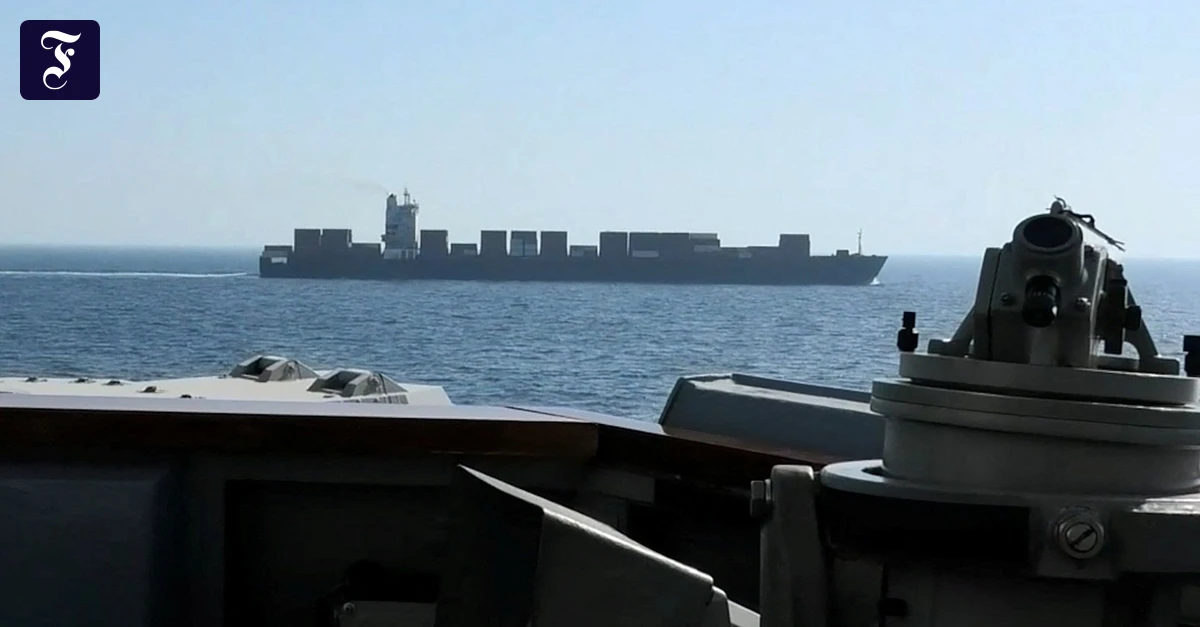
There are a few grainy American military video recordings of the recent escalation in the dispute over the Strait of Hormuz, with a greenish tint from night vision cameras. They show a helicopter taking off from the deck of the amphibious assault ship USS Tripoli. In later sequences, US soldiers rappel from the helicopter onto the freighter Touska in order to put it under American control. The Iranian-flagged container ship is said to have set course from Malaysia for the Iranian port of Bandar Abbas. Before that, there should be regular flights between China and Iran be wrong.
According to the US military, the captain resisted requests to turn over for six hours. After the ship passed the blockade line declared by the Navy, the guided missile destroyer USS Spruance fired on the freighter’s engine room and stopped the ship. The crew had previously been asked via radio to leave the engine room. In this case, the US soldiers faced no resistance. Enforcing the blockade would be more risky if, for example, China decided to protect its merchant ships militarily.
Islamabad: US blockade undermines negotiations with Iran
For seven days, the United States left threatening radio messages after President Donald Trump announced the blockade. With the deployment of the Touska, they are now taking a further escalatory step – just at the moment when Trump has promised a new round of negotiations in Islamabad. Apparently he hopes this will increase the negotiating pressure on Iran. This tactic seems to make the mediator Pakistan nervous. According to agency reports, army chief Asim Munir is said to have told Trump in a phone call that the US blockade was an obstacle to the talks.
But Iran also continues to use the Strait of Hormuz as a means of pressure in the negotiations. The Foreign Ministry spokesman in Tehran said on Monday that the American actions cast doubt on the “seriousness” of the diplomatic process. However, he did not rule out continuing the negotiations. The Revolutionary Guard threatened retaliation, but seemed anxious not to escalate the situation further.
A spokesman for the Iranian armed forces indicated that there were initial plans to use force to free the freighter Touska. “Due to the presence of family members of the crew and to protect their lives and safety,” they refrained from doing so.
The Touska is owned by the state-owned shipping company Islamic Republic of Iran Shipping Lines, which is sanctioned by the US, the EU and the United Nations for supporting Iran’s nuclear and missile programs. CNN reported, citing “naval experts,” that the ship would be taken to an anchorage or port to inspect its cargo. The cargo could be seized by the US government. The nearest countries, Oman and Pakistan, are unlikely to be keen to have their ports singled out for this because it could make them the target of retaliation.
Lots of experience in evading sanctions
Since the blockade was announced, the US military says it has forced 25 merchant ships to turn around or return to Iranian ports. But the blockade is not impermeable. The analysis company Tanker Trackers reported at least one empty giant tanker flying the Iranian flag that passed the blockade line unhindered on Sunday. Media had previously reported that several ships had entered the Gulf of Oman from Iranian ports without being stopped.
One reason for this could be that Iran has been under sanctions for decades and is adept at undermining the movements of its shadow fleet through manipulated tracking systems, fake delivery documents, multiple port calls or ship-to-ship transfers on the high seas. But even a blockade that is not completely tight can have an impact: Iran loses oil revenues, transport and goods costs rise, and the supply of key goods is restricted. Iranians are currently reporting massive increases in prices.
Report: Iranians fear surprise attack
The continued US blockade has also prompted the Iranian Revolutionary Guard to reverse the interim opening of the Strait of Hormuz and bring shipping back under its control – with corresponding consequences for the global economy. The Guard fired at and threatened several ships over the weekend to enforce their own conditions for passage. Accordingly, ships should only be allowed to pass along a route specified by them with the approval of the Revolutionary Guards and after paying a “security fee”.
There appear to be different ideas within the Iranian power apparatus about how to deal with the strait in the future. While some see this as a lever to enforce Iran’s conditions in negotiations with the USA, others speak of a permanent control regime, for which the Iranian parliament has already drawn up a draft law.
In preparation for future transits, the U.S. Navy is currently conducting demining operations using unmanned watercraft and underwater drones, according to the Wall Street Journal. This is apparently intended to strengthen the confidence of shipping companies that passage will be safe again in the future – but probably only after a negotiated solution with Iran.