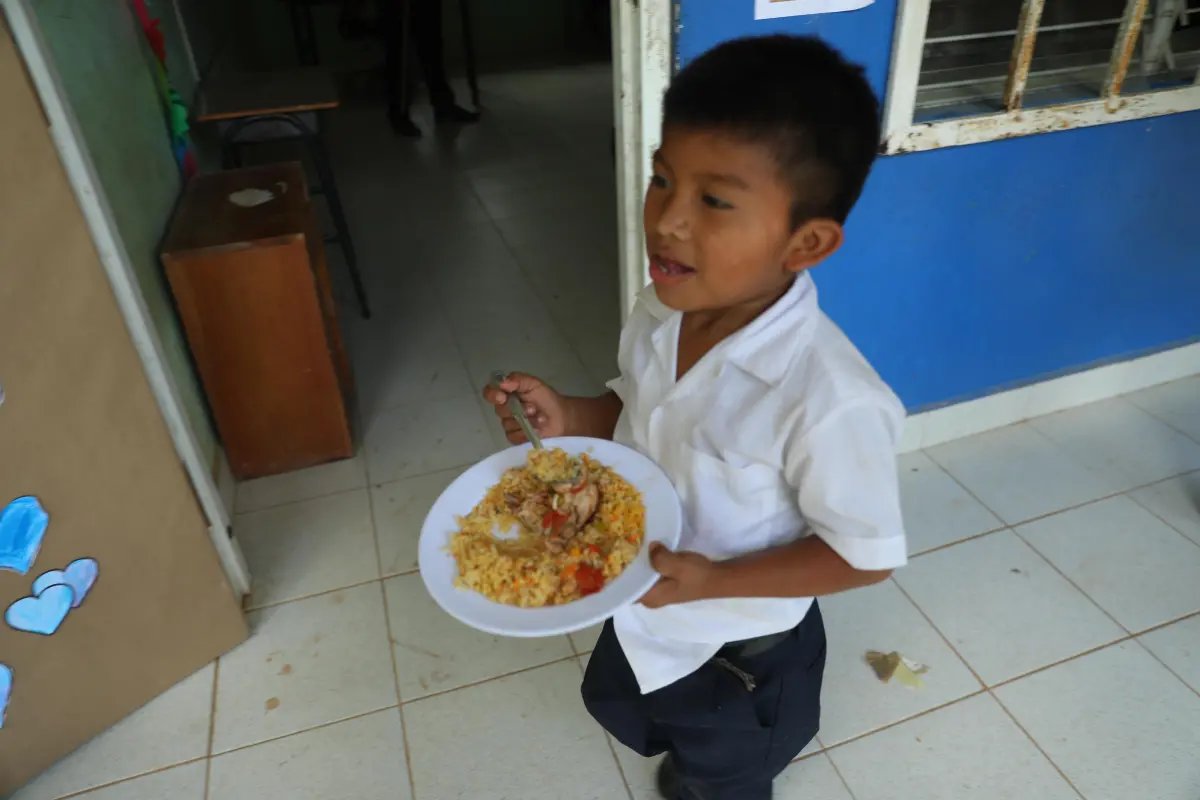
A multimillion-dollar tender for the school lunch program of the Ministry of Education (Meduca), which will be used by some 284,000 students nationwide, ended up in the hands of disparate winners: on the one hand, companies linked to food distribution; on the other, a company whose experience is in waste management, sanitation activities to the exploitation of mines and quarries.
The ministry thus sealed the contract, whose reference price was $95.5 million and whose award this month was for $87 million, and which provides for 28 food deliveries during 2026 and 2027.
The tender for supply, transportation, delivery and unloading at food sites for the preparation of healthy school lunches in educational centers nationwide is distributed in 22 lines that cover various educational regions and regions.
The contract will be valid for one year and ten months and will be executed by Distribuidora Mini Market SA, Building Paradise SA, and the El Machetazo Consortium composed of Compañía Goly SA and Transporte Ligo SA
Distribuidora Mini Market SA, chaired by Virgilio Athanasiadis Ramos, will be in charge of the transportation and distribution of food in the Ngäbe Buglé Region, specifically in the regions of Nedrini and Kadriri, for $14.5 million.
The company is dedicated to the sale of poultry, meat and food products in general, according to its operation notice.
The remaining 20 educational regions, that is, the provinces except for these two regions, will be managed by the El Machetazo Consortium made up of the companies Compañía Goly SA and Transporte Ligo SA, for $71.6 million, dedicated to the purchase and sale of agricultural products and others for their distribution and land transportation, respectively.
On the other hand, Building Paradise SA, whose work will focus on educational centers located in the Emberá Wounaan Region, for the sum of $777,924, has an industrial and construction line, according to documents from Panamá Emprende and the Public Registry.
According to its notice of operations, Building Paradise, SA, chaired by Ahmad Mohamad Saheli, is dedicated to waste management, sanitation activities, the exploitation of mines and quarries, construction of roads and railways and treatment of non-hazardous waste, sanitation, waste management, septic tank cleaning and industrial cleaning, among other services.
A very similar description that is cited in the articles of incorporation of the Public Registry company, which aims to direct public and private concessions and tenders for constructions, repairs and buildings in general of concrete, cement and wood, alarm installations and preparation of plans, among others.
La Estrella de Panamá consulted Meduca about this company, whose purpose is different from the tender, but at the end of this edition no response was obtained.
For his part, Sahali, president of Building Paradise SA, had “several” operational notices, one of these including the food transportation service, which he provided to this medium, but which does not appear on the Panama Emprende portal of the Ministry of Commerce, the entity that issues them.
Another situation that was recorded in the tender is that according to the specifications of the process, the participants had to deliver their complete financial statements for 2023 and 2024, audited by a firm of Authorized Public Accountants. However, the consortium only provided the information calculated until June 30, 2024, leaving the rest of the period unsupported.
Faced with this statement, the group filed a claim action in which it argues that the document did not clearly establish that the income must necessarily correspond to a “calendar year.”
Furthermore, he maintained that the intention of the requirement was to demonstrate solvency and liquidity of the companies, an objective that is amply accredited with the documentation delivered, according to the consortium, explanations accepted by Meduca.
While the global tender for the Healthy School Lunch program progressed, Meduca decided to ensure student nutrition from the beginning of the year through a transitional scheme: each regional directorate could make local purchases with nutrition funds and, through public events, obtain the necessary resources to cover lunches, explained the national director of School Nutrition and Health, Hilda Montenegro, in an interview at the beginning of the year.
Some of these processes lasted until the end of the first quarter. In that period, the regional governments together allocated about $841,747 to supply educational centers. However, not all of them managed to do so: only 14 of the 22 allocated resources to meet the demand.
In the midst of these acquisitions, several of the companies that today appear as winners of the national contract had already been favored in regional purchases. Distribuidora Mini Market obtained a contract for $46,420 in the Central Panama Regional, while Building Paradise SA a contract for $40,111 in the Darién Regional.
Regionals varied their contracts during the first quarter, with some requesting prepared meals while others required lists of foods to cook in their schools.
Panama Centro concentrated the largest investment with $459,017, followed by San Miguelito, which allocated $149,644, and Veraguas, with $66,111.
In a second level, Chiriquí appears with $33,365, Panamá Oeste with $21,062, Coclé with $20,735 and Herrera with $14,442.
And the smallest amounts were in Bocas del Toro with $12,281, North Panama with $9,337, the Ngäbe Buglé region with $6,199, East Panama with $4,875 and Los Santos with $3,978. At the lower end of the list are Darién with $40,111 and Colón, which registered the lowest figure with just $585.