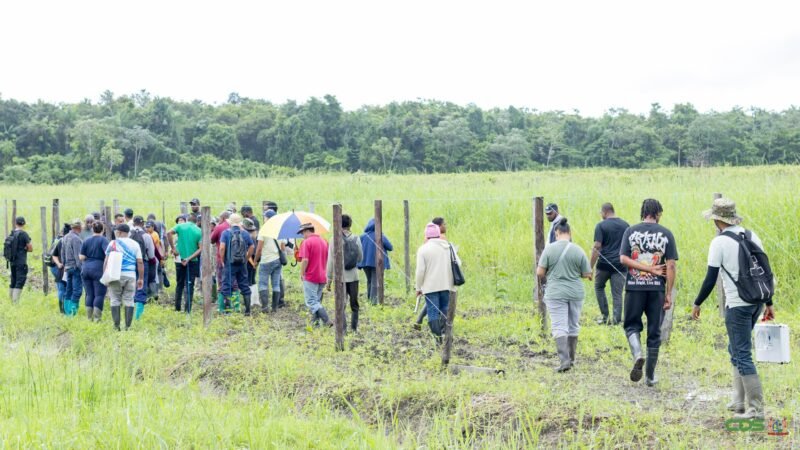
PARAMARIBO – The more than fifty growers participating in the ‘Markoesa Outgrowers project’, which was launched on Thursday in the presence of President Jennifer Simons, received their practical initiation on Saturday. In this context, a field visit was made to marcusa fields in Saramacca, on the Road to Coppename km 82, on the property of Daniël Durga, director of AgroSurBra.
Theoretical sessions were provided for two days. According to Soekarina Ardjosentono, senior researcher at the Department of Soil Research and Agrohydrology at the Ministry of Agriculture, Livestock and Fisheries (LVV), the participants were first given a solid theoretical basis. This was followed by a visit to AgroSurBra to view the practical aspects of the theoretical part in the field, according to Ardjosentono. Various trainers provided the participants with the necessary knowledge about the cultivation of markoesa. “It concerns aspects such as weed control, disease and pests and how to deal with them. So a complete package for growing markoesa.”
Chairman of the National Assembly, Michael Adhin, also attended the practical part. As a lover of markoesa, he expressed his appreciation for the government’s initiative to encourage people to develop in the sector. “It’s nice to see that there are outgrowers. I can only applaud that. The more training people receive, the more prepared they are for problems that may arise.” Adhin hopes that the intended goal of exporting markoesa on a large scale will be realized. However, he emphasized that some preconditions must be in order to get the most out of the project. According to him, the production of markoesa is a sector with great potential. “Because markoesa is a lucrative product and there is a market for it in the region. We have to look at the competitive advantage of our prices.”
Participant Ronny Rambaran, who has been growing markoesa at various locations for more than twenty years, says he was inspired by the field visit to think bigger. He believes that with the knowledge he gains through the project, he can enter the market better prepared. According to him, the government is strongly committed to agricultural production. “I see that there is a great will on the part of the president to create the ultimate food store of Suriname. We farmers must now get up and wake up.” Rambaran also emphasized the importance of certification, continuity in production and cooperation in a cooperative context. At the same time, he warned against excessive use of chemicals due to the possible negative consequences for public health.
According to AgroSurBra director Daniël Durga, his company has mainly focused on the cultivation of markoesa for more than eight years. We work with two varieties from Brazil, with which there is a strong cooperative relationship. Durga gained experience with the agricultural sector in the neighboring country and held discussions with experts about possible technical support. AgroSurBra was born from that collaboration.
Durga says that the demand for markoesa is high both locally and internationally. According to him, there is still sufficient room in Suriname to supply companies, but continuity remains a challenge. “But continuity must be offered. And so far Suriname has not been able to do that. And that is what I have been striving for for a long time: to interest other people in planting markoesa,” says Durga. In addition to private companies, a new processing line at the Melkcentrale will also create additional demand. “Demand is becoming high. So we have to plant.”