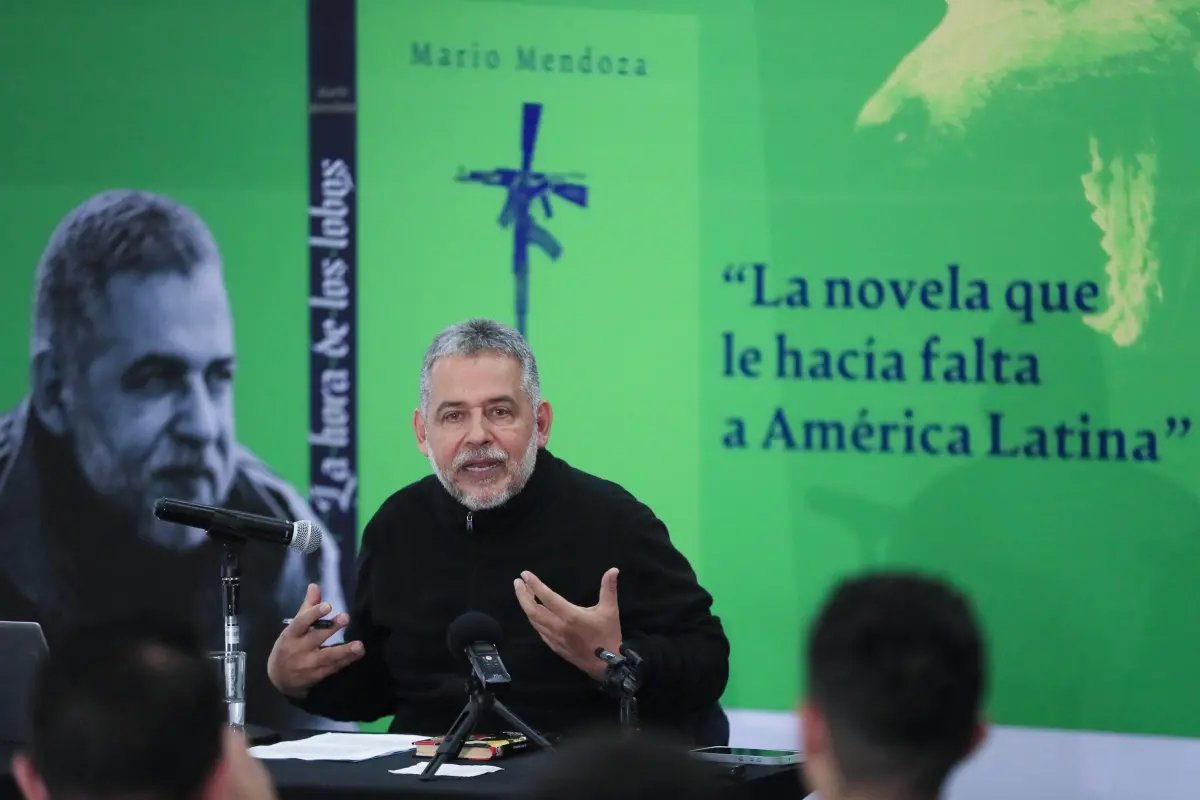
The Colombian writer Mario Mendoza published this Thursday ‘The Hour of the Wolves’, a novel that reflects on new crime and mixes violence and marginality to talk about life “in the underworld” of Latin America.
“This book was very difficult for me to write, because for a long time I refused to enter the mafia, that world did not interest me narratively,” the author confessed at a press conference in Bogotá in which he presented his new work, published by the Planeta publishing house.
Mendoza, born in 1964 in the Colombian capital, pointed out that political violence – which is exercised by groups outside the law that attack the “establishment”, such as guerrillas, paramilitaries or drug trafficking – had never interested him.
Instead, his interest has been in transpolitical violence, which refers to violence that takes place within the system itself: “The system itself operates in a terrible, cruel and ruthless way and that psychologically affects us all.”
For the first time, the author reflects on whether current criminal groups function the same as the old Colombian drug trafficking cartels, such as those in Medellín, Cali or Norte del Valle.
Mendoza delves into the traditional imagery of the leaders of these groups, such as the well-known photograph of Pablo Escobar with a Mexican hat and weapons, and wonders if these same references are still valid today.
The author concludes that the new leaders are influenced by Japanese anime, extreme sports and martial arts: “The contemporary boss is someone who goes to the gym, does weight training, runs, it is something very different from what a boss from the 80s or 90s would be.”
‘The Hour of the Wolves’ tells the story of Bruno Guerrero, a marginalized young man, besieged by death since he was a child, who discovers martial arts and with the help of these, added to his “intelligence and sagacity”, he forges a path in the world of the underworld.
As a result of his actions he ends up in prison, where he meets a “brilliant and terrible” man who becomes his teacher and protector.
For Mendoza, one of the first references to understand the relationship between organized crime and Latin America was the murder of Luis Donaldo Colosio, which occurred on March 23, 1994 in Mexico.
Based on that event, the author suggests that there is a deep relationship between the State and drug trafficking in Latin America.
“We continue to believe that there is a State that operates and that works differently from the drug trafficker and that the drug trafficker is still trying to co-opt us. No, that doesn’t work like that. Since the murder of Colosio we know that it doesn’t work that way,” he insisted.
To which he added that the same establishment is already “co-opted”, since it has “strong ties” that connect it “with the mafia” through businesses, deals and alliances.