Four senior women are currently placing Rummikub game pieces in front of them at the table, a few others have retreated to their rooms to rest, the rest are waiting in the living room for the gymnastics lesson. It’s 38 degrees and in Maria Roggendorf things are taking it easy on this Thursday morning.
Only Christa Schwinner seems unfazed by the heat. The 48-year-old busily leads through the many rooms at the “Sonnenplatzerl”. A stone’s throw from her home in the Weinviertel, the Lower Austrian has transformed an old farm into a care center and shared apartment for seniors. “In December 2023 we started the operation with two guests, today there is a waiting list. At peak times there are between 20 and 40 applicants,” says Schwinner.
In the future, fewer and fewer young people in Austria will have to look after more and more older people. Entrepreneurs like Schwinner who implement creative solutions for this privately should therefore be actively supported and even courted. But that is not the story that Christa Schwinner tells.

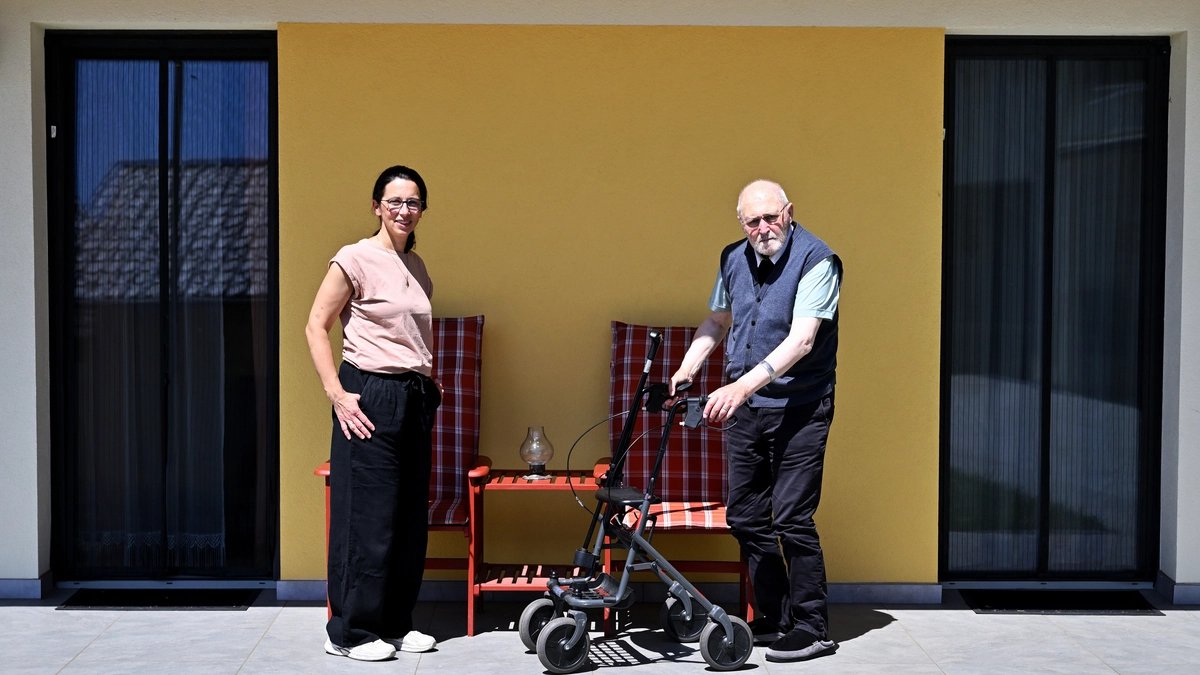
Christa Schwinner is a farmer and nurse and runs the retirement community. Clemens Fabry
The aging population is one of the most challenging issues for the country’s future. While the proportion of people over 65 in the population was 12 percent 50 years ago, today it is 21 percent and in 50 years, according to forecasts Statistics Austria at almost 30 percent. At the same time, the proportion of employed people who can support these people is decreasing, and traditional large families are now rarely a common practice. This means that sooner or later the community must take on the task of caring for the elderly if senior citizens are to grow old under livable conditions.
Use Christa Schwinner. The basic idea of their “Sonnenplatzerl” is simple: older people should be accommodated in small units, not far from their families or previous places of residence, and ideally in the countryside or on a farm. The seniors move into their own residential unit with a barrier-free bathroom and access to the garden. They can organize their everyday lives independently, but there is always the option of living in a community. Food is cooked for them, a household help takes care of the laundry and cleaning, nursing staff are always on site during the day and available at night for emergencies.
The chiropodist, hairdresser and physiotherapist come by once a week. Nine rooms are available for seniors, who, however, still need to be able to look after themselves to some extent. There is also a day care center for up to 14 seniors, which is open four days a week to look after people with more severe disabilities. Side note: The agricultural part of the project is limited to a large garden, raised beds and a goat stable. However, years have passed from the idea for the project to its implementation.

Nine rooms with bathrooms are available for seniors. Clemens Fabry
Schwinner is a trained nurse, but comes from a farm; her husband is still a full-time farmer today. When her parents retired, she resigned from the hospital and took over the business in 2010. During her training to become a master farmer, the desire to combine her two areas of expertise grew. “When my mom was still a farmer, she looked after her aunt, who had dementia and lived in the house next door. She took her everywhere on the farm, to the hens, to the vegetable garden, to crack nuts. And that calmed her down. Then I thought to myself, I’ll do that myself.”
“Nobody was interested in the project beforehand, but after it was completed all kinds of politicians came to visit.”
Christa Schwinner
Operator of the retirement shared apartment
She came across a few projects that were implementing something similar in Austria. For example, social farms run by the Green Care initiative. Care and education for children, people with disabilities and senior citizens are offered on the farm. Schwinner went on a research trip. She went to Carinthia and looked at the “Alternative Living Spaces” project there, or to Renate Pointner in Upper Austria, who combines an alpaca farm with care for the elderly.
But thanks to federalism, every federal state in Austria has a different law for social institutions. So what can be implemented in Carinthia cannot necessarily be done in Lower Austria and vice versa. And something that has never existed in a federal state is certainly not funded. For Schwinner, a bureaucratic gauntlet began, which she only got through with the support of her four children and her husband, happy offers of help from unexpected quarters and consistent optimism. There was hardly any financial support and the banks were not prepared to pre-finance the project for a long time. Schwinner and her husband will probably continue to pay off loans until they retire. “I’m a little disappointed with politics, I have to say that. Nobody was interested in the project before, but after it was completed all kinds of politicians came to visit,” says Schwinner.
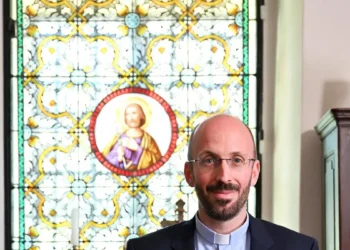
“I always thought that this was my reward for going to confession every month,” says Robert Bösner when he talks about his accommodation at the “Sonnenplatzerl”. The 91-year-old was born in Vienna, but was a priest in Lower Austria for a long time. He found his confessor in Benedictine St. Josef Monastery in Maria Roggendorf. Once a month he came to the small town, visited the monastery and at some point he noticed that a new project was being built nearby. “My fellow brothers in the monastery could no longer take care of me, my coordination center was a little insulted during the third stroke. So I moved here,” he says. He wears a gray vest over his smooth shirt and expresses himself with choice. Only sometimes does he repeat himself or go too far. The Russian occupiers then have to carefully bring him back to the present.

Robert Bösner was one of the first residents of the retirement community. Fabry
“I’m basically a founding member, I like to say,” said the priest. After all, he was one of the first two residents at “Sonnenplatzerl”. Here, too, he takes on pastoral tasks, says the blessing at lunchtime before eating, and listens willingly and carefully to everyone. He is one of two gentlemen in the care center. While he sits outside in the shade, a group of ten senior women sit together in the living room and exchange recipes. Each of the women has a specialty: cardinal slices, nut croissants, egg dumplings. All of them are talkative despite the heat. Before the communal lunch there is gymnastics and memory training. “We’ll never get bored,” one of the women says to the group and the group nods back.

Sonnenplatzerl senior living community, Christa Schwinner Photo: Clemens Fabry Clemens Fabry
Schwinner is convinced that facilities like hers are becoming increasingly important. “Actually, every town needs a day care center. And instead of large nursing homes, there should be smaller units in the surrounding area,” she says. This guarantees a better care ratio and also means that relatives don’t have to travel too far. In order to make this possible, we would need not only people with perseverance but also a fundamental rethink in politics.
Focus: What lies ahead for us?
It’s been 30 years since diepresse.com went online, “Die Presse” took the step into the digital age. We are taking this anniversary as an opportunity to look forward again. Young entrepreneurs, researchers, artists and politicians are asking themselves the big questions of our time: How will our most important areas of life change in the next few decades? How will we work, believe and love? And what else do we need to know in the future?
To the focus.