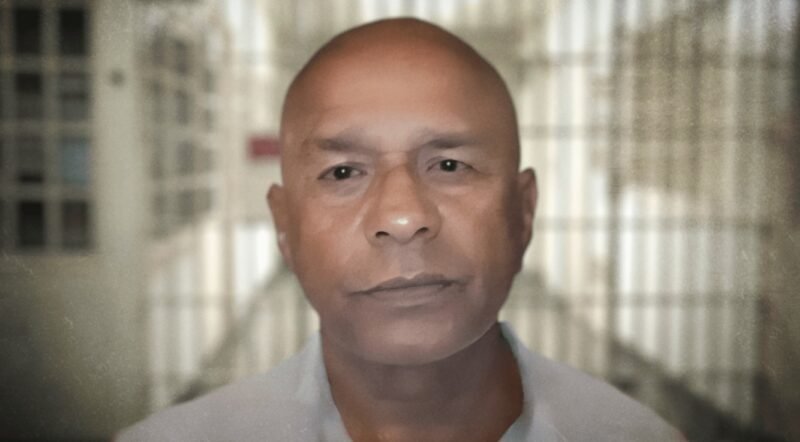
AMSTERDAM – The Public Prosecution Service (OM) in Amsterdam wants the elderly Jaitsen Singh to receive a life sentence. The 81-year-old Dutchman of Surinamese origin was convicted in the United States 41 years ago for the double murder of his wife and stepdaughter and was recently transferred to the Netherlands. Singh fought for years to serve his sentence in the Netherlands and to give him the chance to die there. He has acute leukemia and doesn’t have long to live.
Singh left Suriname for the Netherlands in 1965 and returned to Suriname with his family in 1969. From there they left for the United States. He lived in Ontario (California) since 1970 with his wife Grace, his son Surendar and his stepdaughter Daphne, from Grace’s previous marriage. He was a maintenance technician at a plumbing company and rented out real estate.
His wife and stepdaughter were found dead in the trunk of Grace’s car on August 27, 1983, in a crime-prone neighborhood in Los Angeles, more than fifty miles from their hometown. She had been beaten to death with a baseball bat and Daphne had been stabbed to death with fourteen stab wounds. It had previously been discovered that the Ontario home had been ransacked and was covered in blood.
In April 1984, then 39-year-old Singh was arrested based on the testimony of one witness, Raymond Copas, who was himself imprisoned at the time. In 1986, a jury sentenced Singh to 56 years in prison for ordering the double murder. The verdict rested solely on the testimony of Copas, who later retracted his testimony in a written statement and died shortly afterwards.
Even after that, numerous statements and file documents would have shown that Singh almost certainly had nothing to do with the double murder. The widow and a brother of one of the suspected perpetrators have signed a statement stating that the Dutchman is not guilty of the murders.
Lived and worked in Suriname
The witness statement on which the verdict was based turned out to have been bought by prosecutor Dennis Stout, who later had to end all his criminal cases due to corruption. Exculpatory testimony from the then fourteen-year-old Suren, Singh’s biological son, has always been excluded from the trial.
After his conviction, the Netherlands made no effort to assist Singh and allow him to serve his sentence in the Netherlands, which was possible. The argument was that Singh – despite having a Dutch passport – had too little connection with the Netherlands because he had mainly lived and worked in Suriname.
Only last year, after years of litigation, the judge ruled that the Dutch state must bring Singh back to the Netherlands on humanitarian grounds. This happened in March of this year, after which the judge must now consider his sentence according to Dutch criminal law. So not about the question of whether Singh is really guilty of the murder. If it is up to the Public Prosecution Service, it will be life in prison. The Netherlands does not have a sentence of 56 years to life in prison, but according to the public prosecutor, the American sentence is equivalent to life in prison according to Dutch standards.
Punishment must be suspended immediately
Singh’s lawyer Rachel Imamkhan agrees with the commutation to a life sentence, but believes that the execution of that sentence should be suspended immediately. She advocates that the American sentence also include an option for leave. Although Singh was entitled to that, he never got it. A punishment that is adopted by another country should never become more severe. Therefore, Imamkhan requests to suspend the execution of Singh’s sentence and therefore release him.
Before this happens, according to Imamkhan, everything must first be arranged by the State. Singh has no Citizen Service Number and no health insurance. He was born in Suriname in 1944 when that country was still part of the Netherlands. Singh himself said in his closing speech that if the State had granted his requests earlier, he might have been given the opportunity to build a life in the Netherlands. Now he’s been stuck outside longer than he’s ever been outside. “I have forgotten what freedom is,” said Singh, who hopes to spend the last months of his life with his family.
He now resides in Scheveningen prison, where he receives permanent medical care. The court will make its ruling on May 19.