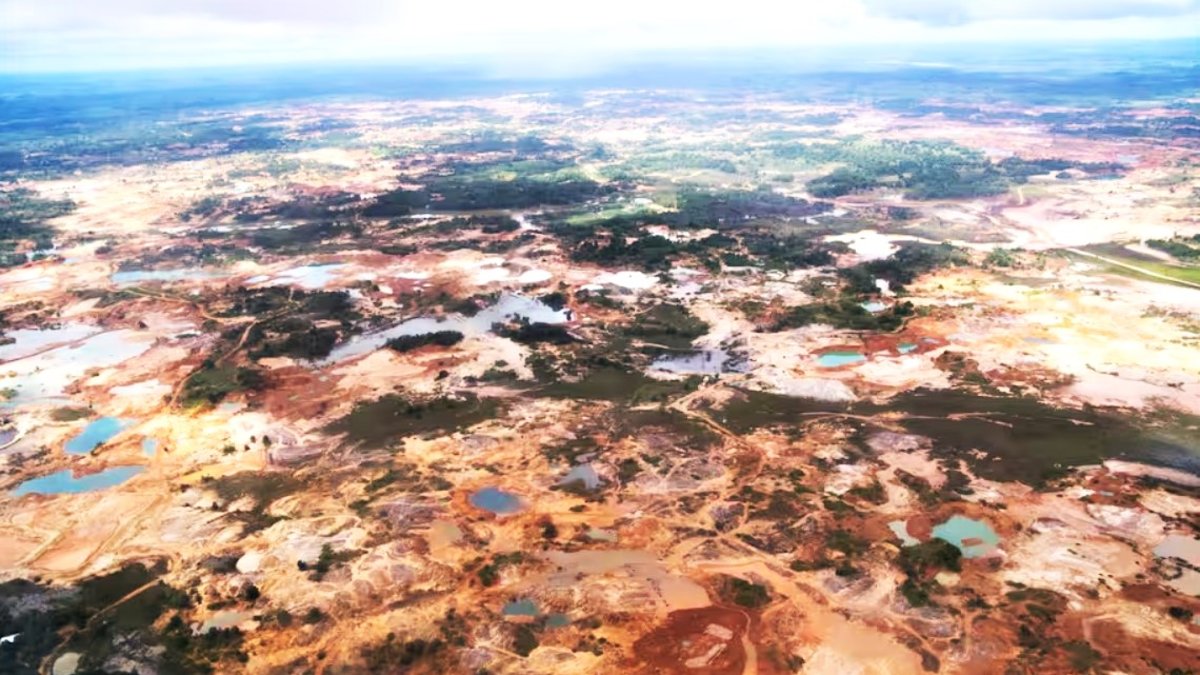
This week public opinion has turned its attention to the case of the illegally exploited gold mine of ‘La Mandinga’, located in the municipality of Cáceres (Antioquia) and adjacent to the 31st Rifles Battalion of the National Army. According to international media reports, the revenues from that mine are largely kept by the Clan del Golfo, whose center of operations is in Urabá and Bajo Cauca in Antioquia.
A reading of the problem of illegal mining, on a general level, shows that What happens in ‘La Mandinga’ is constantly multiplied in Cáceres and exponentially in the department of Antioquia. This is how it is established the most recent report on Alluvial Gold Exploitation from the UN Office on Drugs and Crime (UNODC). Although the document was published at the end of 2023, it is the most precise tool that Colombia currently has to measure illegal mining.
According to the report, In Cáceres, gold is extracted on the banks of rivers and near bodies of water in a total of 4,972 hectares. This is equivalent to around 7,000 football fields and 5% of the total that is extracted throughout Colombia. The UN report states that, in fact, Cáceres is one of the 10 municipalities where the most gold is extracted in the entire countrywhich should keep environmental and judicial authorities on alert.
La Mandinga Mine located next to the 31st Rifle Infantry Battalion. Photo:Private file
“Of 101 municipalities with alluvial gold exploitation in the country, 10 of them concentrate 54% of the national detection (52,859 ha): Zaragoza, Nechí, Nóvita, El Cantón de San Pablo, Cáceres (where ‘La Mandinga’ is located), Istmina, El Bagre, Ayapel, Río Quito and Unión Panamericana. 26% of the national gold production is obtained from these municipalities and is presented high illicit exploitation of gold (59%)”explains the UN in the report.
Likewise, the investigation adds that these territories are characterized by their high complexity since, in addition to the illicit exploitation of gold, Some have coca crops, which coincides with high levels of poverty and low development rates..
Cáceres is one of the eight municipalities that, in addition to illegal mining, also had coca crops. They are: Zaragoza, Nechí, El Bagre, Nóvita, Istmina, El Cantón de San Pablo and Río Quitowhich implies a double problem for the authorities.
“Besides, Formal gold production is not reversed in these territories, causing them to become favorable scenarios for the presence of organized criminal structures. that dispute territorial control due to the high profitability of illicit economies”, such as the Clan del Golfo, the investigation reads.
Gulf Clan. Photo:Private file
Regarding departments, Antioquia is the second most depredated in Colombia, with 37,588 hectares (almost 50,000 football fields)only below Chocó, which registers more than 38,890 as of the end of 2023. After them are Bolívar, Córdoba, Nariño and Cauca.
On the other hand, regarding the alerts of gold exploitation in water, that is, directly within the riverbed, The monitoring was concentrated in 10 rivers located in the Amazon and Orinoquia.
Of these, the Caquetá River concentrates the greatest number of alerts for this type of exploitation. All of these alerts are in the category of illicit exploitation. To this journey we must add what has happened since 2025 in the Saldaña River, in Tolima, which has been invaded by hundreds of miners throughout all its municipalities..
In the middle of that panorama, The ‘La Mandinga’ file shows the overwhelming situation of illicit gold extraction throughout the country and specifically in Antioquiaas one of the epicenters of the criminal business, which is carried out, even under the noses of the Army bases.
Jhoan Sebastian Cote Lozano
jhocot@eltiempo.com
@SebasCote95 in X
MORE INFORMATION IN JUSTICE SECTION