Text Audry Wajwakana
Image Private collection
PARAMARIBO – “There is currently not really a music industry in Suriname, but a music sector. There are also not many people who can really make a living from music alone,” says Shavero Ferrier. This reality is the starting point of ‘Kraka’, a Surinamese production initiative with a link to the Netherlands, which focuses on guiding emerging artists in professionalizing their music.
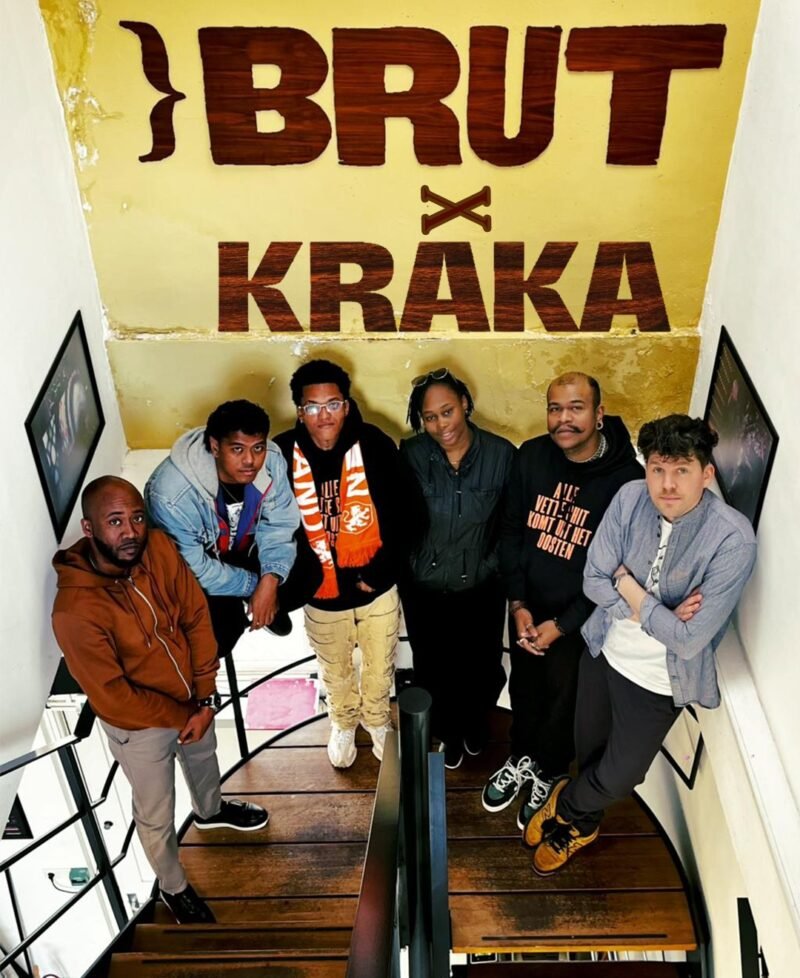
Ferrier, known as a punk artist, forms the core group of Kraka together with Dwayne Weltevreden (musician), Jamie ‘Carter’ Resosemito (artist), Charmain Belfor (director of the Conservatory of Suriname) and Dennis Platvoet (director of the Dutch Production House Brut). A Surinamese delegation is currently on a working visit to Brut as part of an exchange program. At the same time, the young Brazilian-Surinamese rap artist MenorBoy, who traveled with Kraka, is preparing for a performance during the Booster Festival next Saturday.
Widening view MenorBoy
“What is an important step in his development for Kraka is part of a larger process for Kraka; building a foundation on which Surinamese artists and musicians can grow,” Ferrier emphasizes.
The aim of this collaboration is not only to gain knowledge, but also to work concretely on a structure that is still largely lacking in Suriname.
According to the Kraka core team, MenorBoy is at the beginning of a promising career. He makes music that is unique and strives to reflect the Surinamese musical identity. They say he is passionate and has a good work attitude. This was decisive in his selection. “We do not want to support artists only when they have already broken through, but rather guide them in a phase where direction and structure are still lacking,” says Ferrier.
This support for MenorBoy started in August last year, during the first edition of the Kraka Poku/Tori, a two-day event where emerging talent open call got a stage. During that event there were not only performances, but also workshops about it brandingmarketing, a DJ workshop and a singer-songwriters workshop. MenorBoy stood there on stage as one of the participants. His presence in the Netherlands is not just about performing at the Booster Festival. He also participates in a writers’ camp and goes to an auditory laboratory at the Conservatory, Artez University of Arts in Enschede, where he works with producers, among others.
Weltevreden, project coordinator of the Kraka core group, adds that the process has been deliberately designed in such a way that development is central. “He has the ability to network and make music.”
The fact that this opportunity exists is the result of a collaboration between Kraka, Production House Brut and the Booster Festival. Around this time last year, a delegation from Kraka was also represented at the festival showcase.
Own production house
While MenorBoy develops as an artist, the core group of Kraka in the Netherlands on something that is less visible, but at least as important: the development of our own production house. “We are in the process of setting up the Kraka Production House.” The aim of this collaboration is not only to gain knowledge, but also to work concretely on a structure that is still largely lacking in Suriname. Ferrier describes how he encountered limits as an artist. “As an artist it was very difficult to find places to perform, so I started myself venues to approach, restaurants and bars,” he says.
When he saw that other people had the same problem, he started looking for other artists. “Without even knowing it, I was giving them a platform.” That experience was one of the impetus for Kraka, which started in 2022 when former student at the Suriname Conservatory, Xillan Macrooy, (nowadays storyteller in music, literature and theater) and Belfor, spoke about how to professionalize the Surinamese music scene.
The basis of Kraka lies in a question that was previously asked within the network surrounding the Conservatory of Suriname and Brut: why do artists such as Xillan and Jeangu Macrooy move to the Netherlands to develop their careers? And why shouldn’t that be possible in Suriname itself? After all, the Macooy’s also attended the Surinamese Conservatory and were already making music in Suriname. This research gave rise to the idea of setting up a local structure that supports artists in their development.
Kraka: working together
“We want to make music a serious revenue model in Suriname,” says Ferrier. Kraka works directly with Brut and the Conservatory of Suriname in supporting musicians. In addition, there are partnerships with the Bondru Foundation, Promarman, Farao Productions, the Culture Directorate, the Dutch Embassy and various funds, including the Cultural Fund, the Cultural Participation Fund and the Performing Arts Fund. This collaboration must prevent the initiative from remaining isolated. “We don’t want to do things on an island. The name Kraka speaks for itself, that we want to do it together,” Weltevreden emphasizes.
We are pokuman, so we will try to do it from our side to bring that structure to the musicians.” The idea is that change can grow from the bottom up
The exchange ends on April 22, when most of the delegation returns to Suriname. But according to Weltevreden, that’s when the work really begins. “We are re-establishing a link with the musicians who appeared at our showcase last year,” he says. There were about thirteen. Kraka wants to set up concrete talent development programs for them, tailored to their needs. Kraka’s ambitions extend beyond individual careers. The initiative also touches on structural problems within the sector, such as the lack of clear revenue models and copyright regulations.
“A lot has to come from the policy itself,” Weltevreden acknowledges. At the same time, Kraka does not want to wait. “We are pokuman, so we will try to do it from our side to bring that structure to the musicians.” The idea is that change can grow from the bottom up. If more artists work professionally, release their music well and reach an audience, there will automatically be more pressure to better arrange the preconditions.