
Listen to this article
Estimated 3 minutes
The audio version of this article is generated by AI-based technology. Mispronunciations can occur. We are working with our partners to continually review and improve the results.
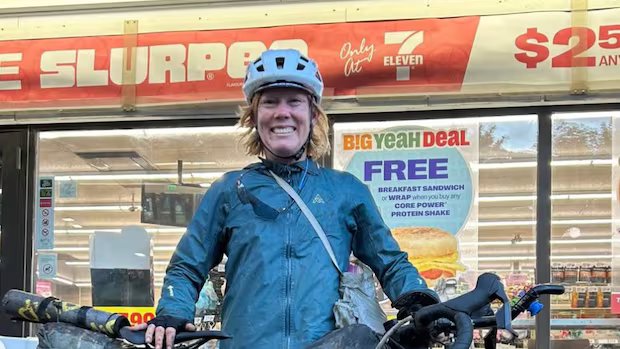
A cyclist from Kelowna has broken the women’s record at the Tour Divide, an event many consider the pinnacle of offroad ultra-distance bike racing.
Meaghan Hackinen rode from Banff, Alta., to Antelope Wells, N.M., in 14 days, 10 hours and two minutes, officially finishing her ride at about 4 p.m. PT Friday. She was the first woman to finish the race and placed eighth overall.
Hackinen battled harsh conditions to break the women’s Tour Divide record by more than an entire day, recording the fastest-known time for a woman on the route.

“I think her record is going to stand for a long time,” said Mike Martin, a cyclist from Vancouver who raced the Tour Divide last year.
He is one of thousands of people around the world who followed Hackinen’s GPS tracking dot on the 4,400-kilometre journey along the Great Divide Mountain Bike Route.
“Riders face very harsh conditions. Rain, snow, elevation, mud that will bring you to your knees. Demoralizing winds and crushing heat,” said Martin.

Gruelling race
Hackinen was not available for an interview. Her social media manager told CBC News she needs to prioritize rest and food after the gruelling race.
Racers travel on single-track mountain biking trails, forest service roads, rough and muddy gravel roads and a bit of pavement through the Continental Divide mountain range.

For the last two weeks, Hackinen has ridden her bike for approximately 18 hours a day, stopping only briefly to buy food, refill bottles, sleep, and care for her body and bike.
“She rides a little bit slower, but she just doesn’t stop riding,” said Martin of Hackinen’s strategy.
“She is spending more time riding than anyone else.”

The Tour Divide, like many ultra-distance bikepacking races, epitomizes the spirit of offroad racing, said Martin. There is no registration fee, no official race organizers and no prize money.
Racers must register and carry a GPS tracker with them at all times, which allows fans from around the world to “dot watch” them as they tackle the Great Divide Mountain Bike Route.
There are no organizers or officials enforcing rules, and racers are expected to be entirely self-supported.
Racers are only able to access resources that are available to all of their competitors. They buy their own food and supplies from shops and gas stations along the route and can only stay in lodging, like hotels, that is available to everyone. Most racers spend at least a few nights sleeping outdoors in a tent or bivouac in the interest of saving time.
Martin said there are several stretches where riders need to survive more than 400 kilometres of rugged road and trails between towns.
When racers experience a mechanical issue, they must either fix it themselves or figure out a solution that would be available to everyone, like bringing it to a local shop.

“It really is mentally very hard,” said Martin.
He said one of Hackinen’s strengths, other than her ability to ride hard for hours at a time, is her mental toughness.
“She’s got a great attitude and just kind of rolls with it. She’s ready for the challenges that show up,” said Martin.