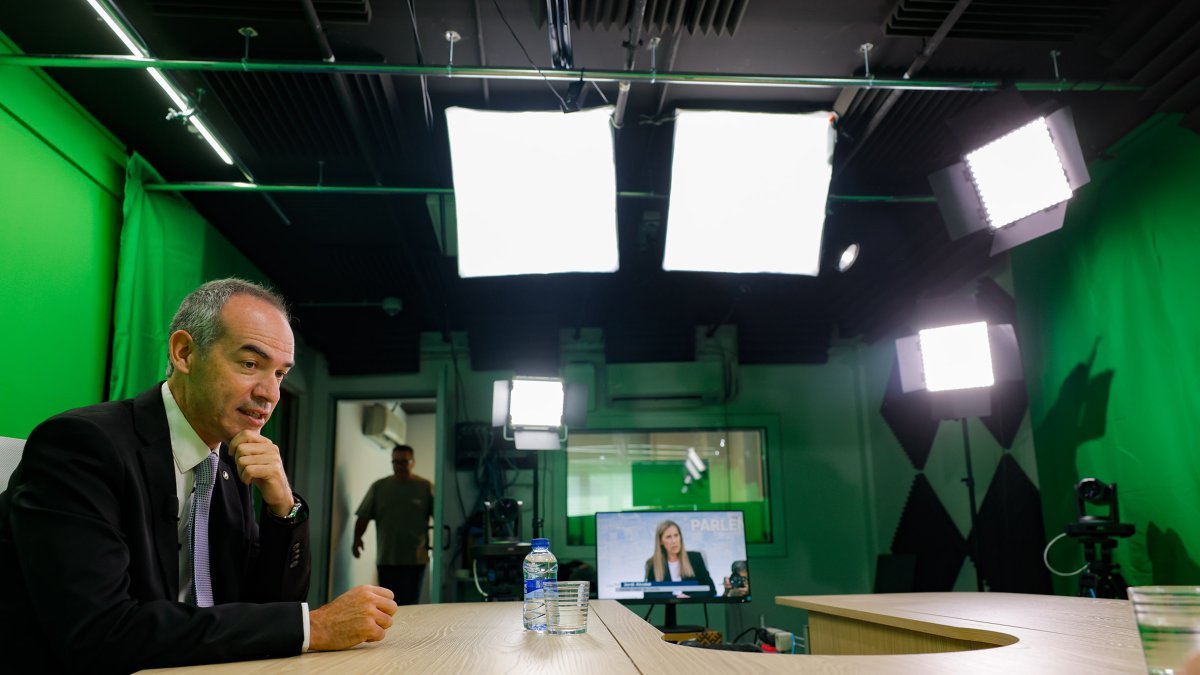
Jordi Alcobé yesterday opened the door for the future centre-right platform to go far beyond the acronyms that have traditionally occupied this political space. The consul major of Canillo pointed to the Let’s talk about Diari TV that the project, apart from the expected actors who already make up the majority, must also be open to part of Concord, the PS or Wake up Laurèdia. The key, he argued, would not be where each one comes from, but to share the same idea ofAndorra.
Alcobé he insisted that the platform should not become a simple sum of parties or a dress-up operation Democrats with new acronyms. “It is not about whitewashing any brand”, he warned. In his opinion, the project should be built around people, ideas and a certain vision of the country, leaving partisan borders in the background. “Here we don’t have to choose between him Barça or the Madridwhich sometimes seems that if you are born in yes you die in yes.” For this reason, he remarked, they should weigh more “commitment to your country, to the parish and the will to contribute value”, than the differences between parties. Alcobé he gave an example of understanding from points of departure opposed to communal politics, recalling that the seven communes are governed by four different political tendencies and that, despite this, the consuls tend to understand each other in the great affairs of the country. “Things are more about the people than the political acronym”, he summarized.
“This is not about choosing between being from Barça or Madrid”
The reflection also included a look home. Alcobé claimed the sixteen years of governments of yesbut admitted that the project needs a shake-up. He spoke of a “significant disaffection” around the Democrats and considered that the time has come to “rethink” the future strategy to re-attract people who have moved away from the political space represented by the party.
“It would be a guarantee for us to have Ladis as a candidate”
The centre-right platform would, as he explained, be a way of re-locating the debate to the problems of theAndorra current, which he considered very different from those that existed five or fifteen years ago. Alcobé he bet on bringing together diverse sensibilities around a model he defined as a low-intrusive Andorra, favorable to economic freedom but, at the same time, capable of controlling growth and planning what the country should be like in the coming years.
A clear candidate
Alcobé also named the profile that, in his opinion, can stitch together all these sensitivities. After categorically ruling out the possibility of him being a candidate for head of Government -he denied it up to five times in a row-, highlighted the name of Ladislaus Baron. For the consul, the minister would be a natural figure to lead the project and added that “it would be a guarantee for us to have the ladies of a candidate, if he ends up accepting it, which I hope so.” Of the potential candidate, his experience was particularly noteworthy. Alcobé he remembered that baron is one of the few active politicians who lived first-hand theAndorra of the 1993 Constitution and considered that this background can be important in the face of the challenges to come. He cited the association agreement with the European Unionpossible political changes a France and Spainthe future of co-principality facing issues such as abortion and the need to strengthen identity and social cohesion in a country that has changed a lot demographically.
The renewal he brought up, however, is not limited to the names that are already on the front line. Alcobé he also claimed to bring back people who have moved away from politics and involve new generations. He lamented the “criminalization” of the political class and the personal cost of assuming public responsibilities, and advocated re-dignifying “politics with a capital P” as a vocation of service and a temporary activity.
The drawing he made Alcobéin short, it looks more like a cross platform of people than a conventional coalition between devices. A proposal that starts from the centre-right, but that aims to overcome its traditional borders and that could go in search of complicity even within spaces that today compete electorally with Democrats for Andorra.
WITHOUT A REAL ALTERNATIVE TO THE POLITICAL PANORAMA
Jordi Alcobé considered that concord has not established itself as a real alternative to Democrats during this legislature. The consul major of Canillo he recalled that four years ago the training appeared as “the alternative to yes” and as the opposition with more options to grow, but he regretted that he has not been able to take advantage of this path. According to Alcobé, concord it has maintained “unclear positions”, it has had difficulties to mark its own line and, at times, it has adapted to sectoral or social pressures and “political opportunism”. Despite recognizing that several members have contributed interesting proposals, he concluded that the party “has lost the opportunity” to strengthen itself as the main alternative and present itself solidly as a replacement for yes. In the same way, he remarked that Andorra Forward is also not ready to touch power.