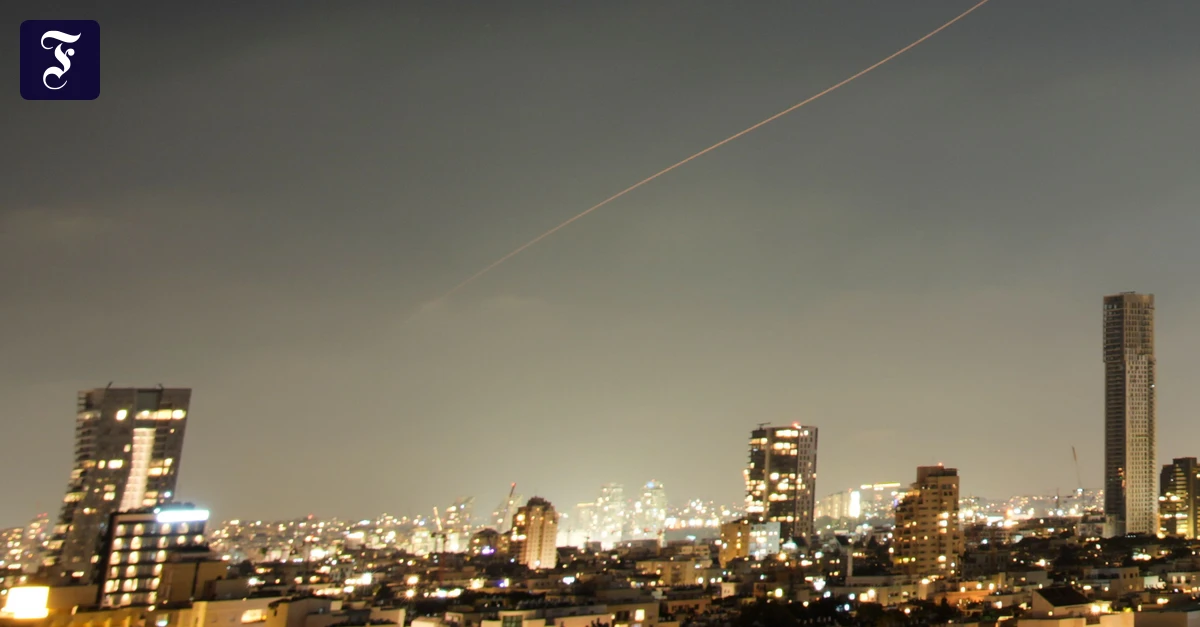
Hardly had Iran On Sunday evening Israel was fired at with rockets, for the first time since the ceasefire began on April 8th, when Donald Trump spoke up. “I will call Bibi immediately and tell him not to hit back,” the American president told the platform Axios. “They both had fun. Israel had its hits, and Iran had its hits. We don’t need another one.” He does not want the escalation to endanger his “deal” with Iran.
Trump thus appointed the Israeli Prime Minister Benjamin Netanyahu faced a dilemma: he had to either go against the words of his closest ally or let Iran dominate the escalation.
Netanyahu chose the former. On Monday morning, the Israeli military announced that it had fired on the regime in the west and center of the country. Explosions were reported in Tehran, Tabriz, Isfahan and Karaj. According to Iranian information, a petrochemical plant in Khuzestan province was hit, among other things. Nothing was initially known about the victims. The Iranian regime responded to this on Monday morning with further rocket attacks on Israel.
The latest spiral of escalation began on Sunday evening with Iranian missiles on northern Israel. According to the Revolutionary Guard, the target was the Ramat David air base. The Israeli military said the bullets were intercepted. Tehran was reacting to an Israeli bombardment on an outskirts of the Lebanese capital Beirut, which was directed against the Shiite militia loyal to Iran Hezbollah should have directed. Iran had previously declared attacks on Beirut as a red line.
The USA is trying to contain the escalation
It was the first time in the history of the 47-year conflict that Iran bombed Israel to retaliate for an Israeli attack on another country. In doing so, Tehran wants to “force a new equation,” said Israeli military spokesman Effie Defrin. For the first time in months, the Yemeni Houthi militia, allied with Iran, fired a rocket at Israel on Monday.
The USA seemed to be trying to contain the escalation. A government official told Axios that the Israeli strikes were “relatively limited.” Trump also appealed to Iran: “You’ve fired your missiles. That’s enough. Come back to the table and make a deal.” However, the Revolutionary Guard said it was the “beginning of a week of sustained military strikes.”
Tehran also called into question negotiations with Trump on a declaration of intent to end the war and restore shipping traffic in the Strait of Hormuz. Chief negotiator Mohammad Bagher Ghalibaf accused the US of giving Israel the “green light” to fire in Beirut. He wrote on Platform Ghalibaf described both American and Israeli bases and assets as “legitimate targets.”
Iran is testing Trump’s willingness to put Netanyahu in his place
Iranian strategists suspected that Israel’s action against Hezbollah was an attempt coordinated with America to weaken Iran’s negotiating position. The longer the unclear situation between war and peace lasts, the more Tehran fears an erosion of the position of strength it believes it achieved in the war. Above all, the ongoing American naval blockade is undermining the already devastated Iranian economy. According to American estimates, it costs Tehran $500 million a day in lost oil revenues.
By linking the ceasefire in Iran to the fighting in Lebanon, Tehran is testing Trump’s willingness to put his ally Netanyahu in his place. At the same time, Tehran is underscoring the importance it attaches to Hezbollah and other militias in the region, the so-called “Axis of Resistance,” as part of its security strategy. Israel had stated from the start that the April 8 ceasefire between the US and Iran did not include Lebanon. Iran had contradicted this, but had so far left Israel’s actions unanswered.
The negotiations between the USA and Iran recently seemed to be making little progress. On Sunday evening, shortly before the start of the latest escalation, Pakistani Interior Minister Mohsin Naqvi, acting as a mediator in Tehran, handed over a letter to Supreme Leader Moschtaba Khamenei. Among the key points of contention is Iran’s insistence on releasing $12 billion in frozen funds immediately after signing a memorandum of understanding.
Many Iranians fear another internet shutdown
Trump, however, fears comparisons with his predecessors Barack Obama and Joe Biden, whom he himself sharply criticized for similar releases. In order to increase the pressure on Tehran, Washington spread ideas that it could use the funds frozen in the USA for reconstruction in the Gulf states under attack by Iran.
Many Iranians have been expecting fighting to flare up again for weeks. Despite the ceasefire, there had been regular skirmishes between the US and Iran in the Strait of Hormuz. Beyond the fear of war, many now fear that the regime could once again cut off their access to the global Internet. The ban was lifted just two weeks ago after 88 days.