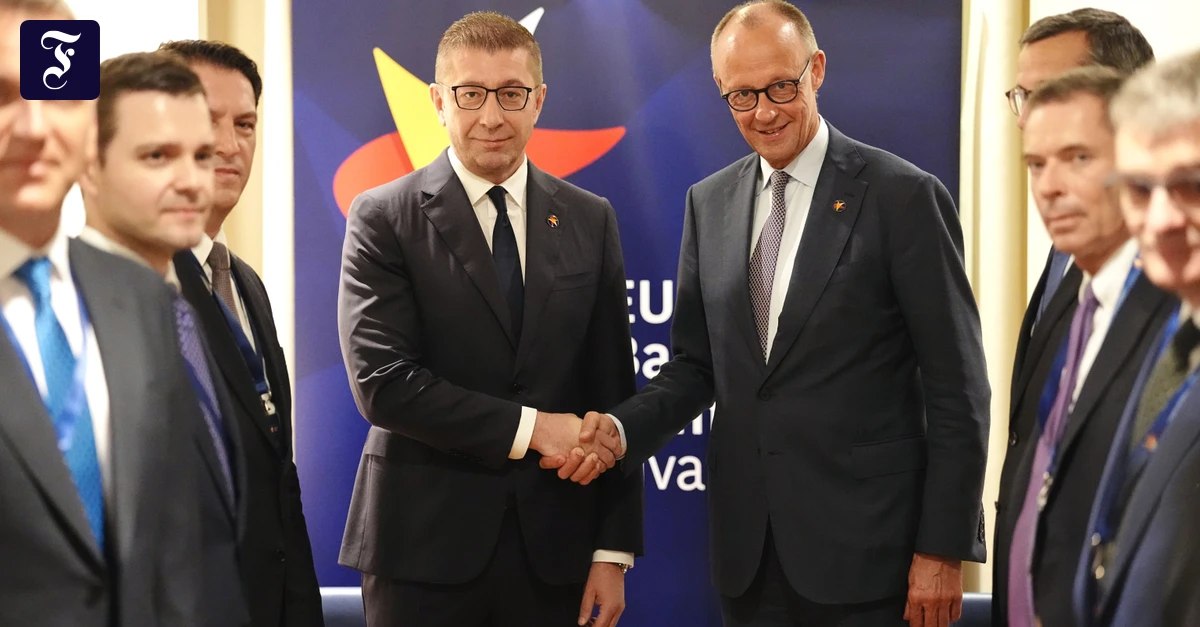
Just in time for the EU Western Balkans summit in Tivat, Montenegro, at the beginning of June, Germany and France presented an unofficial position paper that could bring movement to the enlargement process, which has been largely stalled for years. It has been read closely in the region’s capitals and is likely to spark serious debate in the coming weeks.
The German-French paper entitled “New impetus for enlargement” is striking Advance by Albanian Prime Minister Edi Rama and Serbian President Aleksandar Vučić in February of this year on. In a joint guest article for the FAZ, the two politicians described “accelerated integration of prepared candidate countries into the internal market and the Schengen area” as a “strategic opportunity” for the EU praised. Both praised the EU’s enlargement policy: “No other political instrument has changed Europe more profoundly or peacefully.”
An incentive for faster progress towards the EU?
In order to counter the suspicion often expressed in the Western Balkans that the offer to admit states into the internal market is just a pretext to exclude the candidates from full EU membership, the initiative launched by Berlin and Paris expressly emphasizes that the goal of full EU membership remains unaffected: “Our intention is neither to replace full EU membership nor to extend the path there – on the contrary: we want to create incentives that promote faster progress on this path.”
Similar to the Montenegrin leadership, Ukrainian President Volodymyr Zelenskyj is demanding nothing less than full membership for his country, although it is much further away from fulfilling the conditions than Montenegro, and not only because of the war. What is striking is that the Western Balkans and the Republic of Moldova are mentioned in the German paper, but not Ukraine. So should the offer of inclusion in the European internal market not apply to them?
New divisions are looming in the Western Balkans
That is one of the questions that arises from the German-French paper. Another situation arises for at least three of the six states in the Western Balkans, but ultimately for all six. While SerbiaAlbania and Montenegro have already started accession negotiations, this does not apply to North Macedonia, Bosnia-Hercegovina and Kosovo. North Macedonia has been blocked by Bulgaria for years under the flimsy pretext that it is not complying with a “compromise proposal”. In Bosnia, internal disputes are hindering progress. And Kosovo is not even recognized as a state by five EU members.
Here the German-French proposal could increase the risk of an internal division in the Western Balkans. In the worst case, there is even a risk of new conflicts. Paradoxically, this danger applies precisely if Albania, Montenegro and Serbia recognize the opportunities of the German-French proposal and take it seriously. If these three states pursue a substantial reform policy in their accession negotiations in order to achieve the attractive milestone of joining the internal market, it would be conceivable that the process could be completed within just a few years. In such a case, however, new, sharp dividing lines would arise in the Balkans, which would then consist of a trio of states inside and one outside the internal market.
In concrete terms, this means: Serbia’s current borders with North Macedonia, Bosnia and Kosovo, but also the Albanian-North Macedonian, the Albanian-Kosovar and the Albanian-Montenegrin borders would become “hard” borders with strict controls. Bosnian Serbs on the way to Serbia or Kosovars on the way to Albania would feel this. Borders, which have been fought over in many wars in the region, would become more visible again and potentially more prone to conflict. Progress in regional market integration between the Balkan states would be at risk.
Internal market without accession negotiations?
Initial ideas have been heard unofficially from some countries in the region as to how this could be avoided: by giving the three states that, for various reasons, have not yet started EU accession talks, the chance to work through and fulfill the conditions for admission to the common market. If they succeed and the EU Commission certifies the necessary reform success, they should also have the chance to join the internal market – even without EU accession talks having begun.
Otherwise, the success of the German-French proposal could mean new risks for stability and peace in the region. Of course, it is not yet certain whether the German-French idea will prevail at all – and whether the government concerned will publicly adopt the demand to offer it to all six states in the region.