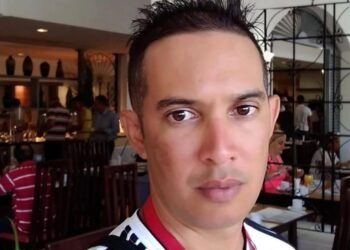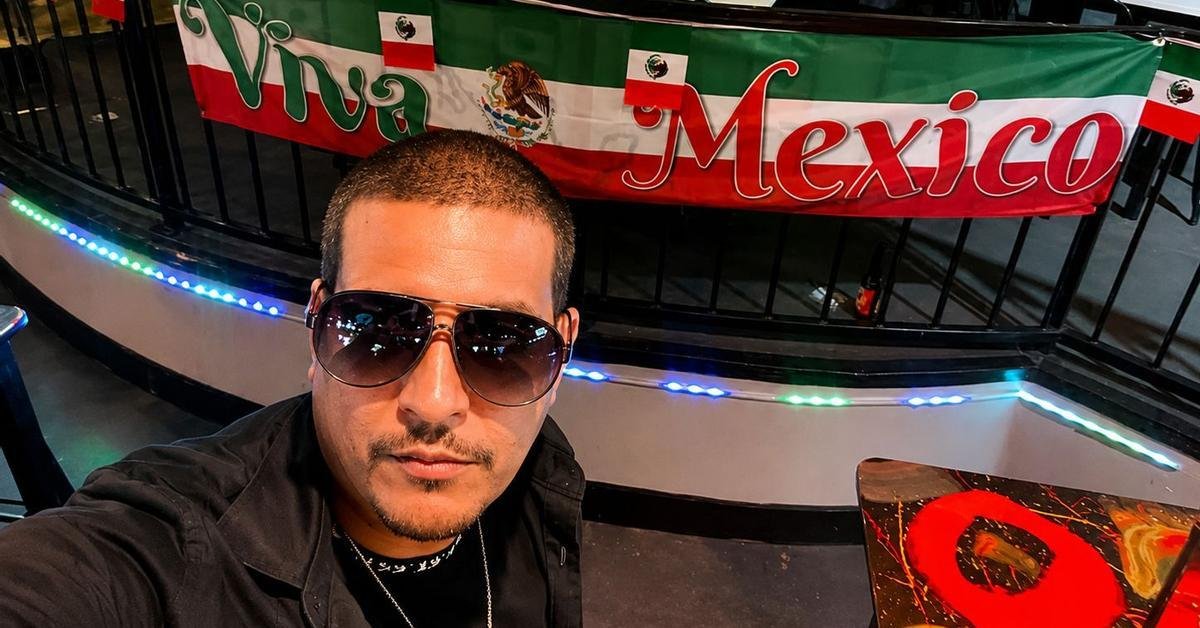
Havana/Rogelio Bolufé assures that he does not receive orders from any institution, that his only command is his conscience and that he works for reconciliation between Cubans. However, he also maintains that he continues “in active service,” proudly claims the olive green uniform and calls the members of the Cuban military corps “brothers.”
Recently deported from the United States to Ecuador and later transferred to Mexico, where he claims to have residence, Bolufé offers an image that is difficult to classify. He presents himself as being persecuted by Havana – which links him to alleged terrorist crimes – but at the same time he defends the military apparatus to which he claims to have belonged and avoids defining Fidel Castro as a dictator.
In responses to questions submitted by 14ymedioBolufé affirms that he was head of a so-called Department 0 and that he will soon complete thirty years of “active service.” According to his explanation, the name represented the idea of ”multiplying by zero everything that affects Cuba, the homeland and the nation.” Nor did he provide documents that would confirm the position, the rank of major that has previously been attributed to him, or his alleged closeness to Fidel Castro’s security environment.
Bolufé rejects that his use of the expression “active service” implies a current relationship with Cuban institutions. He says that he does not belong to an official structure, he does not receive orders and does not perform functions for the State. It is, he affirms, a “moral and permanent” commitment to the country. “My only command is my conscience,” he maintains. “I do not serve a man or an organization; I serve Cuba and the Cubans.”

/ Courtesy
In other passages he speaks of himself as a permanent member of a military community and addresses an appeal to those who have been part of the Armed Forces and the Ministry of the Interior. “Be proud of your olive green uniform,” he tells them. Bolufé maintains that it is not just the uniform of an institution, but the “uniform of the homeland,” and assures that those who assumed the commitment to protect the country remain “permanent servants of the security of the homeland.”
Asked why he feels proud to have belonged to the Ministry of the Interior and State Security, responsible for the surveillance, imprisonment and repression of opponents, activists and independent journalists, Bolufé avoided assuming institutional responsibility. He acknowledged that there are people and organizations that have reported human rights violations and said he respected the victims’ right to express themselves and seek justice. However, he defended that the Ministry of the Interior, the Armed Forces and the Police are made up of Cubans and, therefore, “they are part of the people.”
“My pride does not come from any abuse that may have been committed by another person or that is attributed to an institution,” he responded. “My pride comes from the work I did personally.”
Bolufé did not explain what that work was or if he participated in surveillance operations, interrogations, preparation of files or monitoring of opponents. His condemnation of the abuses remains on a general basis, without identifying those responsible, practices or victims.
Bolufé defended “national sovereignty, education, public health and dignity in the face of external pressures” from Castroism.
The same caution appears when asked if he considers that Fidel Castro was a dictator. “Fidel is a highly debated figure,” he responded, before noting that some consider him a dictator and others a revolutionary leader.
Bolufé defended from Castroism “national sovereignty, education, public health and dignity in the face of external pressures,” and generically condemned “any violation of human rights, abuses of power and any action that has caused suffering to Cubans.” He did not answer affirmatively or negatively to the question about the dictatorial nature of the Castro regime.
His speech seeks to place himself in an intermediate space between the ruling party and traditional exile. It speaks of reconciliation, democracy and respect for different thoughts, but also of sovereignty, national unity and military pride. It does not propose an explicit break with the Cuban armed structures nor does it mention processes of purification, responsibility or reparation for the victims.
He also maintained that Sandro Castro “is not a communist” and that he advocates democratic participation and reconciliation among Cubans.
One of the most striking elements of his responses is his relationship with Sandro Castro, grandson of Fidel Castro and known on social networks for exhibiting a life of privilege in the midst of the Cuban crisis. Bolufé assures that he maintains communication with him. “I have always supported her, she is my family,” he stated, without clarifying whether he was referring to a relationship of kinship, friendship or political closeness.
He also maintained that Sandro Castro “is not a communist” and that he advocates democratic participation and reconciliation among Cubans. Immediately afterwards, he clarified that Fidel Castro’s grandson has never expressed to him the intention of promoting a political transition and that no other member of the family has conveyed a similar approach to him.
Bolufé also did not specify when he last spoke with Sandro Castro. Instead of responding, he dedicated several paragraphs to interpreting a video made with artificial intelligence in which both appear as superheroes facing an eagle. According to him, the eagle represents the “external enemy,” while a stone that appears in the images symbolizes Félix Varela. In his interpretation, even the rock under which Fidel Castro’s remains rest would not glorify the former ruler, but would remind that no man can place himself above the nation.
“Fidel Castro wanted to rest under a stone. Not so that we Cubans would remember a man forever,” he stated, but so that Cuba would one day return to its “foundational stone,” which he identifies with Varela.
He also states that he maintains several lawsuits against the Immigration and Customs Enforcement Service and the US federal government.
Regarding his deportation, Bolufé assures that he had a pending process before the Board of Immigration Appeals and an appeal for habeas corpus. He also states that he maintains several lawsuits against the Immigration and Customs Enforcement Service and the US federal government. According to his version, he did not receive a legal explanation before being put on the plane and considers that the expulsion was retaliation for his activism. In his responses, he has not provided the file numbers or resolutions that would determine whether the appeals legally prevented his deportation.
Bolufé was sent to Ecuador, but did not clarify his legal status in that country. He limited himself to stating that the United States maintains immigration cooperation agreements with Quito and that some 191 Cubans would have been deported there. He later traveled to Mexico, where he says he has a residence and is reorganizing his life.
He also referred to his arrest in Hialeah, during which the Police reported the discovery of a substance that looked like cocaine in one of his pockets. Bolufé assures that the Prosecutor’s Office withdrew the charge, that the case was dismissed and that he was declared not guilty. He did not explain if the substance was subjected to analysis, if there were problems with the police record or what was the specific reason for the rejection. “The accusations speak of the beginning of a process; the judicial decisions speak of its result,” he responded.
He is also credited with developing the concept “Patria y Vida” in 2020, before the appearance of the song that popularized the slogan.
In another passage, he confirmed being the founder of The New Cuban Nation, the organization that the island’s authorities use to link him with terrorist activities. Bolufé assures that the project has promoted passports and symbolic currencies, advertising campaigns and the so-called Operation Return. He is also credited with developing the “Patria y Vida” concept in 2020, before the appearance of the song that popularized the slogan.
That same year, Bolufé took his political aspirations further and began to present himself publicly as “interim president of the Republic of Cuba.” In interviews and broadcasts broadcast on the Internet, he claimed leadership of an eventual transition and, according to publications of the time, he even declared Miguel Díaz-Canel dismissed through an alleged decree without institutional recognition or known support among the main exile organizations.
Despite being wanted by Havana, Bolufé assures that he has never been contacted by State Security since he left the United States. He says that, if the agents approached him, he would receive them “with a hug” and invite them to work together for Cuba.
The phrase summarizes the difficult political fit of the character. Bolufé presents himself as persecuted by the regime, but not as an enemy of its security forces; talks about democracy, but avoids directly judging Fidel Castro; denounces abuses, but vindicates the uniform of those who executed them; and claims not to belong to any structure, while insisting that he has never stopped being on duty.
More than clarifying who he was within the Ministry of the Interior or what role he intends to play now, his answers draw the identity he tries to project: that of a nationalist military man who aspires to build bridges between exile, the uniformed and sectors of the Castro family, without completely breaking with the legacy of the system he claims to have served.