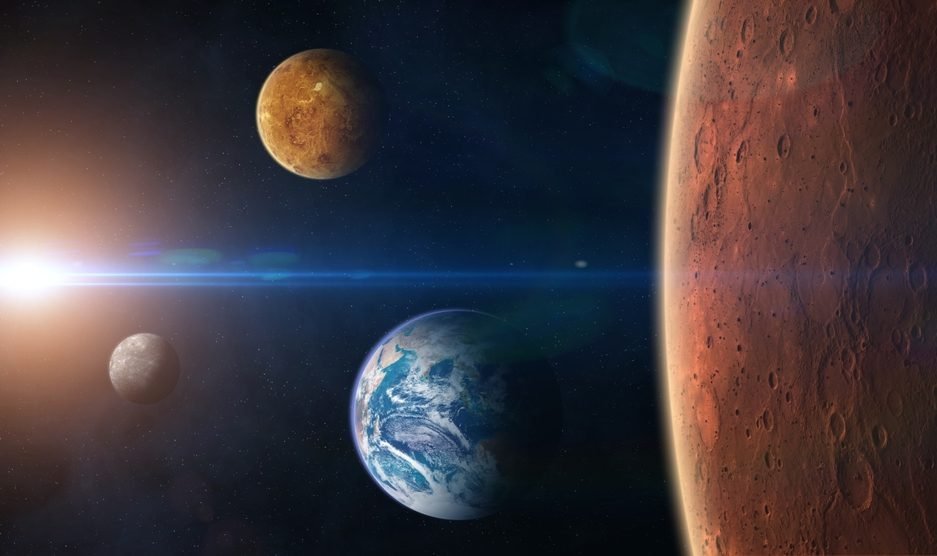
During June 2026, astronomy fans will be able to enjoy interesting scenes in the evening sky. Venus, Jupiter and Mercury will be visible after sunset, while the new Moon will further enhance the scene. Special attention will also be attracted by the bright twin stars, Pollux and Castor, which will be located near these celestial objects and provide an attractive sight to observe.
Go outside after sunset this month and look west. The two brightest objects in the night sky are located very close to each other and are hard not to notice, he writes Discovermagazine.
Venus and Jupiter will be visible in the western sky throughout June 2026, and will be joined by Mercury at the end of the month. Around June 16 and 17, 2026, the young Moon and the twin stars Pollux and Castor will be in the same part of the sky, offering astronomy lovers one of the most beautiful sights of this month, reports N1.rs.
When to observe Venus, Jupiter and Mercury
Look to the west as the sky darkens, about an hour after sunset.
From June 11 to 15, Mercury will become visible below Venus and Jupiter in the western twilight, according to the Planetary Society. It will reach the highest point above the horizon on June 15. Since Mercury never gets very far from the Sun from our perspective, it usually stays close to the horizon and is easily lost in the twilight light.
The three planets are in the same part of the sky because they all orbit the Sun in roughly the same path, which looks like an arc across the sky from Earth, NASA explains. When their orbits align from our perspective, they group together in a way that seems almost choreographed.
The Moon and the stars of Gemini join the scene
On June 16 and 17, the new Moon will be in the same part of the sky as Venus, Jupiter, and Mercury, while Pollux and Castor will be nearby. These objects will form a loose line stretching towards the horizon.
On June 17, 2026, observers in parts of the US, Canada, Brazil and Venezuela will be able to see the moon pass directly in front of Venus in a phenomenon known as a lunar occultation. Venus will briefly disappear from view and then reappear, according to NASA. For many observers, this event will take place during the day.
If you plan to observe, do not point binoculars, a telescope, or a camera at the Sun without proper solar filters. Observing the Sun or its proximity with optical devices can cause serious visual impairment.
More interesting celestial phenomena in June
For early risers, Saturn and Mars will be visible in the predawn eastern sky throughout June 2026, according to the Planetary Society. Saturn’s yellowish hue makes it easy to recognize, while Mars is lower above the horizon and harder to spot.
On June 21, 2026, the summer solstice occurs – the longest day of the year in the northern hemisphere and the beginning of astronomical summer. As the nights grow shorter, the Summer Triangle will rise in the eastern sky after dark, along with deep space objects like the Ring Nebula and the Teg Nebula for those with telescopes.
However, during the next two weeks, all attention will be directed towards the western horizon. Three planets, a new moon and two of the brightest stars in the sky – all of this will be visible from your backyard.
Follow us on our Facebook and Instagram page, but also on X account. Subscribe to PDF edition of Danas newspaper.