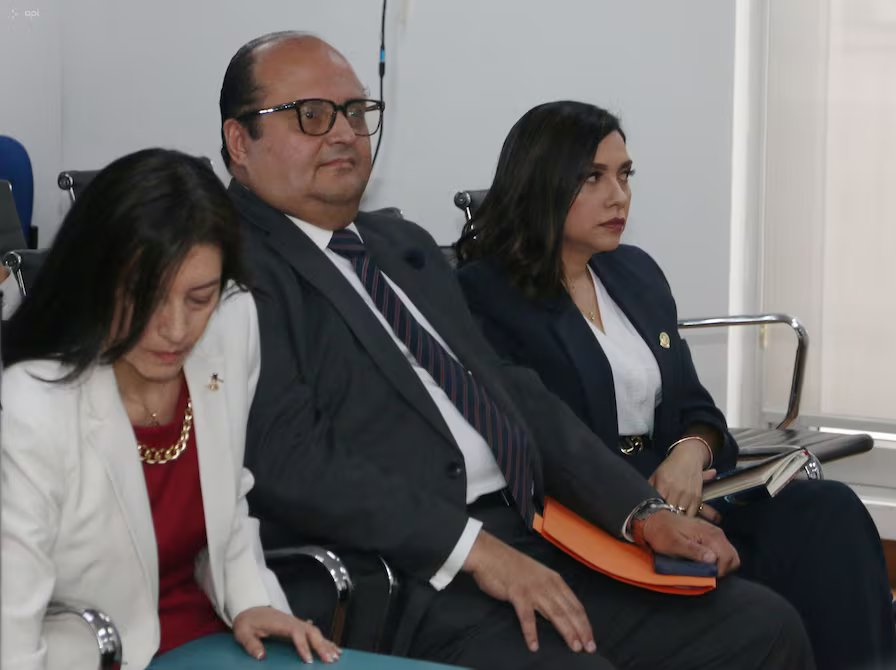
Once the Council for Citizen Participation and Social Control (CPCCS) designated Mercedes Caicedo and Ramón Echaiz as regular member and president and substitute member of the Council of the Judiciary (CJ), respectively, what remains is for the two new officials of the governing body, administration, discipline and surveillance of the Judicial Function to be installed in the plenary session of the National Assembly.
On the afternoon of last Friday, April 24, with five votes in favor, the Citizen Participation Council appointed Caicedo, judge of the National Court of Justice (CNJ), to lead the Judiciary until 2031. In the same way, Echaiz, a freely practicing lawyer, will remain as a substitute member of the CJ during the remainder of the six-year period for which the members of the last plenary session of the Judiciary were appointed, in September 2025.
Mercedes Caicedo and Ramón Echaiz were the first two of the shortlist delivered by the president in charge of the National Court, Marco Rodríguez, to the CPCCS for selection. Caicedo will replace Mario Godoy, president of the CJ, who was dismissed and removed from office by the National Assembly with 148 votes last February; while Echaiz would be in place of the substitute member Alexandra Villacís, who resigned from the position once she could not be appointed for the functions.
Although in January 2025 there should have been officials who would replace those who remained in the Judiciary for the period 2019-2025, on September 24, 2025, in session 041, the president in charge of the National Assembly, Mishel Mancheno, took the oath of office as president and regular members of the CJ to Mario Godoy, Magaly Ruiz, Alfredo Cuadros, Damián Larco and Fabián Fabara.
Likewise, the substitute members, at that time, Alexandra Villacís, Nicolás Burneo, Wendy Moncayo, María Gabriela Vinueza and Laura Flores, were sworn in. These authorities were appointed by the CPCCS based on the shortlists sent by the CNJ, the State Attorney General’s Office, the Public Defender’s Office, the Executive Branch and the National Assembly.
On the morning of last February 18, Mario Godoy presented his resignation to the presidency of the CJ, but on the afternoon of that same day, with 148 votes in favor of the plenary session of the Legislature, he was censured and removed from office when a “manifest ineffectiveness in the fulfillment of his functions” was proven.
“The current political situation shows that partisan interests and calculations have acquired a force that surpasses the will to serve and the great institutional efforts made,” Godoy said in his resignation letter.

In just over two years, Mario Godoy became the second incumbent president of the CJ to leave the body of government, administration, surveillance and discipline of the Judicial Function amid complaints of corruption, questions about his actions and his name related to at least two previous investigations opened in the Prosecutor’s Office: one for influence peddling and another for organized crime.
Damián Larco, the member of the CJ from the shortlist sent by the Executive, is the one who held the position of temporary president of the CJ. He was first installed on February 10 to temporarily replace Godoy, who requested leave and vacations in the middle of the impeachment trial, and then, on the following February 18, by definitive resignation, he was again unanimously appointed as acting president of the CJ, but on this occasion until the appointment of the titular member and president.
A date is not yet known on which the plenary session of the Assembly will receive these two new CJ authorities for their inauguration. Beyond that, once this act is completed, they will go to the CJ’s headquarters building, in the north of Quito, to take over their offices and begin to formally carry out their activities.
In the case of Mercedes Caicedo, she will leave her activities as a judge of the National Court. Between January 2021 and February 2022 she was co-criminal judge of the country’s highest ordinary justice body and from February 2022 to the present she became judge in charge of the Criminal Chamber of the CNJ due to the absence of regular judges.
In article 120, paragraph eleven, of the Constitution, it is established that the National Assembly has among its powers to possess the highest authority of the Comptroller General of the State, the Attorney General of the State, the Attorney General of the State, the Ombudsman’s Office, the Public Defender’s Office, superintendencies and the members of the National Electoral Council, the Contentious Electoral Court and the Judicial Council.
The Organic Law of the Legislative Function determines that possession is formalized in plenary sessions where the elected authorities swear to comply with the Constitution and the laws. (YO)