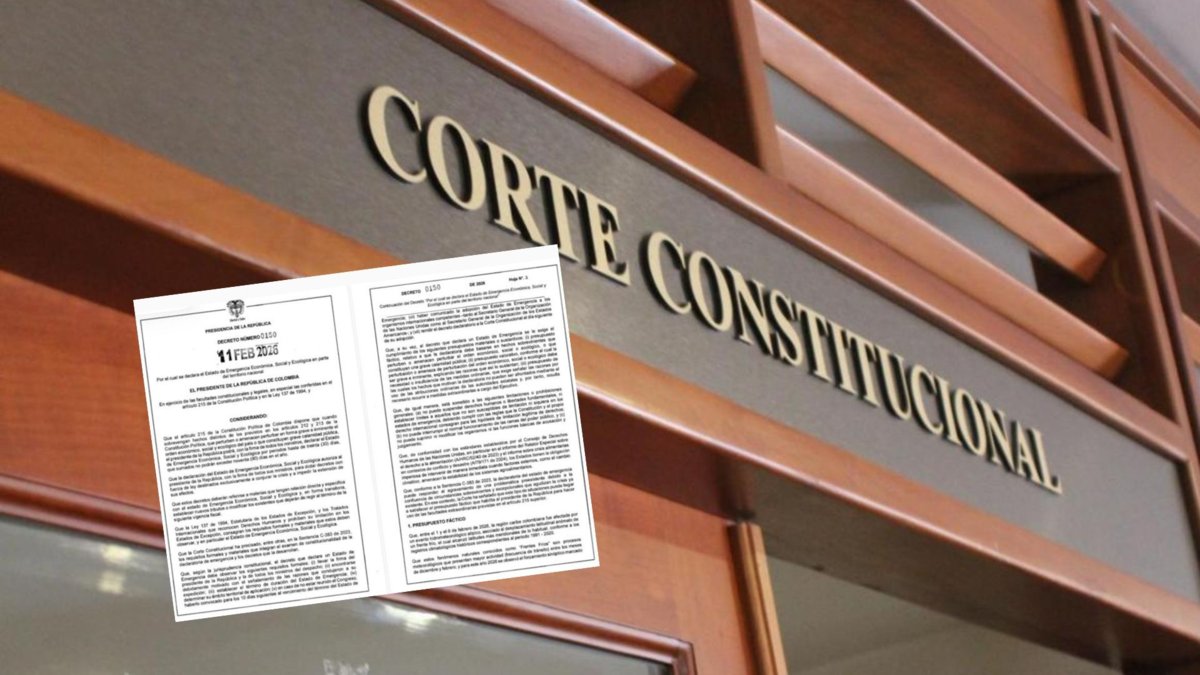
Barely 24 hours after the Council of State suspended the controversial decree with which the Government intended to force the transfer of 25 billion pesos of savings in private pension fundsthe administration of President Gustavo Petro suffered a second judicial setback in his plan to achieve extraordinary resources.
The Constitutional Court provisionally suspendedpartially, the estate tax contemplated in the second economic emergency decreed by the Government. He did it only for non-profit entities covered by the decree, as private universitiesfoundations, non-governmental organizations and other entities of the special tax regime, as well as for companies in the process of liquidation. This is the first decision adopted by the Court on the taxes decreed in this state of emergency, the legality of which is still under study.
On behalf of this extraordinary tax, universities from all over the country and other institutions had set off the alarm, considering that it was putting them in a situation of financial unviability. In fact, in a concept close to the Court’s file, the Colombian Association of Universities (Ascun) pointed out that the wealth tax for legal entities, as established in the decree, “is a cause of deep concern and raises serious concerns.” questions from a constitutional point of view”.
Constitutional Court. Photo:ANT
“He decree is contrary to the Constitution because: lacks motivationa circumstance that is particularly evident in relation to non-profit legal entities classified as subjects of the special tax regime. If it is considered that a motivation can be formally considered to exist, it is, in any case, inadequate and insufficientbecause does not account for the specific reasons that make the tax necessary, to the extent that it does not discriminate the amount that is estimated to require attention to the emergency, nor the amount that is aspired to be collected with the tax, nor the projected destination for resources collected,” says the concept.
The vote in the Plenary Chamber was 6-3. Judges Héctor Alfonso Carvajal Londoño, Juan Carlos Cortés and Vladimir Fernández Andrade they saved the vote. For their part, judges Carlos Camargo Assis, Natalia Ángel Cabo and Lina Escobar Martínez they clarified theirs.
He second suspended tax payment was scheduled for May 4according to the provisions of article 5 of the Decree 0173 of February 24, 2026.
Gustavo Petro, president of Colombia. Photo:Presidency
With this rule, the Government adopted tax measures in matters of estate tax to attend to “the expenses of the General Budget of the Nation necessary to face the state of emergency”, declared on February 11 due to the natural disaster of the winter wave in eight departments. The tax—only for the entities mentioned by the Court— will remain frozen until the Plenary Chamber issues a substantive decision.
It is a transitional tax that taxes accumulated wealth and not the profits. Those companies whose liquid assetsas of March 1 of this year, is equal to or greater than 200,000 UVTthat is, more than 10,474 million pesos.
The decree contemplated that the payment had to be made in two moments. The first, the past April 1stwhen the companies to which the tax applied submitted the declaration and They paid 50% of the tax.
Reference image. Photo:tax
According to calculations by different unions, this payment was 2.4 billionalthough I expected to raise around 4. He remaining balance was scheduled for May 4but with the Court order will no longer have to be disbursed. In the case of foreign companies, the first payment was scheduled for today.
The warnings
In addition to Ascun, the Guild Councilin its opinion, considered that the consequences of the entry into force of the norm “are generating a real and immediate deterioration in the economic and productive capacitythe competitiveness and financial stability of the taxed companies, which shows that the damage derived from the decree is not merely hypothetical or future, but current and progressive”
Furthermore, he pointed out that there is evidence of “a pattern of systematic abuse of the figure of emergency during the current Government”, which has resorted to this extraordinary tool in at least four times “to attend situations of a structural and foreseeable nature that had to be conjured up through the ordinary means of state planning.”
In fact, the Council had requested the total suspension of the decree “because it prevents the effects of a prima facie unconstitutional lien“, under the arguments that “the double taxation on the same source of wealth that has already been taxed via income tax; he confiscatory nature derived from the temporal compression between causation and enforceability; the violation of the principles of contributory capacity and tax equity; and the transgression of the principle of non-retroactivity enshrined in article 363 of the Constitution”
Constitutional Court. Photo:Minjusticia.
In addition to provisionally suspend this taxthe Plenary Room stopped partially and totally various articles of the Decree 0174 of 2026with which the Government established measures for the relocation and reassignment of agricultural units.
One of the articles granted extraordinary powers to the Government for acquire real estate “for reasons of public utility and social interest“Another empowered the National Land Agency to authorize the occupation of land.
Justice Editorial