First major test of ‘Yellow Envelope’ law broadens employer responsibility beyond direct hires
South Korea’s labor authorities have ruled that Hyundai Motor and Hanwha Ocean are legally responsible as employers for some subcontracted workers for collective bargaining purposes, a move that could significantly expand labor-management negotiations across the country’s manufacturing sector.
The Ulsan Regional Labor Relations Commission ruled Monday in favor of 10 subcontractor labor unions seeking direct collective bargaining with Hyundai Motor, recognizing the automaker’s “employer status” in relation to the workers.
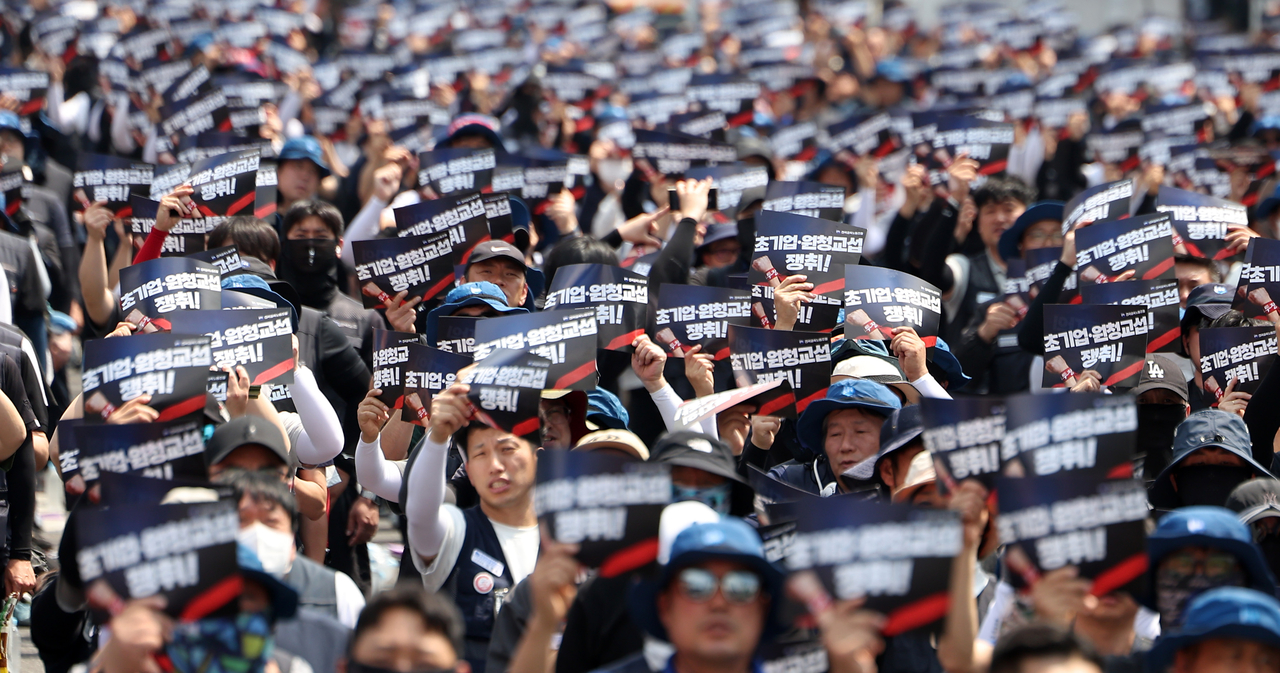
The unions represent about 1,675 workers affiliated with the Korea Metal Workers’ Union and include employees engaged in logistics, security, cleaning, cafeteria services and vehicle sales at Hyundai Motor facilities, including its Ulsan, Asan and Jeonju plants, as well as the Namyang research center.
Details of the ruling have not yet been fully disclosed. Labor officials said the written decision, which will be announced within about a month, will determine whether employer status was recognized for all 10 unions or only some of them.
This was the first ruling involving a major automaker since amendments to the Trade Union and Labor Relations Adjustment Act, commonly known as the “Yellow Envelope” law, took effect in March. The law expands the definition of “employer” to encompass anyone who “substantially and specifically controls” working conditions, which gives bargaining power to unions representing workers in indirect or outsourced jobs.
The ruling comes after the unions had requested bargaining with Hyundai Motor on March 10, the day the revised law came into effect. But Hyundai declined, prompting the unions to file a petition with the labor commission.
In a separate ruling issued the same day, the National Labor Relations Commission upheld a previous ruling recognizing Hanwha Ocean’s employer status for workers belonging to Welliv, a subcontractor that runs cafeteria, laundry and shuttle bus services at the shipbuilder’s facilities.
The commission said Hanwha Ocean exercised “substantial and concrete control” over working conditions because improvements to facilities such as kitchens, laundry rooms and commuter bus systems could not be implemented by the subcontractor alone without the shipbuilder’s approval or cooperation.
As a result, the commission concluded that Hanwha Ocean was in a position to effectively determine workers’ employment conditions and therefore qualified as an employer for collective bargaining purposes.
Both Hyundai Motor and Hanwha Ocean said they would decide their position after reviewing the written decisions.
“We will review the case comprehensively after receiving the written decision and carefully consider our response in accordance with legal procedures and regulations,” a Hyundai Motor official said.
“We were notified of the results via text messages from the National Labor Relations Commission and will determine our position after a thorough legal review of the written decision,” a Hanwha Ocean official said.
The rulings are drawing attention because their scope extends beyond core production activities such as shipbuilding to support functions including catering and transportation services. Labor authorities have effectively determined that bargaining demands related to workplace safety and working conditions require the participation of the principal contractor because it controls the physical facilities where employees work.
Industry officials are concerned that the rulings could pave the way for broader collective bargaining demands across the manufacturing sector and other industries that rely heavily on subcontracted labor.
Business groups criticized the decision, saying that a broader interpretation of employer responsibility could increase uncertainty for companies.
The Korea Enterprises Federation said the Hanwha Ocean decision was inconsistent with guidelines issued by the Ministry of Employment and Labor, which cited factory cafeterias and similar outsourced operations as examples of work that does not automatically constitute structural control over subcontracted workers.
“Expanding the scope of collective bargaining counterparts beyond direct production subcontracting arrangements to include indirect support-service relationships risks creating significant disruptions across industrial sectors,” the KEF said in a statement.
The business lobby called for the NLRC to avoid rulings that could “increase uncertainty in the market” and instead deliver objective and neutral decisions based on rigorous legal standards to prevent “unnecessary confusion in the workplace and labor-management relations.”
sahn@heraldcorp.com