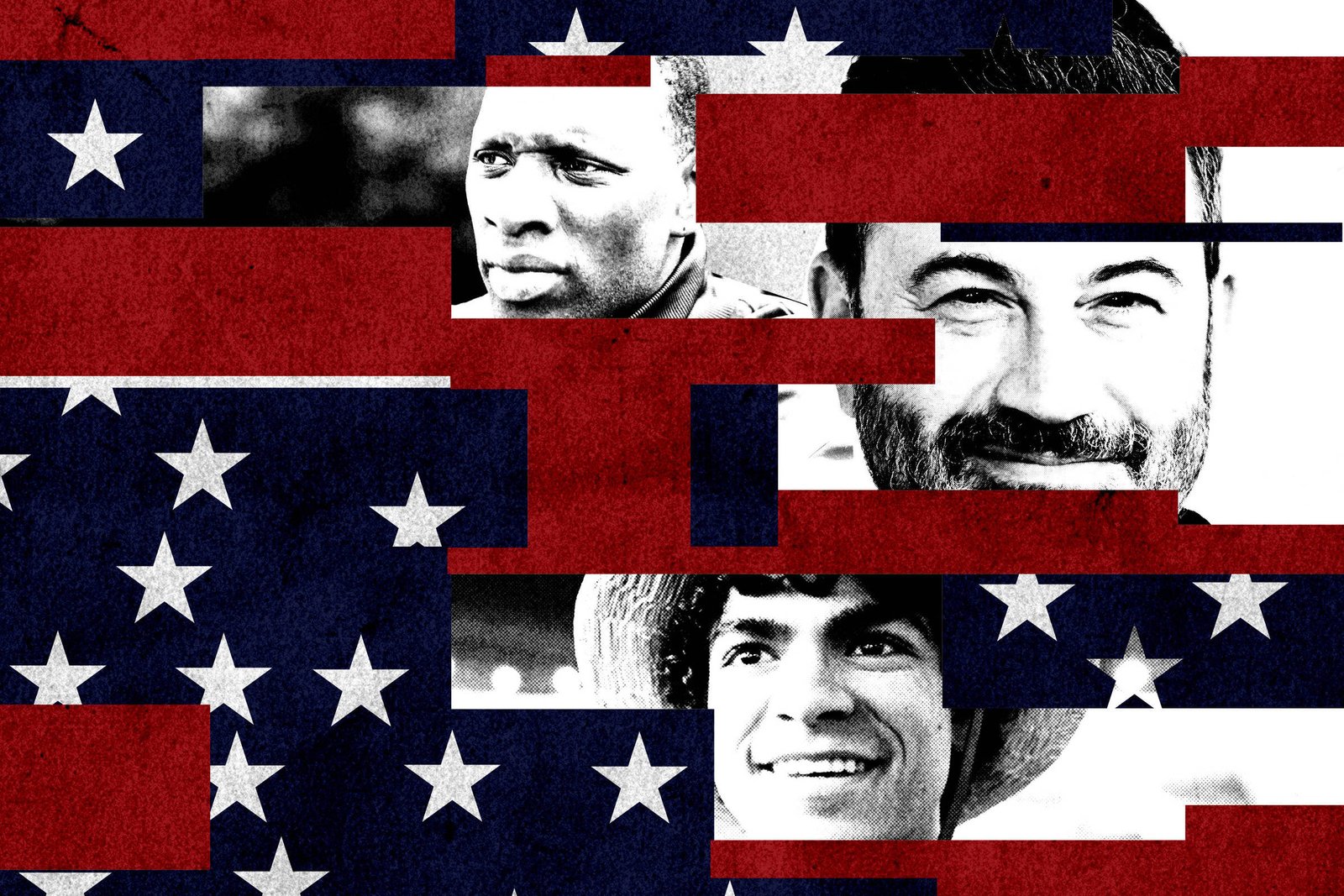
The presenter Stephen Colbert will lose his job next month. He has been aware of this since last year, when broadcaster CBS announced that would end his program, The Late Showone of the most important on American TV. There was outrage, and the channel defended itself by saying that the reduction was to avoid financial losses.
The end of the talk show and the recent suspension of Jimmy Kimmel’s program — again under the spotlight of donald trump after a joke with the first lady—, these are not isolated cases. They indicate a crisis befalling the traditional American TVforced to abandon its old business model in the face of the decline in advertisers and audiences, which now have their attention disputed by streaming platforms. streaming.
These services, full of content from outside the USA, helped to dismantle the American monopoly on the small screen. THE South Korean “Round 6”for example, became the most watched series on Netflix, ahead of American works such as “Stranger Things” and “Wandinha”. Netflix also successfully exported the German “Dark”, the French “Lupin” and the Spanish “La Casa de Papel”.
In parallel, there is a wave of American productions that seek aesthetics and narratives from outside, a sign that even US production is no longer anchored solely in its own codes. Example is the “One Piece” seriesadaptation of the super popular manga, which was praised for not giving up the Japanese signs of the original work.
A similar case is “Shogun”, Disney series which, although produced in United Statesis spoken almost entirely in Japanese — and thus broke the record for Emmy wins, surpassing “Game of Thrones”, a jewel of American TV.
This was unthinkable before. Language has always been a barrier — without speaking English, a production would hardly have the support of Hollywood and little chance of global scale. The success of “La Casa de Papel”, for example, was because Netflix bought its rights and took it beyond Europe.
“We grew up without access to programming in non-English languages. Zero. Now, largely because of streaming, there is content in other languages doing well with the audience”, says Harry Castleman, author of the book “Watching TV”, about the history of this market.
The writer says he watches international series to escape American sameness. But he is an exception — his countrymen have always been resistant to subtitled content, he says. “We get used to not having to try hard.”
It’s no surprise that in the third season of “La Casa de Papel”, in 2019, Netflix hired top actors to dub works in English so that the public could get used to something previously unusual.
At the time, streaming stated that it started investing 30% more in dubbingleaving them as the default option in the case of foreign works. Others, like Prime Video, including added artificial intelligence features to be able to translate the audio into more languages.
The fact is that streaming has become a kind of Trojan horse, undermining the power of big studios when boosting global productions. Today, the same remote control can take you to American works, a Turkish soap opera or a k-drama, South Korea format that broke out in the West.
Data from Nielsen, a company that compiles audience information, shows that streaming — including networks like YouTube, as well as Netflix, Prime Video and others — is already responsible for half of consumption of TV in the USA, with 47% of the audience.
Linear TV, which encompasses paid and open channels, recorded occasional growth at the beginning of the year, driven by sports broadcasts and news. But the advance does not illustrate the downward trend of the last decade, with the emergence of many services at the end of the 2010s. In the comparison between March 2025 and January 2026, linear TV lost 1.8% of share.
Therefore, advertisers migrated to streaming, which, also according to Nielsen, accounts for 66.7% of advertising-supported TV time seen by those aged between 18 and 49. Mondelez, owner of Oreo, for example, cut almost a third of its advertising spending on American TV between 2021 and 2024, according to The Wall Street Journal.
These companies took advantage of the desire for novelty, says journalist Aline Diniz, who presents the podcast Fala de Nada, about the behind-the-scenes of the industry. The hit of 2025, the Canadian “Burning Rivalry”for example, was only purchased by HBO after causing a huge stir among the networks.
There is also an issue of costs that helps explain the decentralization of power in the United States on TV, says Michel Arouca, co-host of the podcast Fala de Nada. “The platforms were uncomfortable with Hollywood’s high costs. It’s no surprise that there was a writers’ strike in 2024. It’s cheaper to go after content from Korea, or produce in Europe, where there is a tax incentive,” he states. Amazon’s new “Tomb Raider” series, for example, is being recorded in London.
But the big platforms are American — and therefore still prioritize production there, says Monica Albuquerque, who works in content development at the Spanish-language Telemundo network in Miami. She disagrees with the idea that a decline in US TV is underway. “On the contrary. The fact that brands are open to outside content shows how strong the industry is.”
It is also necessary to take into account that these companies operate based on changeable algorithms, and are therefore very customizable, which makes it difficult to assess how much they actually prioritize international content over American content, says professor Ramon Lobato, who teaches media at Swinburne University of Technology, in Australia.
A study by the European Audiovisual Observatory, published last year, helps to determine the limits of these changes. The survey showed that, although European works dominate the catalogs of streaming services with paid subscriptions in Europe, American production is still more comprehensive, by filling the catalog of more services and, therefore, reaching more audiences and remaining dominant.
But the point is that the industry was forced to transform. The Emmy, TV’s biggest awards show, has had to profoundly change its rules in recent times to adapt to new developments in the market, recalls journalist Aline Diniz. But it still carries in the name of its main award, the Primetime Emmy, the somewhat dated term that refers to the idea of prime time. The concept lost its meaning with streaming, which today dominates the main award categories.
Furthermore, the award had to reformulate the rules for categories such as miniseries and television films. Now these works are under the umbrella of miniseries or series in anthology format and accommodate shorter productions with flexible structures, sometimes with stories that begin and close with each episode, made outside the logic of linear TV.
Streaming took the opportunity to make fun of this crisis. In fourth season of “Hacks”comedian Deborah Vance, in search of advancement on TV, has to invent strategies that will help recover the audience for her talk show.
It is a portrait of the difficulties that real-life presenters experience. Stephen Colbert, upon learning that he would be without The Late Show, decided to change areas and has already written a “Lord of the Rings” film —but maybe now find another unstable industry.