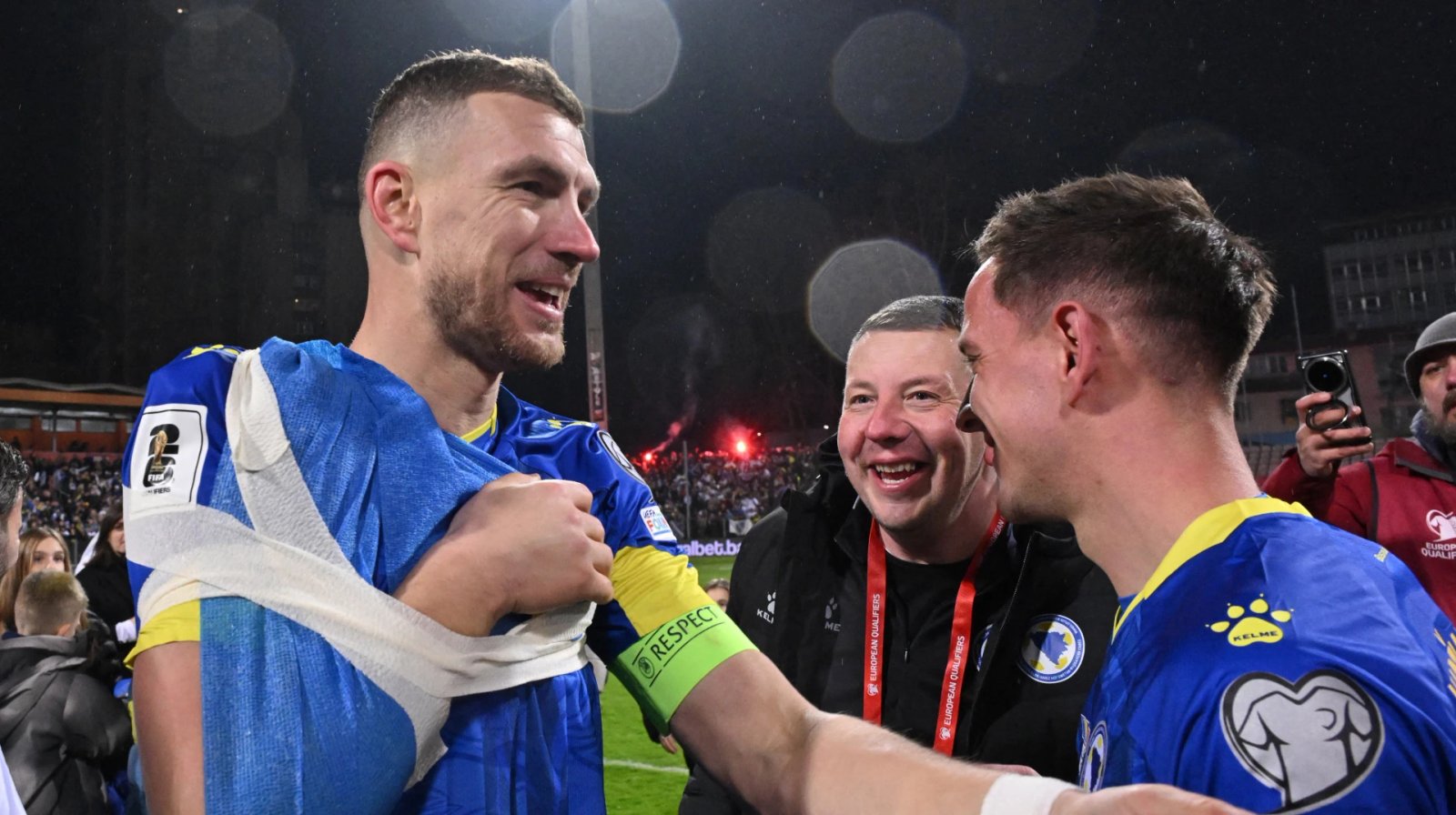
Today, June 12, the national team of Bosnia and Herzegovina will start the 2026 World Cup with a match against Canada.
Edin Dzeko remains the leader and the main hope of the Bosnians for goals.
The powerful Schalke striker is already 40 years old, but he remains in fighting shape and has a huge desire to represent his country in the world.
Wherever Edin played, however things turned out, he always remembered Sarajevo.
And there are more than good reasons for that.
***
“During the war, there were many days when I had to stop the game and run for cover because the sirens went off.
My mother saved my life once. She didn’t let me go to training, and within a couple of minutes a mine fell and killed my friends.
We were too small, not aware of the danger; did not understand what was happening. Because of the war, we didn’t have a happy childhood,” admits Edin Dzeko.
As part of Bosnia and Herzegovina at the 2026 World Cup, he was the only one who experienced these horrors on his own skin.
The rest are young, even young boys, who know the history of their people only from the stories of their elders. They were born in Germany, Sweden, Austria.
Who is he for them?
“Earlier, when I mentioned the country of origin, everyone kept talking about bombs and genocide. Now, when you hear the word “Bosnia”, they immediately say: “Dzeko”. He changed the image of the whole country,” says agent Yasmin Ligata.
And how does the Sarajevo public like Dzeko? Probably, she will never have such an idol again.
***
One more time.
“He was with us even when the city was under siege. And when he comes, he always stays for a long time,” explains a random fan on the street.
Amazing city! In Sarajevo, women in headscarves and shorts walk between minarets and churches. In every tavern, and there are many of them, chevapchichi are being prepared right now, and hookahs are the norm despite the “Ministry of Health warns” on cigarette packs.
And all around – picturesque mountains; and those who draw picture after picture.
Why don’t people live peacefully in this paradise?
After 67% of Bosnia’s population – that is, Bosniaks and Croats – voted for independence from Belgrade in March 1992, the Serbs decided it was time to “protect the rights” of their minority.
They had tanks, armored vehicles, artillery and aviation, and the Bosniaks had only an idea.
And just like that, on April 5, 1992, Sarajevo was under siege.

Map of Bosnia and Herzegovina and neighboring countries. Territories controlled by Serbs in 1992-95 are shown in blue, diplomacy.state.gov
Young Edin did not understand that his father, Midhat, had signed up for the Bosnian Self-Defense Force, which was fighting on two fronts – against the regular Yugoslav army that surrounded the city, and the insurgent Serb quarters inside Sarajevo.
The front line passed right on the streets, in the yards; the central avenue turned into the infamous Alley of snipers, who were shooting straight from the balconies.
On May 4, 1992, the Serbs burned “Hrbavica” – the stadium of the “Zheleznicar” club, beloved by Bosniaks, destroying more than 300 trophies. But the fire was like a signal – there is no place for football here.
And although it sounds unlikely, that terrible “signal” was contested by an ethnic Serb.
On May 15, 1993, ex-player from Stuttgart Predrag Pašić ran to the radio station under bullets to defy hatred and announce the recruitment of children to the multinational (!) football school Bubamara.
“I wanted to give joy to the children who were left to live under the bombs. But I also understood that this was some kind of madness, and no one would come,” he recalled many years later.
And it was to that call that 7-year-old Jacko responded with dozens of other boys hiding in the ruins.
***
Yes, yes, ruins.
The Serbs generously bombarded Sarajevo with shells, watered them with anti-aircraft guns, Grady. On “quiet” days, the city received 200-300 shells, on loud ones – up to 1,300.
The UN peacekeepers stood very close by, but were they interested in peace?
When a mine destroyed the private house of Dzeko’s parents in the Brijesce district, they moved in with relatives in a high-rise apartment. Father fought, mother worked.
There are stories that should not be learned too soon, but war never asks. Young Edin saw a dark footprint on the sidewalk from a man who had jumped from the balcony of their high-rise. He lived above them. He was a Serb by blood, and his wife was a Croat. When and after the hungry winter she moved to Zagreb with her family, he lost the will to live.
And on the way to the football school, Edin’s grandfather stopped him – a madman, he walked directly under fire, reciting “Crime and Punishment” by Dostoevsky.
This is not how children should grow up!

Young Dzeko at the Železničar school (fifth from the right in the top row), x.com/ZZiliani
But, in the end, it was precisely these species that shaped Jacko – gave him a purpose at an age when in peaceful cities peers are still playing hide and seek and collecting Lego.
He came to the Zheleznichar school by himself at the age of 9.
They played mostly in the club gym, but sometimes they changed locations if the area was too heavily shelled.
“He had very good manners from the beginning. And he trained harder than the others from day one. He was ambitious. He wanted to move forward at any cost.
We first played on a grass field in 1994. It took me several months to realize that he was more gifted than others. I chose him for his physique and discipline. He willingly sacrificed himself, he had a great desire,” coach Yusuf Shekhovych said.
The same thing is repeated by Dzeko’s friend from Gelo, Mirza Trbonya: “Once Edin got sick, he didn’t go to school for a week. I came to his house to ask if everything was okay. He was not moving well, but he was changing into his uniform. He was going to train with the team, I asked him for help. I didn’t know whereoh I have never seen such passion.”
And this is not the case of Modric, who was the best in all age groups. Jacko had no innate gift; he was laughed at for clumsiness, bad shots, passes to the out. He climbed each step with hard work.
Football didn’t choose him, Edin chose football to escape the hell that surrounded him.
Shekhovych tried to explain this to visiting reporters: “You have to understand, we lived in extremely difficult conditions. Once after the war, we were invited to a tournament in Italy. There, our boys were taught to turn on and off the light, because they had never seen it before.”

As a child, Dzeko played mostly in the mud, not on the grass, ilromanista.eu
***
Jacko didn’t see him either.
And since he didn’t see the gate, he got the nickname “Lamppole” – they say, it’s just as tall and just as “technical”.
Only certain coaches, like Iso Akhmetovych, noticed something in Edin at the end of the 1990s: “Once we were training a pass. There were seven guys. At that time, Andriy Shevchenko was the best player in the world, and I turned to my guys and said: “Look! Here he is, the new Shevchenko.”
But this was not a popular opinion.
At that moment, Sarajevo was finally quiet. In 1996, the Serbs recognized the independence of Bosnia and Herzegovina and signed the Dayton Peace Treaty.
For Dzeko’s family, this meant that Edin could go to football without the risk of being killed. His father, Midhat, also returned from the war, who now worked for pennies, but every time he found an opportunity to buy his son a banana after training. I believed in him.

And not for nothing!
In 2003, 17-year-old Edin made his debut for Železničar in the senior championship of Bosnia.
I would write here that he immediately broke everyone, but no. On the contrary, doubts persisted. Dzeko was called slow, clumsy for a pro. After 5 goals in the first 40 matches, he did not have many fans in Sarajevo, until the Czech Jiri Pliszek was called to coach Zheleznicar:
“It’s impossible. He was already 17 years old, and no one around saw any talent in him. I was the only one who noticed a gift in him.”
It happens.
In the end, Pliszek beat Czech Teplice to 25,000 euros for Dzeko in 2005. When they saw the check in Gelo, they thought they had hit the jackpot; rejoiced all week.
Well, after a month in the Czech Republic, Edin went to Sparta, whose defense was headed by one of the biggest bone-breakers of the 1990s, Tomasz Rzepka.
“He was 19. He was playing against a Gladiator who had just come back from England. And you know what? He didn’t have an ounce of fear in him!” – proud Teplice partner Samir Merzych, who knew perfectly well where the fearlessness of his fellow countryman took root.
***
What happened next?
Oh, what happened!
And the famous verdict of the “iron” Felix Magat – they say, this guy is as good as a horse, he will play…
And the “magic triangle” of Wolfsburg together with Grafite and Mysymovych, which brought them Salatnitsa in 2009…
And the goal that equalized the score in the match between Man City and QPR in 2012, after which Kun Aguero brought the “City” the championship…
And dozens of cool goals for Roma, including the one that flew into Barca’s goal during the comeback in 2018 – Edin dedicated this ball “to all the children who died during the siege of Sarajevo.”
And even the World Cup has already happened – in 2014, the Bosnians went to Brazil, and before that, the bus with the national team stopped at the former Sniper Alley, where 11,541 red chairs were installed – one for each citizen killed during the war.
In the 2014 national team, it was customary not to mention the old, because, as Vedat Ibyshevych said, “everyone has their own story.”
Now, perhaps, it is different, because the new Bosnia is Dzeko and the youth united around their hero, as Argentina is around Messi. He still helps on the field, scores goals, but is increasingly valuable in the locker room.
Edin has something to tell them and something to teach them. Muhamed Yonich, the first captain in the history of “Golden Lilies”, has no doubts:
“We saw how he went through all the trouble and still made a world-class career. He became great – both for Bosnia and for the world. And he is still a sincere, kind, straightforward man. This is the beauty of his greatness. Everyone here respects him for that.”
Telegram channel of the author: Football stories