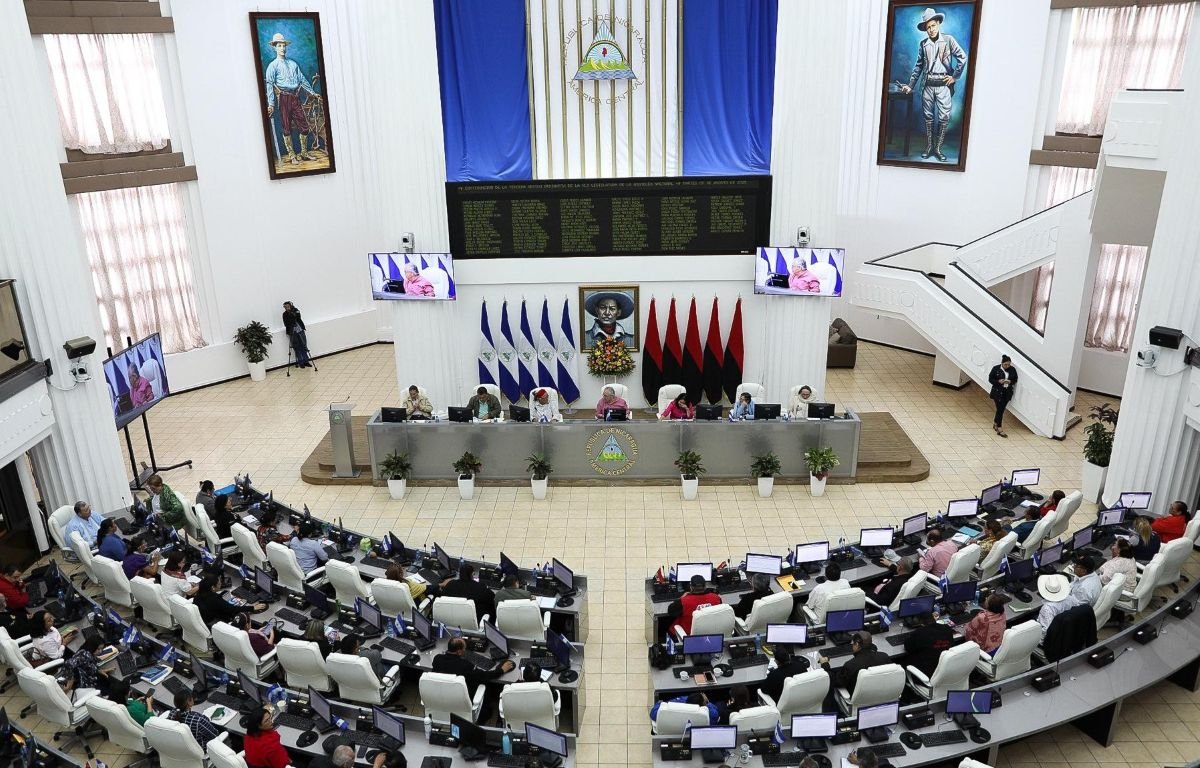
The National Assembly, controlled by the regime of Daniel Ortega and Rosario Murillo, approved a package of economic reforms that, among other things, allow the assets of people accused of money laundering to be automatically frozen, empowers the Police to access electronic devices without any type of judicial guarantee and places greater control on the Non-Profit Organizations that remain in the country.
The measure also redefines the concept of condemning “terrorist acts,” including punishment for “seriously disturbing public order” and obliges financial institutions to mandatory send, when required, the “report of national and international payments, purchases and/or cash withdrawals using credit and/or debit cards.”
The changes made by the regime go beyond a simple homologation of laws and compliance with international standards as justified by the regime. Analysts consulted by CONFIDENTIAL They agree that the reform deviates from international standards and may generate risks of abuse, discretion or political instrumentalization.
The reform, approved on June 17, 2026, modifies the laws Against Money Laundering, Financing of Terrorism and Financing of the Proliferation of Weapons of Mass Destruction; of the Financial Analysis Unit; the Penal Code; the Criminal Procedure Code of Nicaragua and the Prevention, Investigation and Prosecution of Organized Crime and the Administration of Seized, Confiscated and Abandoned Assets.
Automatic immobilization without judicial control
In the reform of the Anti-Money Laundering Law, it stands out that the National Anti-Money Laundering Council (ALA/CFT/CPF) can order all obligated subjects (banks, financial companies, stock exchanges…) to immobilize “without delay” the funds or other assets of natural or legal persons suspected of money laundering.
The term “without delay,” the reform emphasizes, must be understood as “the immediate execution” or “in a matter of hours” of the immobilization of the assets of the person designated by the competent authority. This immobilization can be carried out—even—without a prior court order.
For former deputy and political analyst, Eliseo Núñez, this reform falls outside the international standard because the Financial Action Task Force (FATF) demands speed, but does not require automatic immobilization without prior judicial control.
“International practice (EU, Canada, Chile, Costa Rica) requires a reasoned administrative order or judicial order, not an automatic obligation imposed on private parties. This opens room for errors, abuses and undue freezes,” the analyst noted.
For economist Juan Sebastián Chamorro, this package of economic reforms aims to give “a veneer of legality” to the confiscations that the regime of Daniel Ortega and Rosario Murillo “has been abusively carrying out.”
“This reform seeks nothing more than to make official and process more quickly the confiscation of assets, the elimination of banking secrecy, the elimination of credit secrecy and the liquidation of assets to be distributed among their cronies, as if it were loot among pirates,” commented the economist.
Application of third country designations
The reform also mandates obligated subjects to freeze assets of people with “national designations and those requested by third countries.” A fact that, Núñez warns, “can turn Nicaragua into an executor of foreign sanctions without its own analysis.”
The FATF “allows lists of third countries to be considered, but does not require their automatic application. International practice requires sovereign evaluation, not automatic application,” the analyst emphasizes.
These changes, Chamorro values, “further affect the already deteriorated investment environment (in Nicaragua) and scare away the much-needed foreign private investment that is crucial for the country’s development.”
What the economist is referring to is that as of the reform, the data of any economic transaction will be monitored when the authorities require it, including credit and debit cards.
In addition, penalties are increased in the Penal Code to punish alleged offenders. In short, “more control, more repression, more formalization of the abuse that economic agents, small, large and medium, have been suffering for years,” Chamorro stressed.
Final beneficiary as a requirement for the existence of NPOs and cooperatives
The reform to the Anti-Money Laundering Law also requires NPOs and cooperatives to declare their final beneficiaries as a “requirement for granting legal personality.”
“The FATF does not require a final beneficiary for NPOs as a condition of existence. Recommendation 8 calls for a risk-based approach, not structural controls that affect freedom of association. In addition, the UN and the OAS have warned that this type of measure can be disproportionate and used for political control,” Núñez explained.
The reform also requires presenting the final beneficiary for any procedure as an “essential requirement for the admission, continuity or resolution of the procedure” before any public or private entity. Demand that the analyst assesses as “excessive, not proportional and not based on risk.”
“No FATF-compliant country requires a final beneficiary for ordinary administrative procedures,” Núñez points out.
For Chamorro, this reform gives “a military character” to the supposed fight against money laundering, because the functions of the Ministry of the Interior (MINT) are further expanded.
Expansion of the concept of “terrorist acts”
The reform also expanded the definition of terrorist acts. In such a way that, now, “physical and/or mental injuries” and “seriously disturbing public order” are considered terrorist acts in Nicaragua.
For Núnez, this expansion of the concept of terrorist acts moves away from the “strict criminal standards,” and he adds that both the FATF and the UN require precise and not broad definitions.
“Psychic damage” and “disrupting public order” are vague concepts that can be used to criminalize protest or dissidence,” the analyst points out.
Police can intervene electronic devices
In the reform of the Criminal Procedure Code, the National Police was empowered to carry out the searches and raids “that are necessary” for the investigation and “access and extract information from electronic and computer equipment or devices.”
Changes that, Núñez assesses, constitute another “clear deviation” from international standards and without robust judicial controls, without proportionality standards and without technical guarantees.
“The FATF does not require expanding police powers of direct access to devices. The UN and the Inter-American Court require strict judicial authorization, proportionality and clear limits,” warns Núñez. In other words, he continues, “the international trend is to restrict, not expand, state access to digital data.”