The author’s travel films are available youtube. More news – facebook and Instagram.
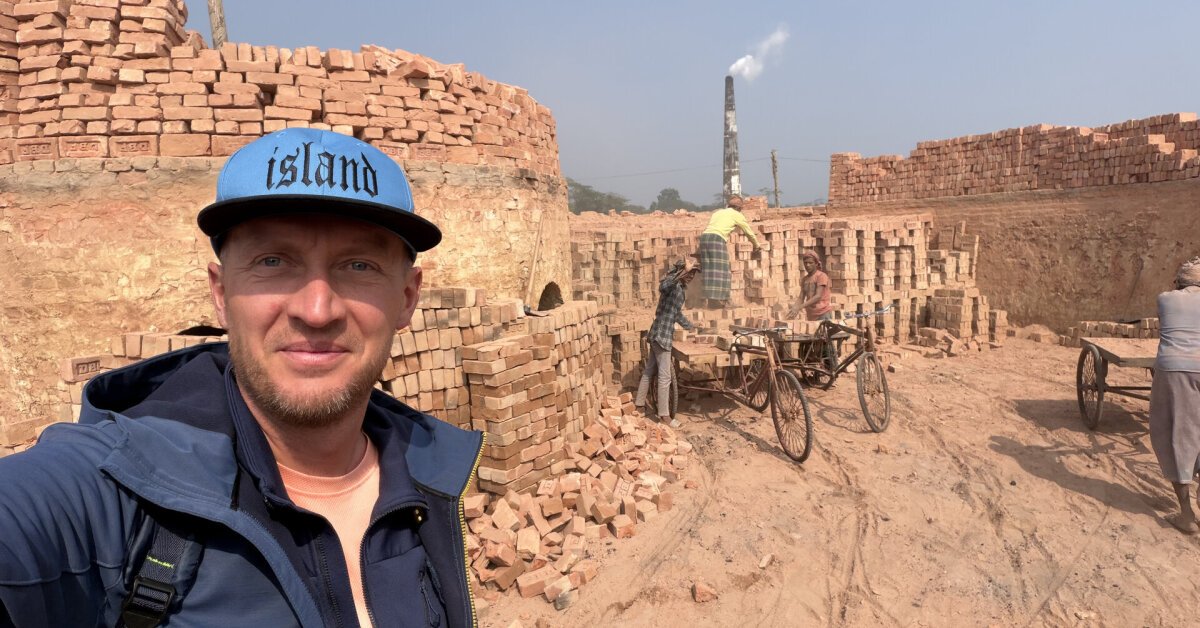
Dark columns of smoke begin to rise in the distance. Giant chimneys are slowly pushing their way into the sky. When I step ashore, I feel the smell of burning clay and the heat, which seems to press me to the ground. As soon as I pull out my camera, people turn. A moment of silence. And then – smiles. I am greeted without suspicion, even with curiosity. One man beckons to come closer, the other begins to show his work himself. That simplicity is disarming.
Brick making is the beginning of cities
Everything starts from the ground. In the following river beds, people dig clay by hand. No equipment, no protection. Just a shovel and a body. I watch them and think, this is work that looks like it’s from the past, but it’s actually the present. Interestingly, around 20 billion bricks are produced annually in Bangladesh and the brick industry forms a significant part of the construction sector. Most of them are handmade.

Photo by Algirdas Morkūnas / “Lost Borders”. / Bangladesh
Clay is transported by small boats. The rivers here are real arteries. Once the boats reach the shore, the hard part begins. Men lift bowls of clay on their heads – often 30-40 kilograms each. I try to lift one – the body immediately resists. They move non-stop at that time. One worker can transport up to 2-3 tons of clay per day.
Molded bricks drying in the sun look calm, almost aesthetic. But behind that lies long hours of work. At the giant shoulders, the heat becomes almost unbearable. The temperature here is around 900-1000 degrees, and most of the kilns are open for months without a break. An interesting fact – the brick industry is also one of the biggest causes of air pollution in the country, creating up to 15% of air pollution. total smog in some regions.
I try to help load bricks – after a few minutes I realize that this is a whole other level of physical ability. The workers smile, as if to say – “everything is fine, we are used to it”.
Wood and sawmills – a balance between life and danger
Moving further down the river, sawmills open up. Giant rasta are floated in the water, some are simply released into the current. Men balance on them barefoot. The scene looks like something from a movie, but here it is everyday life.
In Bangladesh, wood is still widely used as a fuel and building material, and much of the work is done by hand. Interestingly, due to the rapid exploitation of forests, the country has lost a large part of its natural forests in recent decades.
Men balance on them barefoot.
I try to get closer – the surface is slippery, unstable. Even standing is difficult. They move confidently at that time. One even invites you to film closer, as if to show: “Look, this is how we live.”
Stone breaking – roads built by hand
Next – the places of stone breaking. There is dust everywhere. After a few minutes it becomes difficult to breathe. People break huge stones with their hands. No safety glasses, no gloves.

Photo by Algirdas Morkūnas / “Lost Borders”. / Bangladesh
It is interesting that this crushed stone is later used for roads, bridges, buildings – it is one of the main infrastructure elements. However, workers often work without any medical protection, and long-term inhalation of dust can cause serious lung diseases.
I try to stay longer – the body gets tired quickly. They work all day.

Photo by Algirdas Morkūnas / “Lost Borders”. / Bangladesh
Sand mining – man against the river
The work that takes place in the rivers leaves the strongest impression. Men scoop sand with buckets directly from the bottom. Some stand up to their chests in water.
One bucket can weigh more than 20 kg. Hundreds of them are drawn per day. Interestingly, Bangladesh is among the countries where the demand for sand is growing rapidly due to intense urbanization – cities are expanding and sand is becoming a resource worth its weight in gold.

Photo by Algirdas Morkūnas / “Lost Borders”. / Bangladesh
I tried it myself – my hands get tired after a few times. They work for hours. On the shore, sand is loaded into bags and carried on shoulders. The image is reminiscent of another era.
One bucket can weigh more than 20 kg.
And here comes the hardest part – not filming, but watching. There are moments when you want to put the camera down. But at the same time I understand – if I don’t show it, it will remain invisible.
Ship repair – the world of steel
In the workshops associated with Bangladesh’s shipbreaking industry, the atmosphere is quite different. Metal, sparks, noise. Bangladesh is one of the largest ship recycling sites in the world, with up to 30% of ship scrapping done here. of all ships in the world.

Photo by Algirdas Morkūnas / “Lost Borders”. / Bangladesh
The work is dangerous. One man shows the scars on his arm – without much emotion. Just a fact. For this – a few euros per day.
Collecting latex is a quiet job
On land – collecting latex. A white liquid flows from the trees, which later turns into rubber. This process requires precision – the cut must be the right depth, otherwise the tree may be damaged.
This is manual work for about 1 euro per day.
Interestingly, natural rubber is still an important part of the global industry, used in thousands of products. But here, in the fields, it is manual labor for about 1 euro a day.
Rice is the heart of the country
The rice fields are impressive. Rice is the basis of everything here. Bangladesh produces about 40 million tons of rice annually and is among the world’s largest rice producers.
It is interesting that rice makes up about 75 percent. of all cultivated land areas, and almost half of the country’s population works in agriculture. It is a huge manual work, from planting in water to cutting.

Photo by Algirdas Morkūnas / “Lost Borders”. / Bangladesh
Tea plantations – beauty with a price
Sreemangal in the region – greenery, hills, peace. But that’s just the surface. Entire families work in tea plantations. It is interesting that this industry appeared here in colonial times and in many places the structure has hardly changed.
Up to 30 percent children help to work in some places. Women pick leaves all day, often without breaks. The reward is minimal.

Photo by Algirdas Morkūnas / “Lost Borders”. / Bangladesh
Standing among them, I feel a double feeling – the view is beautiful, but the reality is hard.
Textiles are the world’s wardrobe
Sewing in a small village. Bangladesh is one of the largest textile exporters in the world. About 80 percent total exports consist of clothing.
Interestingly, this industry employs more than 4 million people, most of whom are women. Working days are long, often 10-12 hours.
And then you understand – every piece of clothing has its own story.

Photo by Algirdas Morkūnas / “Lost Borders”. / Bangladesh
The author’s travel films are available youtube. More news – facebook and Instagram.