The shortest route from Innsbruck main station to Bozner Platz in the city center has been open again for a few weeks. The so-called Raiffeisenpassage, a pedestrian passage that runs through several properties, was impassable for years because its namesake reinvented itself on the side facing the city at its existing location. This manifests itself in a new building that breaks with the common idea of a bank headquarters and integrates other uses.
One could also interpret it to mean that real estate considerations meant that the bank had to reinvent itself. Anyway, “The Raiqa” is finished. The “that” in front of it is likely to be based on naming trends from the catering industry, which is fitting since a bistro and a rooftop restaurant are part of the functionally mixed complex. The “Q” expresses the neighborhood idea, although it seems a bit exaggerated to call the whole thing a neighborhood. In real estate marketing you never take it too seriously.
Pichler & Traupmann Architects, on the other hand, have delivered pretty much exactly what they promised in the competition seven years ago. The competition requirement to make the passage more attractive has only been partially met. Neither the architects nor the powerful Raiffeisen-Landesbank had access to the sluice on the train station side and the subsequent run-down courtyard with several owners. But where thousands of pedestrians once squeezed past the entrance to the underground car park, a plaza now opens like a funnel to Adamgasse and the city center. Partially covered by the third floor, which continuously accommodates the line of buildings on the alley, and the cantilevered hotel wing, a public space was created on bank property. Lined with a small-scale row of shops, it also offers a high quality of stay despite its function as a transit area. The bank makes this space available to the public and in return can not only continue to use the volume dedicated to it since the 1960s, but even increase it somewhat. This was already specified in the tender, as was the extensive preservation of the main building with its nine-story tower plus a penthouse on top.
»Late in the evening, when the bank and bistro are idle, you can hear the clinking of glasses from the roof bar below.«
Visually, the existing structure, which was built between 1969 and 1971 according to plans by Walter Anton Schwaighofer with the prefabricated part grid and exposed concrete facade typical of the time, has disappeared from the cityscape. Instead, in the city, a wider white building appears again and again somewhere between the roofs and confidently shows its presence in the roof landscape. To describe the form as exalted would not be entirely accurate. If you look at it soberly, the volume, made up of layers, folds and projections, represents the various contents; building regulations are sometimes reflected in bevels and recesses.
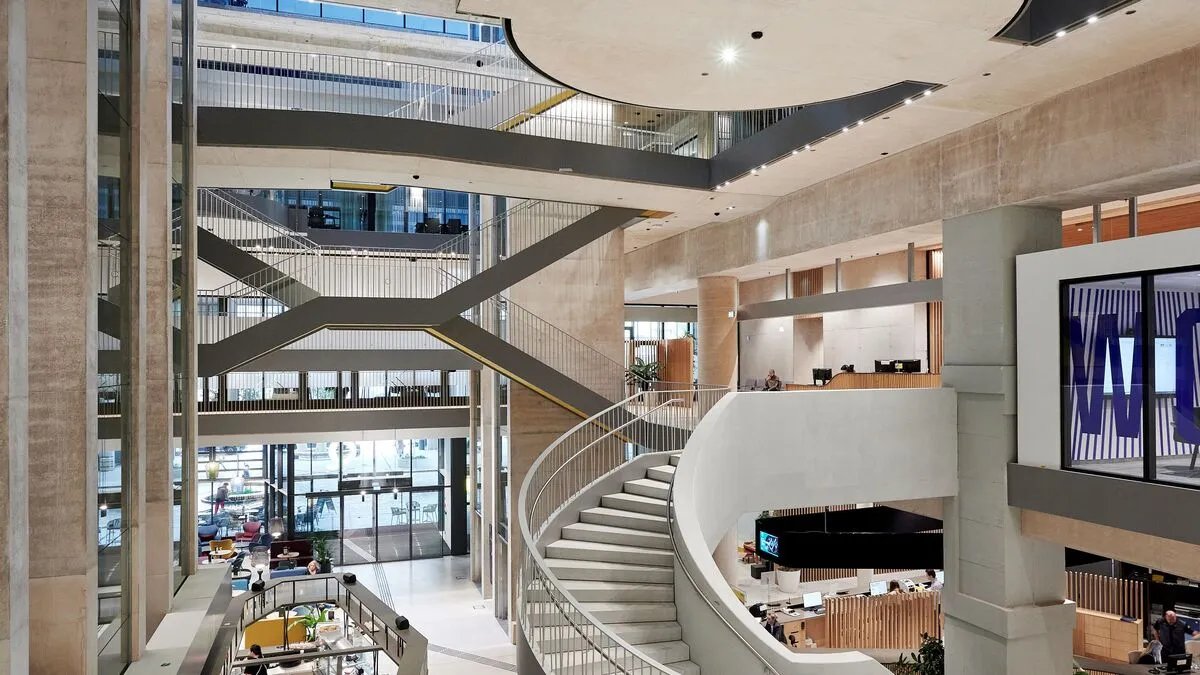
“We wanted to make the largest possible area and space available to the public, both outside and inside,” emphasizes architect Christoph Pichler, and it is clear from the entrance what “largest extent” means. By peeling out the reinforced concrete skeleton, they make the structure, invisible from the outside, the star inside. Within the exposed structure of the old building, an atrium opens up over the entire height, traversed by the old concrete beams. Attached to it are flights of stairs, bridges and islands that protrude into the room, from which the space can be experienced even better than from the glazed lifts that fit between the supports. On the upper floors, the 161 hotel rooms made of wooden modules are packed around this spectacular space. The impression of a castle of beds never arises. As soon as you step out of the room, the view opens up to the outside or the atrium at the ends of the corridor. From above you can feel the life below, and even late in the evening, when the bank and bistro are idle, you can hear the clinking of glasses from the rooftop bar from below.

Bozner Platz was defined with a “tree hall”. City of Innsbruck
It is as if the energy saved through the controlled dismantling could be felt in the air. Here the stock was not destroyed with a wrecking ball and in the tipping trough. It was analyzed with the experts from the construction carousel, dismantled step by step, recyclable materials sorted and components put back into circulation via socio-economic companies. This is good for the environment, qualifies workers in a new professional field, has economic advantages and also looks really cool.
It is a conceptually strong building that you don’t necessarily have to understand to have impressive spatial experiences. The situation is similar a few meters further, with the newly designed Bozner Platz. Here too, a Viennese office, EGKK Landschaftsarchitektur, was successful – with a precise concept that was inconspicuous compared to many of its competitors. The fountain in the middle of the square with the statue of Duke Rudolf IV, “the founder”, was initiated on the occasion of the 500th anniversary of the unification of Tyrol with Austria in 1863. It was designed by the Viennese cathedral builder Friedrich von Schmidt, and the bronze figures were created by the Imst sculptor Johann Grissemann. The square received its current name in 1923 in memory of the separation of South Tyrol in 1919.
While some competition participants proposed daring architectures, Martin Enzinger and Clemens Kolar took up the garden landscape that existed before the development of the politically symbolic, but ultimately mainly traffic-washed square. Around the fountain, they placed a square of 21 leatherwood trees on a water-bound area, which, together with rows of trees on the edges of the square, form a “tree hall”. It shades both the center of the square and the traffic areas, but thanks to its leaf structure it does not form a completely dense tree canopy. On the long benches oriented towards the center, perennial beds were docked to the outside. This fulfilled a political wish for more greenery close to the ground, as was seen in Vienna. This makes the center of the square even more accentuated. Waldviertler granite laid in a braided bond of different colors and paving sizes creates calm zoning on the leveled and decelerated square.
Both times, transit spaces have become urban places in which what already existed has been made to shine through redesign.