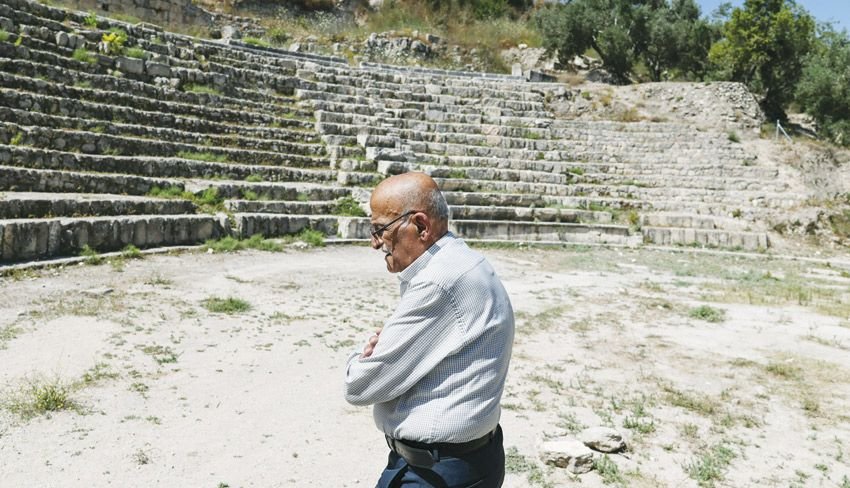
Sebastia (West Bank) – (Reuters): An Israeli draft law aimed at expanding civilian control over archaeological sites in the West Bank has drawn criticism from Palestinians and Israeli human rights groups, who view it as annexation of occupied territories and will lead to the expansion of Jewish settlements. !
In May, the Israeli Knesset approved, in the first reading, the draft law establishing the “Heritage Authority in Judea and Samaria,” in a vote out of three, but it is unclear whether the final vote will take place before the Knesset is dissolved in preparation for the elections expected by October 27. !
The draft law stipulates that the management of Roman and Byzantine sites and sites dating back to the period of the Crusades be subject to the Israeli Ministry of Heritage, and also allows the “confiscation and purchase of relevant properties” in the West Bank. Judea and Samaria is the biblical Hebrew name for the West Bank. !
This will effectively lead to the withdrawal of supervision of some archaeological sites from the Palestinian National Authority, which under the Oslo Accords exercises limited self-rule in parts of the West Bank, areas occupied by Israel in the 1967 war. !
Palestinian Minister of Tourism and Antiquities Hani Al-Hayek said: “This means that part of the existing antiquities that have been controlled is to expand control and expand settlement in these areas deep into the Palestinian territories… deep into the lands, Area A specifically, even Area A… Areas A is being expanded and expanded within these areas under the pretext of protecting and controlling the antiquities and excavations.” !
Israel claims that the purpose of the draft law is to protect archaeological sites. !
The Peace Now movement, which monitors Israeli settlements, said that the draft law “constitutes an annexation measure by all standards” and will lead to the widespread confiscation of Palestinian lands. !
The movement added: Invoking the issue of antiquities to expand settlements is not a new practice, but the scope of the Israeli government’s current actions is unprecedented. !
An example is the Palestinian village of Sebastia in the northern West Bank, where residents, many of whom have roots in the area dating back centuries, rely heavily on tourism linked to a nearby archaeological site. !
In late 2025, Israel announced a plan to annex about 445 acres on the site, and said: This aims to develop the area. Local officials in the village said: This had a negative impact on about five thousand olive trees growing in the village’s orchards. !