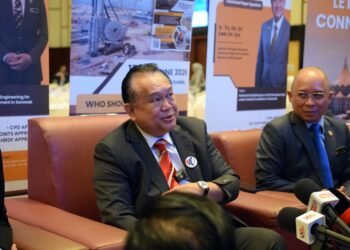

Chief Minister of Sabah Datuk Seri Panglima Hajiji Noor. — Bernama photo
KOTA KINABALU (June 17): The Sabah government remains committed to strengthening the state’s education agenda through various assistance schemes and sponsorship programmes to ensure more Sabahans have access to quality education.
Chief Minister Datuk Seri Panglima Hajiji Noor said the state government continues to place strong emphasis on educational development, from early childhood education to higher education institutions.
“14 education assistance initiatives introduced between 2021 and 2025 will be maintained to help ease the financial burden on students and families across the state,” he said.
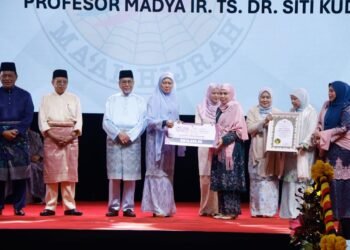
His speech was delivered by Education, Science, Technology and Innovation Minister Datuk James Ratib during the 14th Academic Excellence Awards (Mekar) ceremony held at the Sabah International Convention Centre (SICC) on Tuesday.
Among the assistance offere are the one-off higher education institution registration cash aid (Budi), the Domestic Higher Education Student Contribution Scheme (Sentosa), Examination Fee Aid (Bayu), Computer Assistance Grant (Baik) and the State Education Savings Assistance Scheme (Bistari).
Hajiji said the state government has also unveiled the Sabah Education Sponsorship Portal (PTPS), an integrated platform that brings together various education sponsorship bodies under a single system.
He said PTPS streamlines the education sponsorship application process, making it faster, more efficient and more user-friendly, while ensuring that a greater number of students can benefit from available aid.
In this regard, Hajiji stressed that information on these educational initiatives should be disseminated more widely at the grassroot level to ensure that no eligible student misses out on the aid.
At the same time, Hajiji said the state government would continue to work closely with the Education Ministry to improve educational infrastructure, expand Science, Technology, Engineering and Mathematics (STEM) and Technical and Vocational Education and Training (TVET) programmes, as well as accelerate the education digitalisation of education.
Hajiji added that these efforts are aimed at produced a skilled, knowledgeable and competitive workforce capable of driving future challenges.