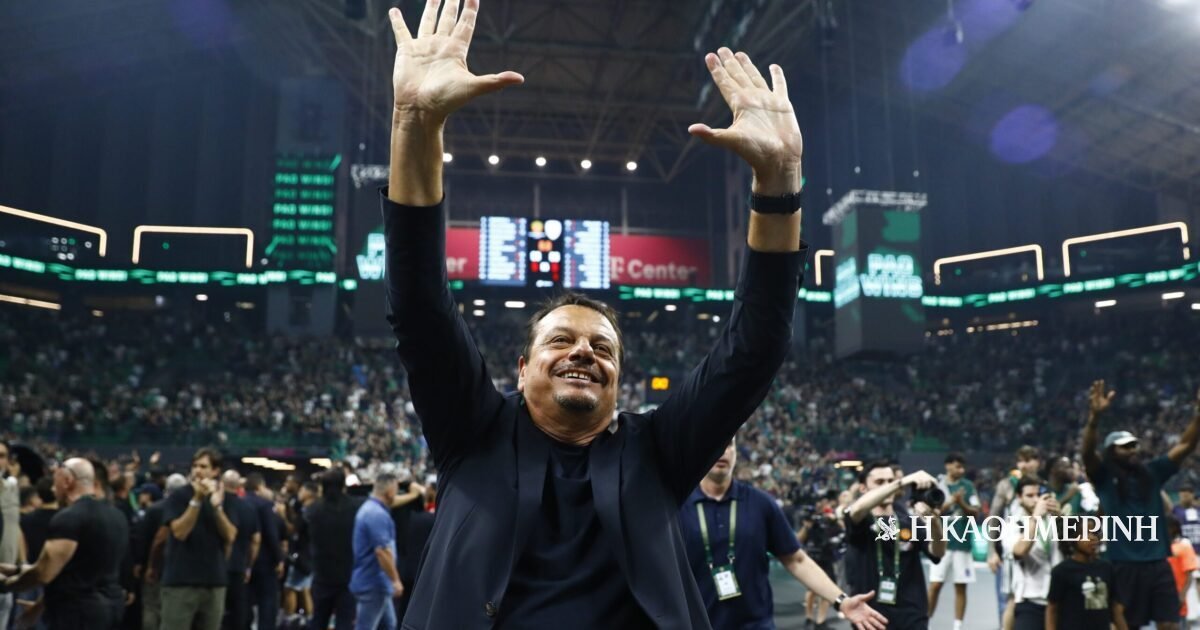
When the Ergin Ataman took him over Panathinaikos in the summer of 2023, he took over a club looking for a return to Europe’s top flight. A few months later, Panathinaikos had returned to the Euroleague thronewinning the seventh European trophy in its history and returning the “clover” to the center of European basketball. The task of conquering the European summit, in fact, took on even greater dimensions if one considers that the previous year of the triumph, Panathinaikos had finished in 17th place in the Euroleague, before the end of 2024 found them at the top of Europe.
Ataman is not just a successful coach. He is a personality that causes strong reactions. For others it is him top dressing room and personality manager in Europe and a “serial winner”. For others, he is a coach who often moves to the edge of the challenge, turning every big match into a personal affair.

“Born Winner”
After the European conquest of 2024, Ataman presented himself as the man who succeeded one of the most impressive team revivals in EuroLeague history. The return of Panathinaikos to the top after years of competitive decline was largely attributed to the personality and philosophy of the Turkish coach.
In fact, after his highly successful tenure at Anatolou Efes, where he lifted two Euroleague titles, his image was strengthened as the coach who cultivates a sense of superiority in his players, while he does not hesitate to use public statements to put pressure on opponents, referees or competitions. A typical example was his frequent public statements about refereeing and the operation of the EuroLeague, which even caused monetary penalties from the organization.

The “war” with Olympiakos
From the first moment of his presence in Greece, Ataman was at the center of the rivalry between Panathinaikos and Olympiakos.
His public confrontations with the coach of the “red and whites” George Bartzokashis complaints about refereeing decisions and his post-derby statements often sparked a new round of debate.
The image projected is that of a coach who does not seek to defuse tension, but instead uses it as a rallying tool for his team. For his supporters, this is part of his successful methodology. For its critics, it is a source of unnecessary tension.

From apotheosis to criticism
In Greece, the Ataman’s presence was accompanied by two parallel narratives.
The first presents him as the man who he brought back the championship mentality to Panathinaikos. The conquest of the EuroLeague and the team’s return to the top European powers are considered proof that his choice was fully justified.
The second focuses on frequencies extra-competitive tensions. Statements about arbitrations, reactions to press conferences, public confrontations with opponents and organizational bodies have repeatedly been the subject of commentary. These incidents raised the profile of a coach who rarely goes unnoticed.

The relationship with the world of Panathinaikos
One of the elements recognized by friends and opponents is the special connection he developed with the OAKA platform. Ataman cultivated the vision of “returning to the top” early on, often adopting a speech addressed directly to the fans.
Even in times of tension or competitive difficulties, he publicly chose to defend his team and appeared confident of the final success, an element that strengthened his leadership profile in the eyes of the “green” platform.
This year’s racing “wreck” and the beginning of the demystification
A particular and defining element of Ergin Ataman’s third season on the Panathinaikos bench was the gradual and, at the end of the year, intense controversy surrounding his coaching. Since the middle of the Euroleague regular season, several choices of the Turkish coach have been the focus of criticism, with an emphasis on the management of the rotation, the participation time of key players and also his reactions at critical points of high-pressure games.
Throughout the season, there were games where Panathinaikos failed to “lock in” wins despite the lead or competitive advantage, which led to discussions about the bench choices in the last part of the matches. The insistence on specific formations, but also the delayed adaptation to tactical changes of opponents, were repeated points of concern. Gradually, that conversation moved from the locker room and the pitching staff into the public sphere, with the pressure mounting as the final stretch of the season approached.
The climax came in the Euroleague playoff series against Valencia, where Panathinaikos, despite taking a 2-0 away lead in the series, eventually lost three straight (both at home) and failed to secure qualification to the Final Four in Athens. There, Ataman’s coaching choices came under intense criticism, both for match management and decisions in the crucial final minutes of matches. The inability to adapt to Valencia’s competitive identity and the loss of control at key points in the series acted as an accelerator of doubt.
This failure was seen not simply as a lost European goal, but as the point where all previous reservations about the team’s management came to a head. The exclusion from the continuation of the Euroleague, in a season where the Final Four was held at his “home”, strengthened even more the climate of disappointment and gave a new dimension to the debate about whether Panathinaikos used its full competitive potential, but also Ataman’s direct partners who saw their scouting going to the… wastebasket by the Turkish coach who had chosen his own competitive path and philosophy.

Titles and review
Three years after his arrival in Athens, Ergin Ataman opened the exit door having secured a special place in the modern history of Panathinaikos. The headlines, the restoration of European glamor and the change in mentality are the strongest arguments of his supporters. Constant confrontations and frequent public outbursts fuel the criticism of his opponents.
In any case, whether as a triumphant or a protagonist of controversy, Ataman managed what few coaches do: to turn himself into a central figure in the narrative of European basketball and associate his name with the renaissance of Panathinaikos.
“Thank you very much for the three years we spent together, but now it’s time for a new era for all of us”, said Ergin Ataman in his farewell message, although the new era of Panathinaikos at the level of technical leadership cannot be ruled out to be titled… back to the future, with a strong “scent” of a possible return by Zeljko Obradovic.
His titles with Panathinaikos:
- Euroleague: 2024
- Greek Championship: (2024)
- 2 Greek Cups: 2025, 2026
- Greek Basketball League Coach of the Year: 2024
RES