The agri-food sector in Panama is going through a period of profound volatility, where the guaranteed supply in centers such as Merca Panamá contrasts with a cost structure that threatens the profitability of producers and the pockets of consumers.
In this scenario, the conflict in the Middle East and the sustained rise in fuel prices have ceased to be distant concerns and have become determining factors of the domestic economy.
Yoris Morales, from the Merca Panama Merchants Association, describes a panorama of continuous movement but marked by uncertainty. Although there is no shortage at this time, it clarifies that the impact is divided into two phases: the immediate cost of distribution and the future risk derived from agricultural inputs.
Morales warns that a large part of the world’s fertilizers come from the East, which could generate a cost crisis towards the months of May and June. “Currently, filling a heavy-duty truck costs 40% more than a few months ago, going from a range of $400 to $800 in some cases,” he said.
This logistical increase has a domino effect that Morales clearly identifies: the producer who uses his pick-up for plowing or irrigation pumps in the summer season is assuming much higher operating expenses.
Although there are specific increases in items such as tomatoes and peppers, Morales clarifies that these respond to natural production cycles and not directly to fuel, although freight already shows serious distortions.
For example, the cost of transporting a box of lettuce from Cerro Punta to the city went from $1.00 to $1.50, while a quintal of potatoes rose from $1.50 to $2.00 just for transportation.
This situation has generated a contradiction at service stations, where many transporters denounce the lack of real access to subsidized fuel, a measure that, according to Morales, the Government should supervise more rigorously through Acodeco to ensure that the benefit also reaches the primary productive sector.
Transmitted cycle
From the commercial manager of the Productos Horticola Virsa, SA, Carlos Saldaña complements this vision by pointing out that the commercialization of national vegetables faces a situation where it is “extremely complicated” to transmit the logistical costs to the final consumer.
Saldaña explains that “companies that have outsourced their logistics see the increase directly, but those producers that manage their own fleet are absorbing the blow to maintain supply stability.”
He adds that this absorption represents a decrease of between 2% and 3% on each pound sold, a cost that the producer assumes due to the impossibility of controlling a market of free supply and demand that has already reached its maximum price ceiling.
Saldaña highlights that, in April, the market consumes what was planted in January under intense summer conditions, which in itself reduces the number of active producers and raises prices naturally. However, he said, “the current volatility is unusual, with dramatic peaks and troughs of between 0.10 and 0.15 cents reflecting fuel instability.”
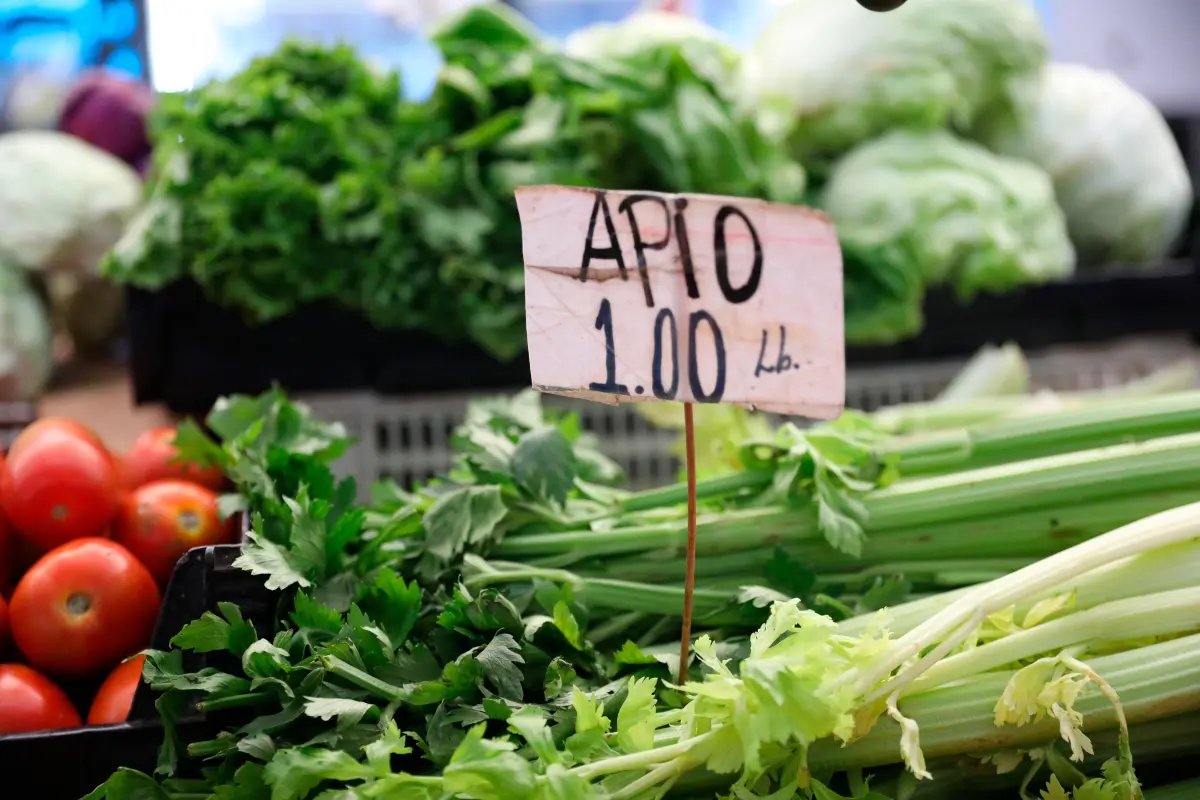
It details that high-volume but low-weight items, such as lettuce or celery, are the most financially affected because the cost of freight is prorated over fewer pounds of product, leaving the merchant in a vulnerable position where any financial miscalculation can translate into net losses.
Tidal competition
At the heart of the retail operation, Elvia Martínez, with 35 years of experience at Merca Panama, brings a dose of pragmatism to the crisis. Martínez describes that “the market is like a tide that constantly rises and falls, regardless of the current crisis.”
In his position, the prices reflect this irregularity: while tomatoes have risen from $1.00 to $1.75 per pound due to the climatic effects of the recent rains, other products such as zucchini (zucchini) fell from $2.50 to $1.00 in a matter of a week.
Martínez assures that the supply is complete and that, despite the speeches about fuel, she has not modified her personal cost structure to cover additional expenses for now, trusting in the resilience that decades of work in the sector have given her.
For her, the customer is still looking for everything, from fruits such as pineapple and watermelon to basic vegetables, and although cabbage has risen slightly to $1.00 per pound, fundamental products such as potatoes and onions remain stable at $0.70.
Basic basket
However, official data from the Authority for Consumer Protection and Defense of Competition (Acodeco) introduce a warning note about the population’s real access to these foods. Between January 2025 and February 2026, the cost of the basic basket in the districts of Panama and San Miguelito has shown a significant gap depending on the place of purchase.
In February 2026, while in supermarkets the average cost was $303.04 with a minimum variation of $10.82, in convenience stores and grocery routes the price shot up to $353.66. This difference of $50.62 confirms that the final link in the chain—the small neighborhood business—is the one that most aggressively reflects the fluctuations in fuel and freight, registering a notable rebound precisely when the conflict in the Middle East began at the end of February.
Land freight
This technical pressure is validated by Daniel Isaza, former president of the Logistics Business Council (COEL), who warns that companies in the sector have seen their variable costs increase significantly, affecting financial planning and service contracts. Isaza indicates that land cargo freight rates have suffered upward pressures of between 8% and 15%, especially on critical routes such as the Panama-Chiriquí corridor and access to free zones.
Isaza warns that, if the instability in the Persian Gulf continues, international maritime freight will also be affected, which, added to Morales’ warning about urea and fertilizers, could increase the cost of national production to critical levels.
The greatest risk, according to the specialist, is that this increase ends up being definitively transferred to the final price of mass consumption products, hitting the purchasing power of the citizen.
Yoris Morales
Panama Merca Merchants Association
Currently, filling a heavy-duty truck costs 40% more than a few months ago, going from a range of $400 to $800 in some cases,”
Carlos Saldana
Commercial Manager of the Horticola Virsa Producer, SA
“The current volatility is unusual, with drastic peaks and troughs of between 0.10 and 0.15 cents reflecting the instability of the fuel.”
Elvia Martinez
Retailer
“The market is like a tide that constantly rises and falls, regardless of the current crisis,”