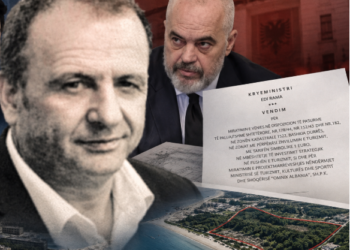
Another decision of the government for the company “Omnix Albania”, of the businessman Shkëlqim “Çim” Beshiri, brings back to attention a series of accusations raised in the media and in politics about his connections with the Berisha family. The government has given the company an area of about 90,000 square meters of land in the Lalëzi area, at the symbolic price of 1 euro, as part of an investment project. But this is not the only relationship between Beshir and the Rama government that has attracted attention.
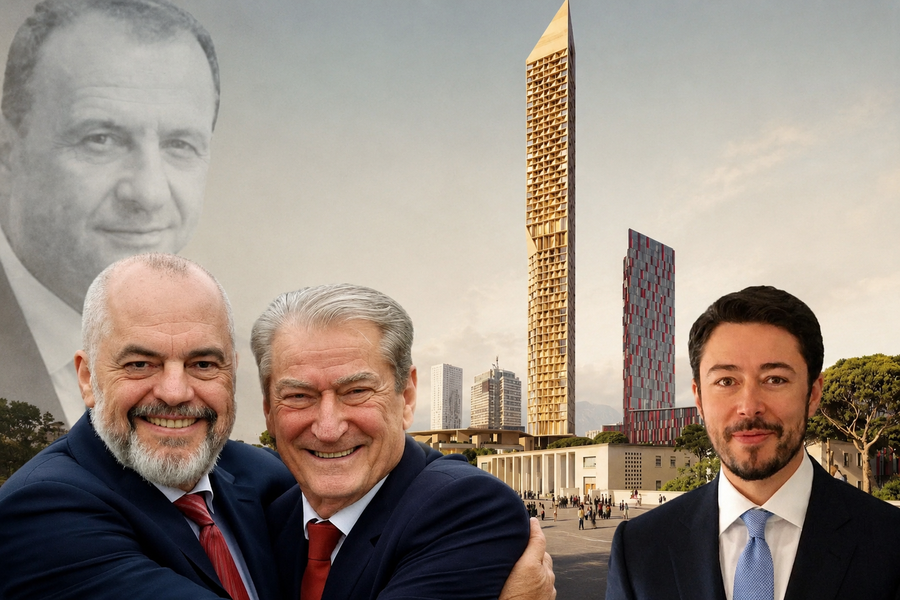
The next government contract for the businessman comes after he has been given the opportunity to develop another very important project: the 65-story tower near the Palace of Congresses, one of the biggest construction projects in Tirana.
This is where an old political story begins.
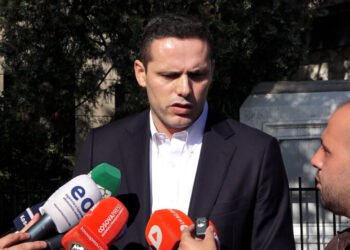
In his denunciations, the former deputy of the Democratic Party, Ervin Salianji, claimed that Shkëlqim Beshiri was related to Shkëlzen Berisha, the son of former prime minister Sali Berisha. Salianji mentioned Beshiri as a person close to Shkëlzen Berisha’s circle, while in his public statements he also used the term “prestanome” to describe the role that, according to him, Beshiri had in relation to the businesses and interests of the Berisha family.
These are political and media accusations, which Beshiri or the mentioned persons should have the opportunity to oppose and give their version.
But precisely for this reason, the new decisions of the Rama government regarding the businessman raise a political question that Salianji has articulated for a long time: how can it be explained that a businessman publicly denounced as being connected to the Berisha family circle benefits from projects and assets of considerable value even during the government of Edi Rama?
Salianji went even further in his accusations, talking about a Rama-Berisha “co-governance”, using the Beshiri case as one of the examples to argue his thesis.
Today, during Rama’s government, the same businessman is in the spotlight again, first with the tower project near the Palace of Congresses and now with another decision for about 90 thousand m² of land in Lalëz, with the symbolic price of 1 euro.
If these decisions are simply part of the government’s policy to attract investments, then the question is why the beneficiary is precisely a businessman for whom allegations of connection with the former prime minister Berisha’s family circle have been publicly raised.
If, on the other hand, the accusations made over the years by the opposition and the media about the Beshiri-Shkëlzen Berisha connections have basis, then the political paradox becomes even greater, a businessman considered by Rama’s opponents as connected to the Berisha family continues to receive projects and benefits from the “Rama” government itself.
And this is precisely where the question that needs an answer lies, are we facing mere decisions for private investments, or a system where business interests go beyond the Rama-Berisha divisions?
Because while in politics Rama and Berisha have appeared as opponents for years, in the world of business and construction permits, the same names continue to appear on both sides of history.