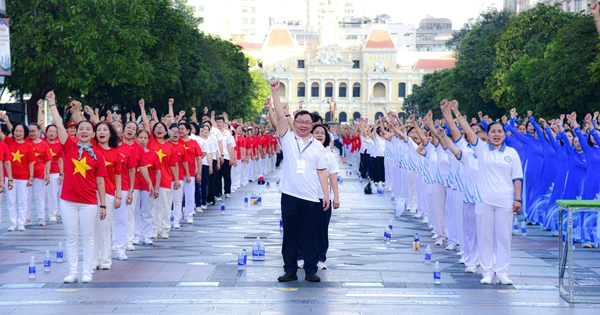

For the first time, a city-level rally was held on Nguyen Hue Pedestrian Street in Ho Chi Minh City to mark National Health Day and World Health Day (April 7), drawing more than 1,000 participants in a mass exercise performance. Photo: Tri Duc / Tuoi Tre
This approach has become a guiding principle for screening programs, bringing healthcare closer to people at the primary care level, with the goal of building a healthier Vietnam.
Routine screening
Due to financial hardship and her children working far from home, D.T.P., a 61-year-old resident of Trung My Tay Ward in Ho Chi Minh City had rarely been able to get a health check-up over many years.
At her age, she often experiences fatigue on exertion along with joint pain but she had never undergone a medical examination.
After receiving a free check-up, including in-depth cardiovascular screening, from doctors at the Ho Chi Minh City Heart Institute at a local health station on April 17, she was found to have heart abnormalities and was referred for further specialized testing.
N.T.T., a 62-year-old resident of Tang Nhon Phu Ward in the same city, who has spent years selling lottery tickets on the street, had grown accustomed to persistent knee, shoulder, and neck pain, along with occasional headaches and mild dizziness.
She considered these simply “ailments of old age” and endured them to keep earning a living.
It was only after attending a free screening program organized by the Tang Nhon Phu Ward health station that she was surprised to be diagnosed with hypertension and degenerative joint disease.
“Thanks to the screening program, I finally understand my health condition after years of neglect,” she said.
“This is very meaningful, giving low-income workers a chance to detect illness early and feel more secure.”
Dr. Pham Xuan Hai, deputy executive director of the Tang Nhon Phu Ward health station, said that many residents were unaware they had illnesses until undergoing check-ups, including tuberculosis and cancer.
During the city’s largest-ever free screening campaign on April 17, which was held across 168 health stations with support from 104 hospitals, nearly 30,000 residents were examined.
Results showed that 19,088 people, or 64.3 percent, had health issues, with many cases identified for the first time.
Of these, 10,634 require ongoing monitoring at local health stations, while 8,447 were referred for specialized care or further treatment.
Notably, non-communicable chronic diseases such as hypertension, diabetes, and cardiovascular conditions accounted for the highest share, with 16,175 cases.
More than 7,100 individuals require long-term monitoring, and nearly 5,000 need continued treatment.
Tackling disease at the root
Associate Professor Nguyen Hoai Nam, president of the Ho Chi Minh City Society of Phlebology, said that as living conditions improve, health should be treated as a top ‘asset.’
Large-scale health screening must be conducted scientifically and systematically, with clear planning, professional protocols, and expert oversight.
Inconsistent or superficial examinations could lead to inaccurate assessments of public health.
Alongside routine check-ups, he emphasized the importance of prevention through daily lifestyle choices.
This includes addressing digestive issues linked to unhealthy diets and increasing physical activity, as many Vietnamese remain relatively inactive.
Dr. Diep Bao Tuan, director of the Ho Chi Minh City Oncology Hospital, also said that screening and early detection are critical to effective treatment outcomes.
Numerous community health and free screening programs have been implemented, enabling people to take a more proactive role in regular health checks.
Detecting diseases early improves treatment outcomes while significantly reducing the burden on both the community and the healthcare system.
“I expect that from 2026, with policies from the national government and Ho Chi Minh City, every citizen will receive at least one annual health check-up, allowing early detection of many conditions, including cancer,” Dr. Tuan said.
Tang Chi Thuong, director of the Ho Chi Minh City Department of Health, noted that while the city’s healthcare sector has achieved significant progress in treatment, a system focused solely on treating illness will inevitably face overcrowding, high costs, and suboptimal outcomes.
Therefore, health check-ups, screening, and population health management have been identified as strategic priorities alongside medical treatment.
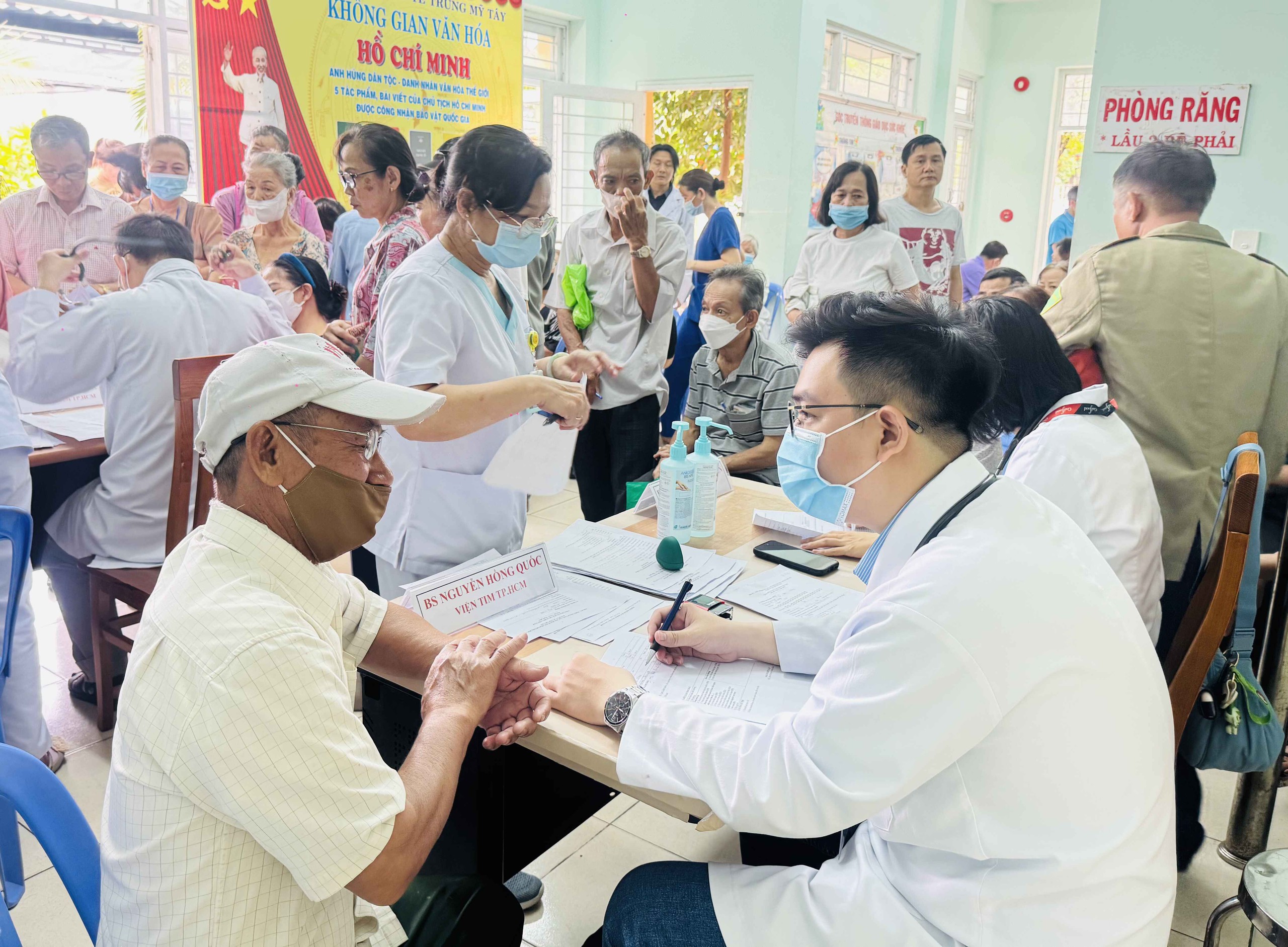
Residents in Ho Chi Minh City receive free health screenings. Photo: Xuan Mai / Tuoi Tre
Comprehensive, lifelong healthcare
Minister of Health Dao Hong Lan said Resolution 72 places people’s health at the center of healthcare policy and implementation, while also addressing long-standing structural bottlenecks in the sector.
The resolution outlines a shift from a treatment-focused model to comprehensive healthcare, emphasizing prevention and early, proactive care.
Health protection and improvement efforts will be closely linked to comprehensive, life-cycle-based health management.
To achieve this, the minister stressed the need to resolve systemic constraints, noting that institutional shortcomings have created obstacles in implementing healthcare tasks.
Future priorities include refining policies, improving mechanisms, and mobilizing and allocating resources more effectively.
A consistent approach will ensure coordination between the state and relevant stakeholders, while combining public and private resources and promoting the role of individuals in managing their own health.
The Ministry of Health will continue reviewing and improving regulations to ensure the effective implementation of the resolution.
Launch of the ‘For a Healthier Vietnam’ awareness program
To support awareness and implementation of Resolution 72, and in response to National Health Day (April 7), Tuoi Tre (Youth) newspaper, in coordination with the Ministry of Health and the Ho Chi Minh City Department of Health, has launched the ‘For a Healthier Vietnam’ awareness program.
The initiative aims to raise public awareness of proactive healthcare, proper nutrition, physical activity, healthy lifestyles, and the importance of regular check-ups and early screening.
Key activities include a dedicated media section, specialized conferences, the ‘10,000 Steps – Change Your Life’ event, a mobile health outreach program, and National Health Day events.
The program was officially introduced at a press conference and seminar on April 24 at Military Hospital 175 in Ho Chi Minh City.
Mobilizing social resources to improve community health
‘For a Healthier Vietnam’ also reflects the mission pursued by Long Chau pharmaceutical retail chain since its early days, expanding access to essential healthcare and contributing resources to national health programs.
The initiative aligns with broader efforts to improve community health, promote preventive care, and build a sustainable, people-centered healthcare system.
Collaboration between the Ministry of Health, the Ho Chi Minh City Department of Health, Tuoi Tre, and private healthcare companies is expected to strengthen public–private partnerships and mobilize social resources for wider impact.
With practical community activities and support from organizations, businesses, and medical experts, the program is meant to gradually shift public behavior from treatment-focused thinking to prevention, helping to reduce disease burden and ease pressure on the healthcare system.

A football tournament for Vietnamese workers and civil servants organized by Tuoi Tre (Youth) newspaper, the Vietnam General Confederation of Labor, and the Vietnam Football Federation. Photo: Quang Dinh / Tuoi Tre
Mobilizing public–private resources
According to Minister of Health Dao Hong Lan, the resolution introduces breakthrough solutions for mobilizing both public and private resources, while emphasizing the role and responsibility of citizens in healthcare implementation.
In addition to state resources, the focus will be on implementing a 10-year national target program with concrete measures to ensure effectiveness, alongside efficient use of other resources.
This includes managing and utilizing the health insurance fund toward universal coverage, leveraging private-sector healthcare personnel, and encouraging individuals to take greater responsibility for their own health.
“Reforming mechanisms and ensuring resources for healthcare in the coming period requires concrete solutions to mobilize all available resources,” the minister said.
“The consistent approach is to strengthen coordination, promote participation across sectors, and institutionalize clear, transparent policies for effective implementation.”