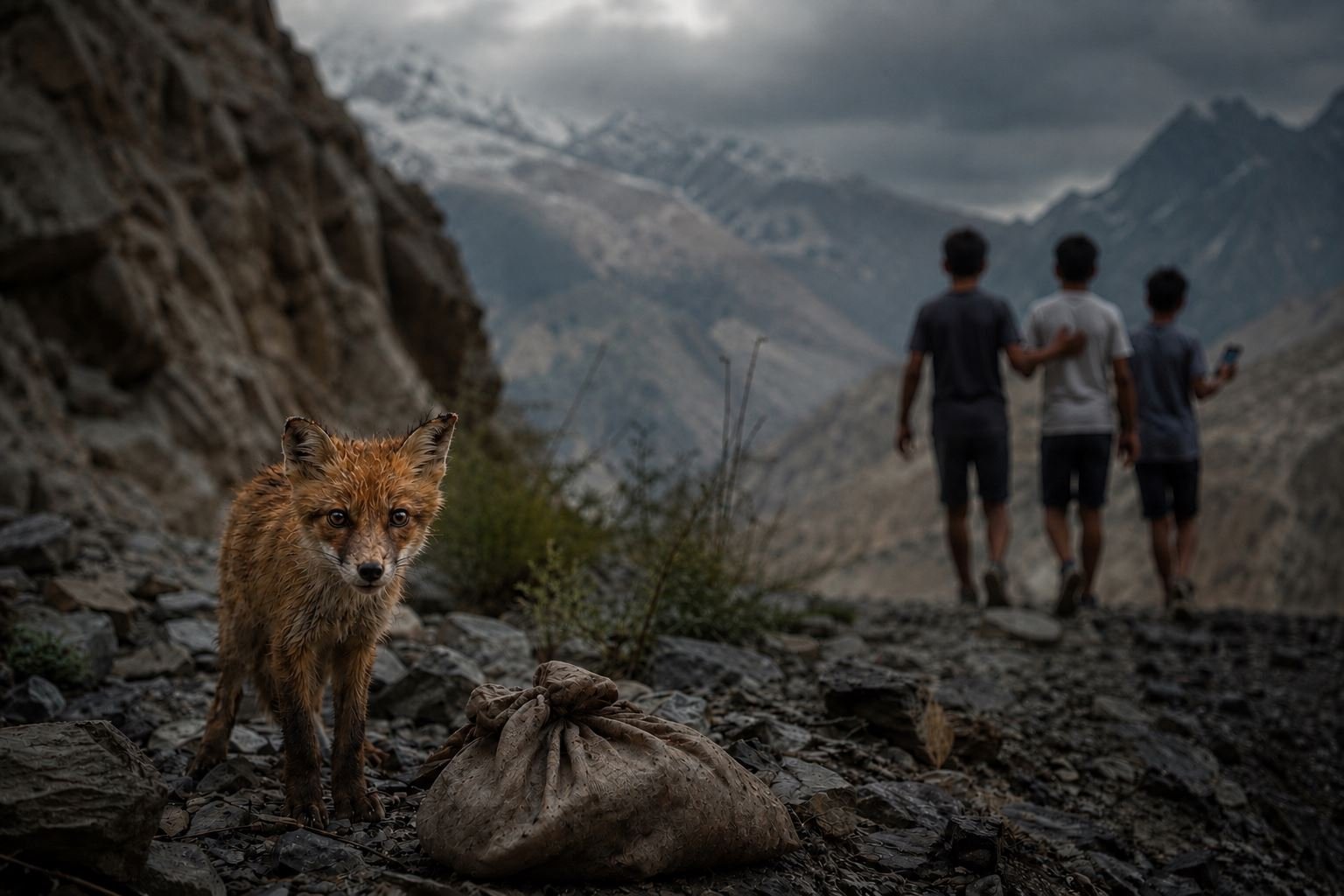
Video where three teenagers brutally abuse a little foxcaused a wide public outcry in Tajikistan. Law enforcement agencies and the Committee for Environmental Protection identified the participants.
What is known about what happened, what punishment faces those responsible, and why did this story turn out to be much more serious than it might seem at first glance?
As Asia-Plus was told by the Department of Internal Affairs of the Rasht region, the incident occurred on June 14 in the village of Kalanak in the Muchiharf jamoat of the Nurobod region. The teenagers abused the little fox, held him down, cut off his ears, filmed what was happening on video, and then published these recordings themselves on social networks.
After the videos caused a wide public outcry, employees of the Committee for Environmental Protection went to the site to clarify all the circumstances. Law enforcement agencies joined the investigation.
As a result, the identities of all participants in the incident were established. They turned out to be two 17-year-olds and one 14-year-old schoolboy from the Nurobod district.
Due to the fact that all three are minors, the editors are not publishing their full names. This is H. Yu. U., an 11th grade student from the village of Kalanak, S. Sh. S., an 11th grade student from the village of Dekhbaland, and N. M. K., a 9th grade student from the village of Kalanak. All three live in Muchiharf jamoat.
What did the teenagers themselves say?
During the investigation, they reported that they met the animal by chance. While grazing sheep, they left a bag of food unattended. A little fox climbed into it, ate part of the food and could not get out.
“According to them, at first they wanted to release the animal, but one of the teenagers, who was probably the leader in the company, suggested “punishing” him for spoiled products and filming it all live,” Abduvokhid Muminov, chief specialist of the Department of State Control of the Use and Protection of Flora and Fauna of the Committee for Environmental Protection, told Asia-Plus.
According to him, during the conversation the teenagers admitted that they had made a mistake, but what they were most worried about was that they had been subjected to public condemnation and now this story could affect their future.
“They recognize that this video will have a bad impact on their future. It’s the video, not the act itself,” he noted.
The official report of the Committee notes that, according to the teenagers themselves, they committed this act due to ignorance of the requirements of the law and lack of understanding of the consequences of such treatment of wild animals.
However, the videos they published speak for themselves. In the footage, teenagers laugh, film what is happening and, judging by their behavior and spoken words (the word “high” was said. – Ed.), they perceive causing pain to a defenseless animal as pleasant entertainment.

“We have never had such a case before”
The village of Kalanak is a small mountain village located next to wild animal habitats. Foxes are not uncommon here, as are other representatives of wild fauna.
“Residents say that there are a lot of animals in these places, but they have never had such a brutal incident,” says Abduvokhid Muminov.
Even before the arrival of the Committee staff and law enforcement agencies, the village residents already knew about what had happened. The teenagers’ act, he said, drew sharp condemnation from fellow villagers. When employees from various departments began to arrive in the village, this story became known to almost all residents of the area.
According to Muminov, the teenagers faced severe public condemnation; they were talked to not only by government officials, but also by the residents themselves, who condemned what happened.
The proceedings went far beyond the village
Employees of the Committee for Environmental Protection, together with law enforcement agencies, conducted preventive conversations not only with the participants in the incident, but also with other children in the village. They were explained that wild animals are protected by the state, and cruelty to them is unacceptable.
“Conversations like these are important. We have instructed local authorities, school management and the makhalla committee to continue this work with children and parents,” says Muminov.

According to him, after this incident, the Committee instructed all its territorial divisions to strengthen environmental education of the population, especially in mountainous areas and settlements located near forests and wild animal habitats.
Explanatory work is planned to be carried out not only in schools, but also in children’s camps, as well as through the media and social networks.
However, this story was not limited to the proceedings on the spot. To clarify the circumstances, as well as discuss measures to prevent such cases, the parents of teenagers, the school director, the chairman of the mahalla and representatives of other structures responsible for working with minors were called to the Ministry of Internal Affairs in Dushanbe.
What punishment do teenagers face?
According to the Ministry of Internal Affairs, protocols on administrative offenses have been drawn up against the parents under Article 90 of the Code of Administrative Offenses, which provides for liability for improper performance of duties in raising minors. The sanction of the article provides for a fine of 15 to 20 indicators for calculations (from 1170 to 1560 somoni).
At the same time, the Committee believes that the teenagers’ actions show signs of illegal removal of a wild animal from its natural habitat, causing harm to wildlife, cruelty to wild animals, as well as violation of the rules for the protection and use of wildlife.

In this regard, the environmental agency proposed to apply Article 277 of the Code of Administrative Offenses (“Cruelty to Animals”). The maximum penalty under this article provides for a fine of 780 somoni.
“We proposed to apply this article when considering the case. Now all materials and protocols are being reviewed by the internal affairs bodies of the Nurobodsky district under the control of the leadership of the Ministry of Internal Affairs. After the verification is completed, they will be sent to the court, which will make the final decision. The committee will separately report on the measures taken,” Abduvokhid Muminov told Asia-Plus.
He also said that monetary damages to the state were not calculated in this case. This assessment is applied in the event of the death of a wild animal. After the abuse, the teenagers released the fox cub back into the wild. They also filmed this moment. A Committee employee saw this recording on the phone of one of the teenagers during an inspection.
The Ministry of Internal Affairs also invited a specialist responsible for maintaining the Red Book. It was found that this species of fox is not listed in the Red Book of Tajikistan.
“Foxes are considered free wild animals and live throughout the republic. According to the Constitution, all wild animals are the property of the state and are under its protection,” Muminov emphasized.
However, just because an animal did not die on the spot does not mean it will be able to survive.
According to experts, even partial cutting off of the ears is a serious injury for a wild animal. In addition to severe pain and risk of infection, such injuries can impair hearing and the ability to navigate the environment. In addition, the ears are involved in thermoregulation of the body. Without veterinary care, such injuries significantly reduce the animal’s chances of survival in the wild.
This is no longer just a story about one little fox
A brutal video filmed in a small mountain village showed that today such stories no longer remain local. In just a few days, the footage spread far beyond the borders of Tajikistan, causing widespread public outcry.

Such cases inevitably affect the perception of the country outside its borders and damage its reputation, including tourism. For many foreigners, such stories become one of the first sources of ideas about the state, society and people’s relationship to nature.
It is obvious that fines and preventive conversations alone will not solve the problem. Systematic work is needed to develop a caring attitude towards animals, environmental education of children and adolescents, as well as tougher responsibility for cruelty to animals, up to the introduction of criminal liability for the most cruel cases.