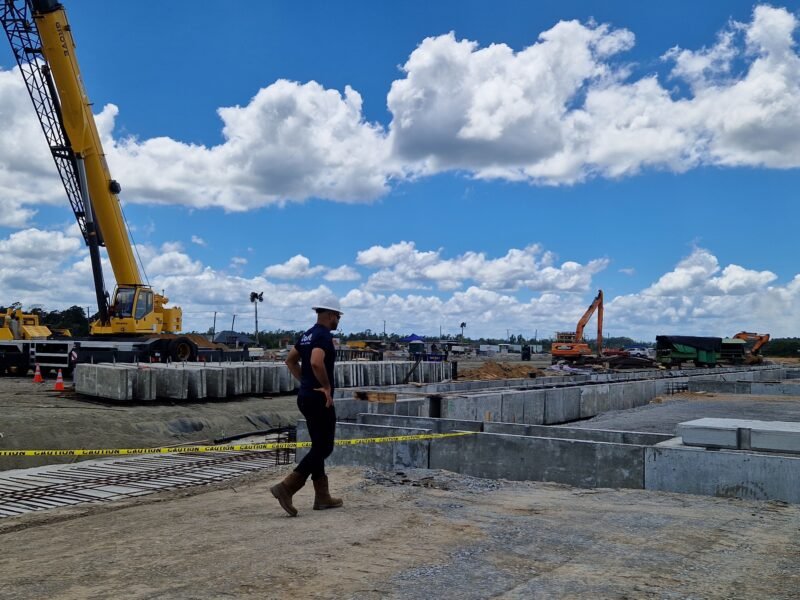
Under a blazing sun, heavy machines drive back and forth on the former Plantage Dordrecht near Lust en Rust. Large cranes and other construction equipment now determine the landscape where banana trees still stood about three years ago. We are working day and night to complete the first phase of the Marine Support Base. The final concrete and asphalting works are in full swing. The initiators, Baitali Group of Companies and FIRM Engineering, want to have the port ready for the first operational activities by the end of November 2026. Several local companies have cooperated to guarantee the construction of the Marine Support Base.
Text and image Sharon Singh
The plan for the development of the port was in place about six years ago. The design of the Marine Support Base and the broader development plan were explained during a tour and Power Point presentation to the media representatives. The project is being implemented by the DORDT Gateway joint venture, in which Baitali Group and FIRM Engineering work together.
“This not only gives the port a supporting role for the offshore industry, but it can also attract new economic activities to the country.”
The name DORDT refers to the former Dordrecht plantation, where the Marine Support Base is being constructed. According to the initiators, the site of approximately 240 hectares offers ample opportunities for further development. “The choice for Dordrecht was made consciously. Its location close to the mouth of the river makes it possible to offer ships that support offshore activities direct access to the port, without having to sail past the busy center of Paramaribo, along the Goslar and under the bridge,” says Guido Koorndijk, director of FIRM Engineering.
Phased development
The final design of the Marine Support Base provides mooring facilities for five ships and the construction of a fuel terminal. However, development is taking place in phases. In the first phase, facilities will be created for two ships, with a quay of 214 meters. The remaining space remains available for expansion.
To provide access to larger supply ships, the channel has been dredged to a depth of eight meters. At the site, the natural water depth at low tide was approximately four meters. The harbor deck is equipped for heavy lifting work. A crane with a capacity of 500 tons is also expected from January 2027. This allows the port to process the heaviest parts required for offshore activities.
The first user of the port has now been announced. Saipem and Medserv, contractors to TotalEnergies, will start mobilizing for the GranMorgu project from December. The company will use the facilities for the next three years for large-scale preparation, manufacturing and assembly work subseaelements. These parts, which can weigh up to 150 tons, are prepared on site and then transported by ship to the offshore installations.
According to Koorndijk, it is precisely this capacity that has ensured that these activities have been brought to Suriname that would otherwise take place abroad, such as Trinidad. This not only gives the port a supporting function for the offshore industry, but it can also attract new economic activities to the country.
Basis for sustainable development
Koorndijk says that the development of the Marine Support Base must be placed in a broader perspective. With the expected growth of the offshore oil and gas sector from 2028, the Surinamese economy will change dramatically. He emphasizes that it is important to prepare the country for that development in a timely manner. Offshore oil is going to seriously transform our country and our economy.
“About one hundred and ninety people work there, all Surinamese, of whom forty to fifty come from the area surrounding the port.”
From 2028 onwards, a gigantic jump in gross domestic product will be noticeable. The impact of this will be great. “We all have to prepare for that.” For the initiators, the emphasis is on critical infrastructure and spatial planning. Not only the ports, but also roads, logistics facilities and other facilities must grow along with economic activities to keep the country pleasant, healthy and liveable.
Koorndijk states that economic growth should not be solely dependent on tax revenues coming in through the government. He advocates that Surinamese companies should be directly involved in offshore activities as much as possible, so that local entrepreneurs can also grow and more qualified jobs are created for Surinamese. “Ultimately, it is about sustainable prosperity. The question is not only what oil and gas will directly yield, but especially how we can convert that into sustainable prosperity for Suriname.”
Koorndijk also mentioned the increasing traffic in Paramaribo and Wanica and points out that the existing infrastructure is not sufficiently prepared for the growth expected in the coming years. He therefore advocates broader spatial planning, in which industrial areas and residential areas are carefully separated and at the same time sufficient space is reserved for roads, green areas and recreation.
Commewijne as a development area
Commewijne can play an important role in that vision. The district offers opportunities to plan new industrial activities and residential areas in such a way that the problems of uncontrolled growth that Paramaribo is now experiencing do not repeat themselves. In fact, proper development can have a positive effect on the infrastructure and quality of life in Paramaribo and Wanica.
An important part of that vision is the improvement of the connections between Commewijne, Paramaribo, Para and Wanica. Koorndijk pointed out, among other things, a bridge beyond Paranam (Rac-a Rac), which was built in 2006 in the context of opening up the then bauxite mines, but is currently not used because the necessary road connection is lacking. By realizing this connection, an additional route between the districts could be created.
In the longer term, he even foresees two additional bridge connections to accommodate the expected growth. Not all of these need to be built in the short term, but the government should already determine where they will be located. This way, the necessary routes can be secured in a timely manner.
The Marine Support Base near Lust en Rust fits within this broader development vision. The initiators see the port as a strategic facility that should not only support the offshore industry, but can also contribute to a better spread of economic activities across the country.
Employment
The project also provides employment during the construction phase. About one hundred and ninety people work there, all Surinamese, of whom forty to fifty come from the area around the port. Even more jobs are expected in the operational phase, at different job levels.
Koorndijk therefore sees the port as a gateway for further activity. The aim is that not only international oil and gas companies benefit from the facilities, but that Surinamese companies also have the opportunity to provide services and work for the offshore sector. With the approaching completion of the first phase, the former Lust en Rust plantation is preparing for a new destination.