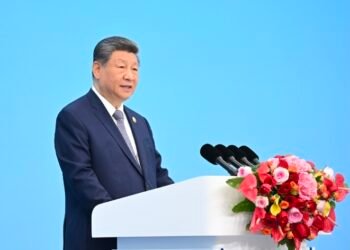
The eyes of the global business community are on Shenzhen this week, where the leaders of 21 economies from the Asia-Pacific region are meeting for the annual Apec summit. Expectations are high. Global trade is under pressure, economic rivalry between China and the United States continues and companies are seeking certainty about their investments. In Shenzhen it will become clear how much room there is left for economic cooperation between countries that are increasingly pitted against each other.
Text Ivan Cairo
Image Xinhua & Andy Chong
The choice of Shenzhen as a host city is significant. More than forty years ago it was still a relatively small city on the border with Hong Kong. Shenzhen is now one of the most important technology and production centers in the world. Major Chinese companies have their headquarters there and the city plays an important role in the development of electric vehicles, telecommunications, artificial intelligence and advanced electronics.
“Shenzhen will mainly have to demonstrate whether countries that seem to be growing further apart politically still have sufficient economic interests in common to make progress together”
For Chinese President Xi Jinping, Shenzhen is the ideal backdrop to present his country’s economic performance. China wants to show that, despite trade tensions with Washington and the cooling of its own economy, it remains an important driver of international trade. This means that more is at stake for Beijing than the successful conduct of an international conference. China wants to convince other countries that closer economic cooperation with the world’s second-largest economy has benefits.
Economic weight
The 21 economies that make up the Asia-Pacific Economic Cooperation (Apec) together represent about 60 percent of global economic output and almost half of world trade. Decisions made in this region can therefore have consequences for prices, investments and employment far beyond Asia.
The meeting also comes at a time when the global economy is facing great uncertainties. US tariffs, Chinese export restrictions and rising geopolitical tensions are forcing companies to reassess their international operations.
The relationship between China and the United States is particularly decisive. Both countries are important trading partners, but are increasingly competing for technological and economic influence. Washington is trying to limit China’s access to certain high technologies, while Beijing wants to reduce its dependence on foreign suppliers.
This development affects international production chains. A smartphone can be designed in the United States, contain parts from various Asian countries, and ultimately assembled in China. When trade restrictions make the supply of one part difficult, it can affect production and sales on other continents. The Apec summit provides an opportunity to limit the economic damage of such tensions. But observers do not expect a complete resolution of the trade disputes.
What do the Chinese want?
The Chinese government has identified three priorities for its Apec presidency: openness, innovation and cooperation. Beijing wants to promote agreements on digital trade, artificial intelligence, cross-border data flows and better connections between economies, among other things.
The Chinese Ministry of Foreign Affairs says it is working on a joint statement by government leaders. Concrete results must also be achieved in areas that are important for international business. This includes, for example, simpler customs procedures, digital trade documents and better coordination of technical regulations.
Such measures may not seem spectacular, but they can save companies significant amounts of money. Smaller companies in particular have an interest in this. They generally do not have money and specialized departments with which multinationals can deal with complex trade rules.
Chinese professor Han Yonghui of Guangdong University of Foreign Studies emphasized opposite Channel NewsAsia that companies especially need clarity about the implementation of new agreements. They want to know when measures will come into effect and which costs will actually disappear. There also lies an important benchmark for Shenzhen’s success. The economic value of the summit will ultimately have to be reflected in the agreements that countries actually implement.
Foreign companies critical
Not everyone is convinced of China’s message of economic openness. Foreign companies have long complained about restrictions on access to the Chinese market and benefits enjoyed by domestic companies.
“China wants to convince other countries of the benefits of closer economic cooperation with the world’s second-largest economy”
Allan von Mehren, chief China analyst at Danske Bank, points out this contradiction. China presents Shenzhen as an example of international economic cooperation, while in practice foreign companies still face obstacles.
This is a real problem for international investors. They want certainty that they can operate under predictable conditions and that political tensions will not suddenly jeopardize their investments.
Interest is therefore also focused on possible agreements between Xi Jinping and American President Donald Trump. Even a limited easing of trade tensions can boost business confidence. That could support investments and international trade flows, according to analysts.
Technology as economic input
Artificial Intelligence (AI) will receive special attention during the summit. Its development requires enormous investments in chips, data centers, energy supply and digital infrastructure. China and the United States both want to gain a leading position in this sector. This raises the question for other Apec countries of how they can benefit from technological progress without becoming completely dependent on one major power.
The economic consequences can be significant. AI can increase productivity, speed up industrial processes and enable new services. At the same time, countries that do not invest enough in digital infrastructure risk falling further behind.
These developments are also relevant for developing countries outside the Apec region, including Suriname. New trade rules, technological standards and changes in international production chains can ultimately affect the costs of imported goods and the ability to attract foreign investment.
The world is watching
The announced meeting between Xi, Trump and Russian President Vladimir Putin will undoubtedly attract a lot of international attention. Major diplomatic breakthroughs are not yet expected. However, a signal that further escalation is avoided could also be significant for the financial markets.
Apec is not an organization that can impose binding trade agreements on its members. The agreements are largely based on voluntary cooperation. As a result, the summit is unlikely to trigger an immediate turnaround in the global economy.
Yet the economic stakes are high. The Asia-Pacific region is an important hub of international trade, manufacturing and technological development. If the largest economies in this region improve their mutual cooperation, it can strengthen confidence in the global economy.
Shenzhen will mainly have to demonstrate whether countries that appear to be growing further apart politically still have sufficient economic interests in common to make progress together. For the international business community, the answer to that question is more important than the usual group photo of government leaders.