PARAMARIBO — The further strengthening of the legal framework to combat money laundering and terrorist financing requires an energetic and coordinated approach. Not only the timely implementation of the necessary legislation is important, but also the coherence between the legal regulations and their practical feasibility.
Against this background, the faction leaders in the National Assembly (DNA) and the chairmen of the Committees of Rapporteurs on the AML (anti-money laundering) draft laws held consultations with representatives of Namlac, chaired by Manisha Japhsie.
“The joint effort is aimed at achieving the necessary legislation and associated implementation measures in a timely manner, so that Suriname can submit a request for reassessment in 2027.”
During the meeting, the Focal Point AML, Deputy Registrar at DNA, Naresh Algoe, gave a presentation on the current state of affairs of the legislative process. The steps already taken by DNA to speed up the parliamentary consideration of the relevant draft laws and to continue them in a targeted and efficient manner were discussed. The consultation was aimed at mutual information exchange, identifying remaining bottlenecks and establishing concrete agreements on the further treatment of the AML legislation.
An important point of discussion was the fourth Follow-Up Report (FUR) of the Caribbean Financial Action Task Force (CFATF), which evaluates Suriname’s progress in implementing international recommendations to combat money laundering and terrorist financing. Namlac explained that Suriname has not submitted a request for re-rating with the submission of this report. The fourth FUR therefore has an informative character and is intended to provide insight into the progress made.
During the consultation, the coherence between the draft laws already pending at DNA and the legal regulations yet to be submitted was also emphasized. The parties emphasized that a fragmented treatment would not do sufficient justice to the interdependence of the various legal provisions. An integrated approach is necessary to actually eliminate identified shortcomings and prevent new gaps or inconsistencies from arising in the legal framework.
Namlac has further explained which areas are still lacking legal provisions and implementation measures. Attention was therefore not exclusively focused on the formal adoption of the draft laws, but also on the question of whether the regulations to be adopted meet the applicable international criteria and can be implemented effectively in practice. This requires that the necessary implementation regulations are also prepared in a timely manner and are viewed in conjunction with the relevant laws.
To ensure the legal quality and international conformity of the legislation, it has been agreed that Namlac will provide DNA with technical support, if requested, in the assessment of proposed changes or additions. It is important that changes are carefully assessed during the parliamentary process against the applicable international recommendations and criteria. DNA will in turn inform Namlac in a timely manner about the progress of the treatment, so that any points of interest can be identified and discussed in a timely manner.
To promote structural cooperation, DNA and Namlac have agreed to hold periodic consultations on the progress of the legislative process. A joint timeline will also be used for the completion of the remaining statutory provisions and the elimination of the identified shortcomings. The joint effort is aimed at achieving the necessary legislation and associated implementation measures in a timely manner, so that Suriname can submit a request for reassessment in 2027.
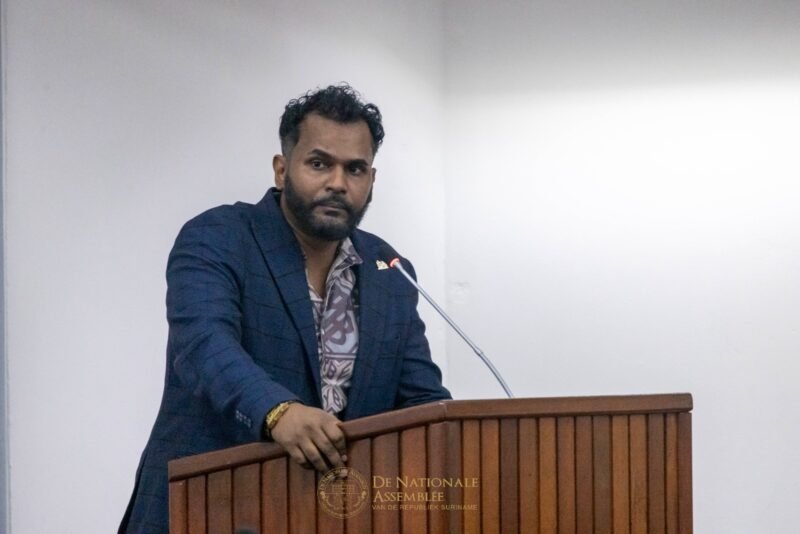
Party leaders Rabin Parmessar (NDP), Asiskumar Gajadien (VHP) and Steven Reyme (A20) participated in the consultation. On behalf of the aforementioned Committees of Rapporteurs, the members Rossellie Cotino (NDP), Ebu Jones (NDP), Ingrid Bouterse-Waldring (NDP), Jennifer Vreedzaam (NDP), Cheryl Dijksteel (VHP), Chuanrui Wang (VHP), Kishan Ramsukul (VHP) and Dorothy Hoever (NPS) were present.