Comparing the Surinamese rice sector with the upcoming oiltree is the same as that of apples and oranges. In the entire rice chain – even if it were healthy – the annual amount involved is at most several tens of millions of US dollars. In the oil business there is talk of tens of billions from 2028. Yet these two sectors cannot and should not be seen separately. While people hallucinate about petrodollars in the ivory towers in Paramaribo, the rice backbone is dying a silent death.
Text Armand Snijders
Image CDS
It goes without saying that things have not been going well for the Surinamese rice sector for decades. For this, the finger can be pointed at successive governments, which have collectively neglected the sector. Rice farmers, paddy buyers and exporters are also to blame. In the meantime, everyone is pointing fingers at each other about why Suriname is now in the current miserable situation, but no one is really doing anything to turn the tide for the better. Listen to each other and look for solutions together. Doesn’t it occur to anyone at all? The (personal) interests of the political parties are too great for that.
“Even a few sopropos cannot be sold in Europe because there are many things wrong with them, so the chance that containers full of rice can sail across the ocean without any problems is very unlikely”
‘Regional export hub’
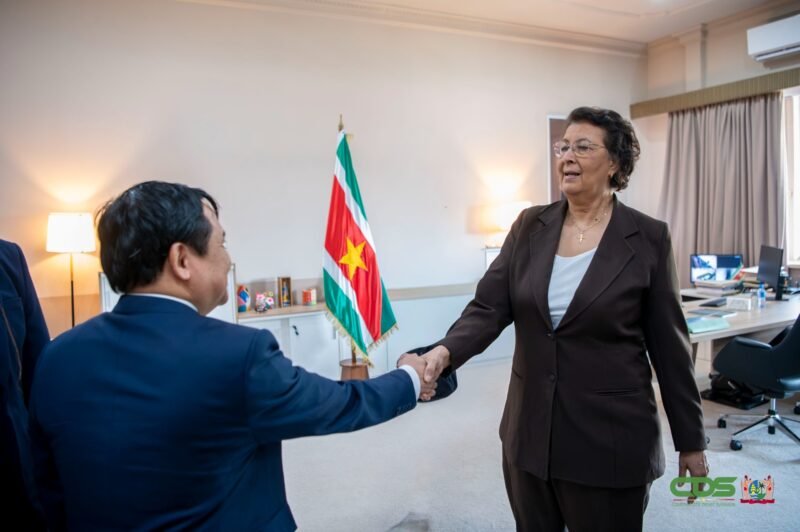
However, there is no shortage of interest from abroad. Last year, the Ministry of Agriculture, Livestock and Fisheries received a helping hand from, among others, Morocco, Pakistan and recently Vietnam. The non-resident ambassador Bùi Văn Nghị of Vietnam even paid a farewell visit to President Jennifer Geerlings-Simons and solemnly promised that Vietnam will help Suriname become a ‘regional export hub’ for rice. But how serious is this really? What does this benefit the hardworking rice farmer in Nickerie? The down-to-earth answer is: very little, especially as long as your own house is a crumbling ruin.
The diplomatic trial balloons can be punctured one by one. Take Morocco for example. The so-called ‘export opportunities’ for Surinamese highland rice to North Africa really do not lie in feeding the ordinary Moroccan. He traditionally gets his rice from somewhere else, Suriname doesn’t need it at all.
Rigorous international requirements
Without the ratification of the economic partnership agreement and compliance with stringent international requirements, not a grain of Surinamese rice will enter the port of Tangier. Even a few sopropos cannot be sold in Europe because there are many things wrong with them, so the chance that containers full of rice can sail across the ocean without any problems is very unlikely. That’s sad, but true.
Then Pakistan. Exporting rice to Islamabad is, all things considered, completely economically insane; Pakistan itself is one of the largest rice exporters in the world. The only theoretical gain would lie in knowledge transfer. For example, if the Anne van Dijk Rice Research Center Nickerie (Adron), which a long time ago could proudly be considered the knowledge center of the world, once developed its own aromatic long grain – a kind of basmati – could develop, Suriname could storm the Caricom market.
Not a reliable partner
But that requires joint ventures and they require a reliable partner. And the Surinamese government has not been that way for decades. To be a serious player for foreign trading groups, constant volumes and a competitive price must be delivered.
Suriname currently has more than fifty thousand hectares of suitable land for rice cultivation. With two seasons per year, one hundred thousand hectares could theoretically be sown. But in practice, the country has been hovering at a sad low point for years. In 2022, annual sowing dropped to 48,960 hectares, but it has only decreased since then. Now people are happy if 25,000 hectares are sown.
High priority
The export value of Surinamese rice has fluctuated between eight and thirty million US dollars per year for years. And the future does not look bright. President Simons said last weekend in the program ‘Kal Aaj Aur Kal’ Rapar Broadcasting Network that the rice sector is given a “high priority” by the government. However, very few people believe in this, also because – as is so often the case – she has not developed a concrete plan for how she intends to do this.
“A country that allows its own farmers to die while floating on a pool of oil is morally and economically bankrupt”
The small rice farmers in Nickerie now fear for their livelihood. Rising production costs, broken infrastructure, drying irrigation canals and defective pumping stations are forcing them to their knees. Anyone who once sowed a hundred hectares fell back to eighty, then fifty, and now is forced to sow nothing at all. They take up government jobs or switch to poultry farming.
Supreme peelers
In addition – because Adron is failing – farmers are now dependent on inferior varieties from Guyana. The farmers also have no influence on the price paid by the all-powerful peelers/buyers. If successive governments had structurally invested in agriculture over the past thirty years – and the rice sector in particular – Suriname would be in a fundamentally better position today.
A healthy agricultural sector would have ensured constant foreign exchange, a stable SRD exchange rate and a broad job engine that could have cushioned the economic blows of 2015 and 2020. In fact, society would have slept much more peacefully if the rice sector had remained healthy and had made significant contributions to the government coffers year after year.
The Dutch disease
Does this mean that Suriname does not actually need the oil? It would be terribly naive to think that. From a macroeconomic perspective, the scale of income from block 58 is unprecedented and in many ways a huge boon for Suriname. Let there be no doubt about that. While the rice sector has the potential to generate tens of millions of US dollars, oil will contribute billions of US dollars to the state treasury from 2028.
These billions are initially desperately needed to accelerate the payment of the astronomical national debt and to finance national infrastructure. However, there is also a crucial lesson for the future of Suriname. Because at the same time the country is in danger of rapidly heading towards… Dutch disease – the Dutch disease – where one dominant sector (in this case oil) stifles all other economic activities and artificially drives up the exchange rate, making local production even more unaffordable.
The petrodollars must therefore not disappear into consumer parties, shiny parade projects or the pockets of the political elite in Paramaribo. They should be used directly to revive sectors such as the rice sector. Not because Suriname has to sell rice to Pakistan, Morocco or Vietnam, but because a country that lets its own farmers die while floating on a pool of oil is morally and economically bankrupt.