President Jennifer Simons does not want to sacrifice primary rainforest for large-scale agriculture. Entrepreneur Ruud Souverein believes that Suriname can dedicate a small part of its forest area to agriculture without losing its position as the most forested country in the world. Behind the clash between agricultural ambitions and forest conservation, a second question arises: how reliable are government agreements when a new government chooses a different course, whether or not under pressure from society?
Text Ivan Cairo
Image dWT archive
The president’s message is clear. In the radio program Well-Informed Circles she stated on October 4: “The point is in fact that the primary Amazon rainforest is not cut down for large-scale agriculture. I am against that.”
“The president does not oppose agricultural development and pointed to opportunities in Saramacca, among others, where agriculture can be expanded without destroying intact rainforest”
The president is not opposed to agricultural development as such and pointed to opportunities in Saramacca, among others, where agriculture can be expanded without destroying intact rainforest. “If there are people who want to help plant that, I have no objection,” she said. But according to Souverein, there are all kinds of problems with areas in the coastal plain, which means they are not real options.
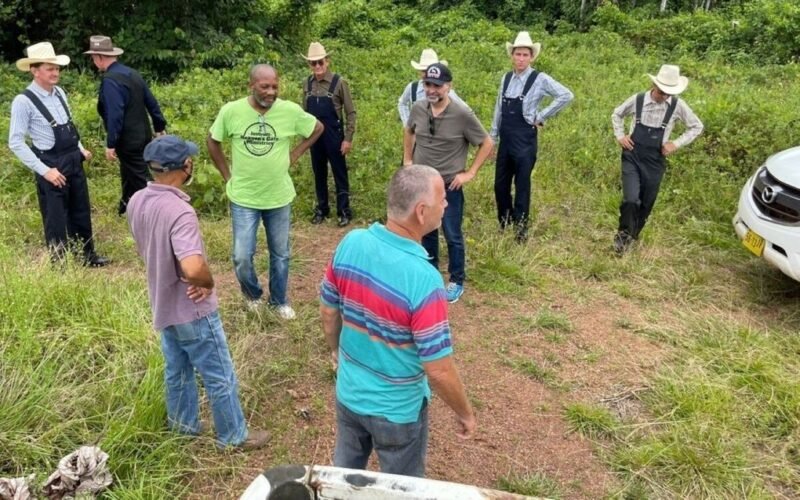
The president’s objection mainly concerns the preference of conservative Mennonite farmers who are attracted to settle in secluded areas in forest areas. “I’m really going to fight that,” Simons announced.
These statements go to the heart of a conflict that arose under the previous government. Entrepreneurs saw the arrival of Mennonite farmers as an opportunity to develop Suriname into a larger agricultural producer. Environmental organizations warned against large-scale exploitation in a country whose exceptionally high forest cover has international significance.
Calculation of Sovereign
Ruud Souverein, one of the driving forces behind Braganza Marketing Group’s agricultural plans, does not consider large-scale agriculture and forest conservation as incompatible objectives. Braganza states that on January 13 this year, three agreements were concluded with the Ministry of Agriculture, Livestock and Fisheries (LVV) for agricultural projects along the Road to West Suriname. This concerns 34,185 hectares, for which the company says it has obtained a twenty-year right of use with the option of extension.
Soverein argues that this area represents only about 0.2 percent of Suriname’s forest area. According to him, the country can develop agriculture without losing its exceptionally forested character.
Braganza presents strong economic prospects: annual production worth US$78 million and an estimated tax payment of US$13 million once the projects are fully operational.
The percentages raise another question. Even if the loss of several tens of thousands of hectares is barely visible in the national forest percentage, the local ecological damage can be significant. Primary forest fulfills biodiversity, carbon storage and water management functions that cannot be easily restored. It is therefore not just about how much forest disappears, but especially which forest, where and with what consequences.
Hundreds of families in the picture
Braganza says he is working with Mennonite agricultural groups from Belize and Mexico. According to Souverein, they are represented by three Surinamese companies: Agriculture The Crown, Agriculture New Start and New Mexico Agriculture.
According to his calculations, the projects offer space for approximately 340 families, assuming one hundred hectares per family. The joint investments are estimated at approximately US$22 million.
Braganza director Lionel Blokland has emphasized that the land will not be sold to Mennonites. The foreign partners would contribute agricultural knowledge, capital and labor, while Braganza is responsible for the organization and management.
The company also states that the intended project areas are not on indigenous or tribal lands. According to Braganza, cooperation agreements exist with communities in Witagron, Apoera, Witagron, Section and Washabo, among others. The Matawai grand chief says his tribe has no agreement or cooperation with Braganza to implement agricultural plans in his tribe’s habitat.
“At the beginning of this week, the Prague Subdistrict Court ruled that the Ministry of Justice and Security acted unlawfully with the deportation.”
Sovereign’s claims do not eliminate the need for independent investigation. To determine whether the plans are compatible with the government’s forest policy, the plot boundaries, existing forest types and required environmental permits must be verifiable.
Agreement is not a land title
LVV Minister Mike Noersalim has stated that his ministry has not found a separate agreement with the Mennonites, but has found agreements with a Surinamese company on agricultural development. He made an important legal distinction: LVV can make agreements about agricultural activities, but the formal issuance of domain land falls under the authority of the Ministry of Land Policy and Forest Management.
In addition, environmental studies, permits and compliance with immigration legislation remain required. An agreement on agricultural development does not automatically give the right to cut down forests, take possession of land or allow foreign workers to work without permits. That distinction turned out to be decisive at the end of October in the lawsuit that revolved around the expulsion of a number of Mennonites.
Second project
In addition to Braganza, Suriname Green Energy Agriculture (SGE) developed its own agricultural plans. The company states that under the Santokhi government it entered into a public-private partnership agreement with the State for agricultural development and the production of, among other things, biofuel.
The project involved more than 113,000 hectares. SGE brought Mennonite families from Bolivia and Mexico to Suriname. When the authorities took action against their stay, the company relied on agreements with the previous government and investments already made.
On October 29, subdistrict court judge Deborah Haakmat-Sniphout rejected SGE’s claim. The judge ruled that the economic interest of the company does not outweigh the obligation of the State to enforce the immigration law. The cooperation agreement did not provide an unconditional guarantee on residence and work permits.
“An agreement on agricultural development does not automatically give the right to cut down forests, take possession of land or allow foreign workers to work without permits”
Deported before judge decides
The legal battle had a remarkable sequel. While judge Robert Praag was handling the second summary proceedings on the deportation, it turned out that 57 of the 63 Mennonites had already left Suriname. The last six, three women with a baby each, were also deported a few days later.
At the beginning of this week, the Prague Subdistrict Court ruled that the Ministry of Justice and Security acted unlawfully with the deportation. It should have waited until a review request to the president on behalf of the Mennonites had been processed. This issue may still have a financial tail.
Promise that requires choices
The Mennonite issue has made two issues visible. The first concerns legal certainty: what expectations can a company derive from agreements with the government, and how are the rights of foreigners who rely on them protected?
The second is about Suriname’s development direction. Soverein believes that a limited part of the forest area can be used for large-scale agriculture.
President Simons draws the line at cutting down primary rainforest.
Both positions require concrete answers. Where are the intended agricultural areas located? How much of it consists of primary forest, secondary forest or already developed land? What do the projects actually deliver, and what are the associated ecological costs?
The expulsion of the Mennonites did not automatically end the agricultural plans. Nor have the judges ruled on the desirability of large-scale agriculture in the Surinamese forest.
Ultimately, Suriname’s position as the most forested country in the world is not only determined by a percentage on paper. The quality and ecological significance of the forests also count.
The essential question is therefore not how much forest Suriname can lose without losing its international ranking, but how much valuable forest it is prepared to retain when economic interests demand space.