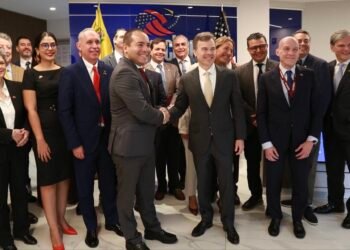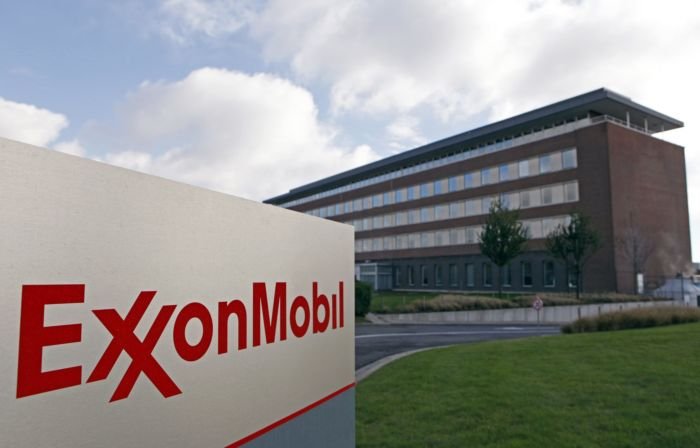
American oil companies ExxonMobil and ConocoPhillips have sent teams of executives and technicians to Venezuela in order to evaluate the possibility of establishing new alliances in the oil sector, after having initially rejected President Donald Trump’s invitation to participate in the recovery of the national industry.
According to information published by The Wall Street Journal this Friday, both companies are exploring business opportunities so as not to be left out of an eventual rebound in the sector in the country. However, companies are cautiously analyzing the risks involved in a possible return, given the expropriations suffered in the past and the prolonged international litigation that resulted from them.
ExxonMobil maintains a strong commitment to Guyana, a country in conflict with Venezuela over the dispute over the Essequibo territory, where since 2015 it has discovered more than 30 fields and increased its production to exceed 900,000 barrels per day in 2025. The company plans to reach 1.2 million barrels per day by 2027, which makes Guyana the country with the greatest oil growth in the world.
Despite the interest, significant concerns remain about legal guarantees for investments and political and institutional uncertainty in Venezuela, especially following the events of January 3.
Several companies in the hydrocarbon sector, both large and small, have sent representatives to the country to meet with local authorities and consultants and evaluate various oil and gas projects.
The historical conflict with American oil companies
In 2007, Hugo Chávez’s government nationalized ExxonMobil’s Cerro Negro project and other assets of foreign companies. The measure forced the company to leave the country and led to lengthy international litigation in which ExxonMobil claimed million-dollar compensation.
In early 2025, an ICSID (World Bank International Center for Settlement of Investment Disputes) tribunal overturned an earlier decision and ruled in favor of Venezuela in a $1.4 billion dispute, although the case remains legally complex.
For its part, ConocoPhillips also left Venezuela in 2007 after the expropriation of its assets. The company maintains a pending claim close to 12,000 million dollars, of which it has only recovered a part.
As part of its collection strategy, ConocoPhillips has taken control of PDVSA assets in Bonaire and Saint Eustatius.
ConocoPhillips executives have reiterated on several occasions that they will not give up their financial claims against Venezuela. Analysts consider that any return of these companies to the Venezuelan oil business will require complex negotiations to first resolve pending claims, before signing new contracts.
ExxonMobil’s optimistic statements
This Friday, the CEO of ExxonMobil, Darren Woods, was optimistic about the investment possibilities in Venezuela. During a conference with investors, he described the country as “an immense resource that is now open more freely to the world.”
Woods positively valued the collaboration between the government of Donald Trump, the current Venezuelan interim government and the oil industry to create a framework that attracts investments. In addition, he highlighted that ExxonMobil is in a unique position to process Venezuelan heavy crude oil, thanks to the development of technologies that allow it to be done at a lower cost.
“I feel optimistic about what is happening and about the opportunity that exists there. There is a lot of work to do, but I think we are going to play an important role in bringing those barrels to the market,” said the executive.
These statements come weeks after it was learned that ExxonMobil sent a technical team to Venezuela to evaluate a possible return, as reported by Bloomberg.
Venezuela has the largest proven crude oil reserves in the world, with 303 billion barrels, equivalent to 17% of the global total.
With information from WSJ and Bloomberg