Since the end of the Second World War, the Piatti family’s porcelain collection has been in ruins. A research project by Angewandte is now putting restoration methods in dialogue with contemporary art – on display in an exhibition at Loosdorf Castle.
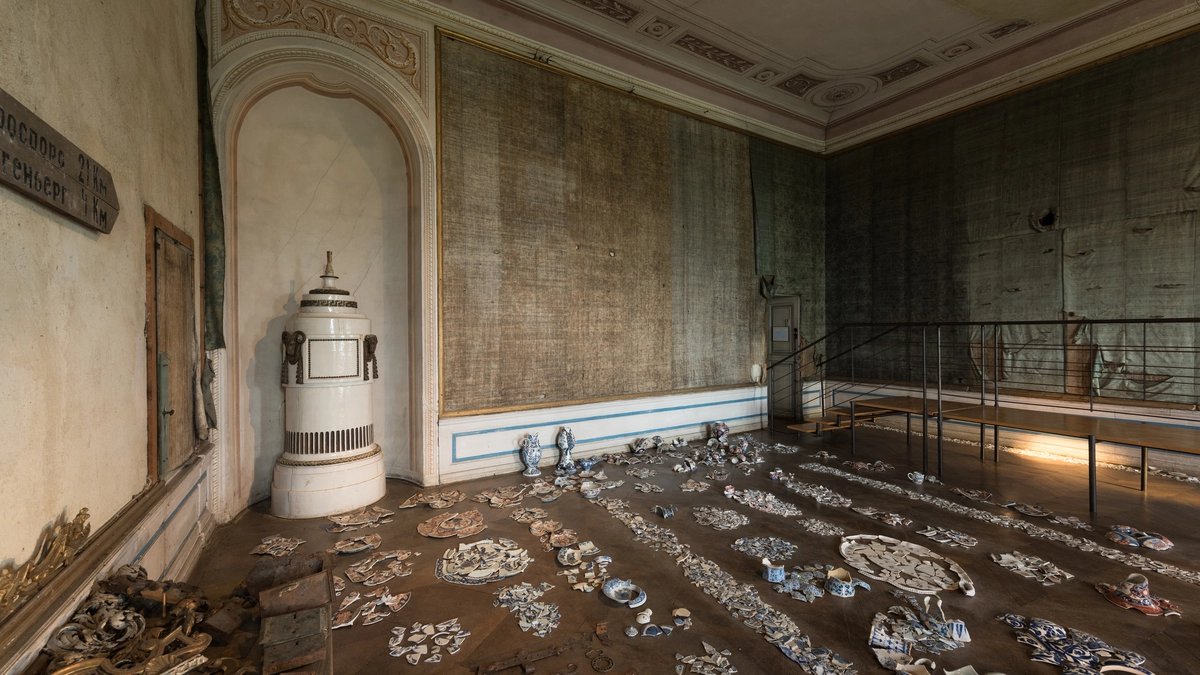
The broken room in Schoss Loosdorf.Institute for Conservation and Restoration
June 5, 2026 at 5:30 a.m from Michael Vosatka
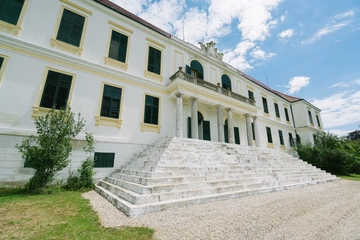
By early 1945 it was obvious that the war was lost. The Red Army steadily advanced. The Piatti family, who had lived in the Weinviertel since 1834, had to leave their home, Loosdorf Castle, within days. She found shelter with her friends, the Revertera family, in Helfenberg in Upper Austria. Before that, however, the family’s treasures – silver, glass chandeliers and an extensive porcelain collection – were buried or walled up in the basement of the castle.
For four months the castle was the headquarters of the Soviet Army’s headquarters. When the Piattis finally returned, they found the hiding place looted: the wall behind which the porcelain was stored had been torn down and the fragile objects reduced to a sea of shards in an act of wanton destruction. Only the buried chandeliers survived the vandalism unscathed. Ferdinand Piatti moved the fragments of Japanese, Chinese and European porcelain works of art into a room in the castle, where he laid them flat on the floor, creating a unique installation in the form of a kind of time capsule: The Shards Room was opened as part of a museum open to the public in 1959 and has since represented a memorial against the senseless destructiveness of the war.
It runs from May 30th to September 13th, 2026 as a result of a research project University of Applied Arts the exhibition “Completed X Contemporary: Resonances to the Broken Collection”. The multi-year interdisciplinary project “Broken Collection” Under the leadership of Gabriela Krist, now head emeritus of the Institute for Conservation and Restoration, and the research assistant Paul Schubert Science Fund FWF funded as a PEEK project (program for the development and development of the arts). “Broken Collection” served as the basis for a whole series of theses.
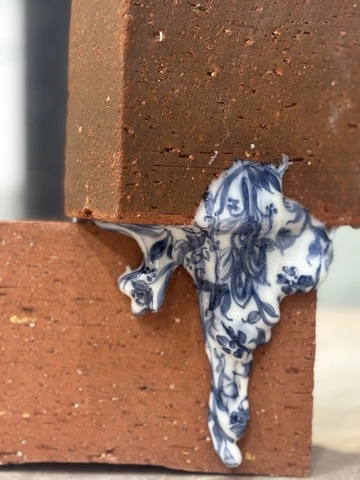
Replaced by painted glaze: the cement becomes decorative.Institute for Conservation and Restoration
Not only old and new approaches to restoration and conservation research were tested using the shards, but also the severely damaged original furnishings of the castle rooms, such as worn brocade wallpaper and crumbling polychrome paneling. Science also entered into a dialogue with contemporary art. And so the results of artistic discussions with the shard room can also be shown in the exhibition curated by Christina Stadlbauer.
These range from a brick wall whose cement is replaced by painted glaze – a reference to the fate of the walled-up porcelain collection – to the sound sculpture “Smashophon”. What they all have in common: “Everyone involved in the project used the Shard Room in Loosdorf Castle as a starting point for research and a source of inspiration,” explains Krist.
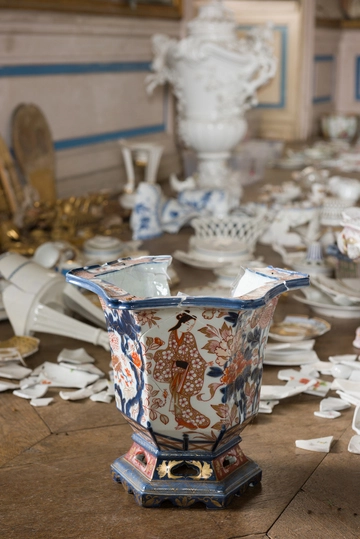
Japanese Imari vessel from the 19th century.Institute for Conservation and Restoration
The Angewandte project was preceded by a collaboration between Loosdorf Castle and the University of Tokyo. During a visit to Japan in 2015, Ferdinand Piatti’s grandson Alfons and his wife Verena were able to make contacts that led to the restoration of some pieces by Japanese experts and ultimately to a highly acclaimed exhibition tour through Japan. Some of these restored objects can now be admired again in Loosdorf.
Alfons Piatti describes how emotionally touched the Japanese partners were that his family in Austria had preserved the pieces and thus the “broken soul of Japan” over the generations. This is rooted not least in the fact that there is only a small amount of historical production porcelain available in Japan itself, as it was essentially intended for export to Europe.
Shortly
The Piatti family comes from Milan. In 1834 she acquired Loosdorf Castle (today’s Lower Austria).
The collecting Exotic porcelain was already fashionable at European courts in the 17th century. The Piattis collected porcelain from Japan and China, but also from Europe, such as Meissen and Vienna.