Solar fences are gaining ground in Europe as households continue to invest in renewable energy amid the war with Iran.
Europeans are turning their garden fences into real mini-photovoltaic parks. But is this trend just a fad or an ingenious solution for energy independence? Solar energy is already helping to protect Europe from the huge costs of fossil fuels in the context of the conflict with Iran and has been described as a “shining star” of the European Union’s energy transition.
According to a recent analysis by SolarPower Europe, the production of electricity of solar energy has already saved the continent no less than 12.8 billion euros by reducing gas imports from the beginning of the conflict.
This means an average saving of 136 million euros per day, despite the fact that Europe’s aging energy grid is currently blocking around 100 billion euros worth of clean energy projects, it writes euronews.com.
Solar energy boom in Europe
Interest in traditional rooftop solar panels has surged after Iran threatened the Strait of Hormuz, a key shipping point for fossil fuels through which about a fifth of the world’s oil supplies pass.
In Germany, renewable energy company Enpal BV saw a 30% increase in requests for solar panels after the conflict broke out, and photovoltaic system manufacturer 1KOMMA5° GmbH also reported a near-doubling of interest in solar energy.
British energy company EON saw a 23% increase in interest in solar panels between 23 February and 1 March, followed by a further increase of 63% between 2 and 8 March.
But it’s not just rooftop panels that are gaining popularity. The UK recently became the latest European country to remove restrictions on plug-in solar panels, confirming that these low-cost systems will soon be available in discount stores such as Lidl and Iceland.
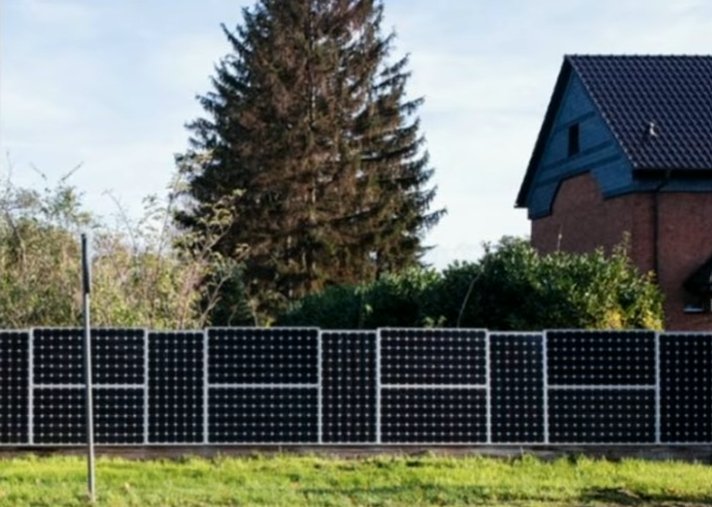
Now, Europeans are getting even more creative, installing solar fences in their own gardens.
Advantages and disadvantages of solar fences
According to Jacksons Fencing, which sells solar panel fencing in the UK and France, solar fencing makes the most of land by combining a “physical barrier with the production of renewable energy“.
One of the biggest advantages is the elimination of the need for expensive installations, which often involve the use of scaffolding. Solar fences also save space, making them ideal for homeowners who have limited roof areas or roofs unsuitable for mounting panels.
These futuristic fences can be gradually expanded, allowing owners to install panels over time, and not all at once.
However, vertically mounted panels capture less sunlight than those installed on roofs. According to Bluetti Power, under optimal conditions, a typical solar fence can generate between 100 and 150 watts for every linear meter.
In the case of a fence with a length of 10 meters, this translates into a power of approximately 1-1.5 kilowatts. If it gets about five hours of strong sunshine a day, the system can produce between 5 and 7.5 kilowatt-hours (kWh) of electricity daily.
Although this amount is not enough to power an entire home, it can support the operation of essential appliances, such as an energy-efficient refrigerator or an LED TV.
By comparison, a typical residential solar system produces, on average, about 2 kWh of electricity per day.
“Performance also depends on the location, the degree of shading and the length of the fence available,” explains Maguire. “In certain areas, permits or regulations may influence installation, particularly in sensitive or protected areas.”
German solar energy company Next2Sun has already completed 479 solar fence projects in six European countries, covering approximately 10 kilometers.
The company claims that vertical PV systems can cost as little as €250, but prices can be higher for households that want a more natural design. The investment can be amortized in about eight years, which puts them at a similar level of profitability to that of traditional roof-mounted solar panels.
The future solar fences
Next2Sun doesn’t just build solar fences for homes, they also offer vertical panels for farms or commercial sites like airports.
“Solar fences are suitable for infrastructure and commercial environments where there are long perimeters that, from an energy production perspective, go unused,” says Maguire.
“Warehouses, logistics centers and business parks often have large areas of fencing that can help power on-site activities, and schools, utility companies and local authorities could integrate solar fencing into their sustainability.”
Maguire adds that while issues such as sustainability, safety standards, light reflections and maintenance in high-traffic areas need to be considered, the concept “aligns strongly with the wider trend of integrating renewable energy into existing infrastructure”.