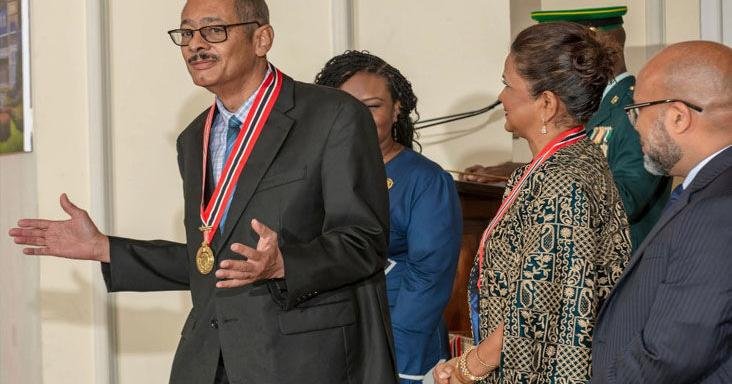
FORMER chairman of the Environmental Management Authority (EMA) Emeritus Professor John Agard has died at the age of 71.
Agard’s death prompted tributes from local and international environmentalists yesterday, who hailed him as one of the Caribbean’s most influential scientists and conservation advocates.
According to an announcement from The University of the West Indies (The UWI), Agard died on Friday.
A 2023 recipient of the Order of the Republic of Trinidad and Tobago (ORTT), Agard earned international acclaim for his work in sustainable development and climate change, including serving as a lead author of the “Small Islands” chapter of the Intergovernmental Panel on Climate Change’s Fourth Assessment Report, which shared the 2007 Nobel Peace Prize with former US vice-president Al Gore.
In a statement, St Augustine campus principal Prof Rose-Marie Belle Antoine described Agard as “a brilliant, innovative, enterprising person who gave so much to The UWI, his community and beyond”.
“A giant in the intellectual world, especially in relation to the environment and climate change sciences, he was committed to sharing his knowledge and worked just as tirelessly as a mentor,” Antoine said.
Environmental conservationist and former president of the Trinidad and Tobago Incoming Tour Operators Association (TTITOA) Courtenay Rooks also paid tribute to Agard’s contribution to the management and protection of Trinidad and Tobago’s “priceless” environmental assets.
Rooks said the country had lost a patriot whose life was dedicated to the future of Trinidad and Tobago.
Describing Agard as “one of the most wonderful human beings I ever met”, Rooks said he “gave of himself to everyone he met, through his heart and his brilliant mind”.
“With nature and science he was incredibly curious in figuring out the true nature of Trinidad and Tobago’s natural history, and used his insightful intellect to create ways to figure out the truth of nature. He was passionate about Trinidad and Tobago and always pushed to save our environment. His work at The UWI, Institute of Marine Affairs (IMA) was done selflessly, with the same passion and strong focus to help save the planet. The world has lost a giant,” Rooks said.
Several people who worked with Agard at the EMA and within the environmental sector also called for greater recognition of his work.
They said his contributions should not be forgotten, citing his role in development planning, disaster prevention and policies aimed at addressing the effects of climate change on Small Island Developing States, particularly in the Caribbean.
Tribute was also paid by the Fatima Old Boys’ Association, Agard’s alma mater. The association shared a previous Facebook post noting Agard had not only “impacted the academic environment” but had also been “mastering the sciences related to the environment, to give us all a better life”.
Agard was among the first alumni inducted into the inaugural Fatima College Hall of Achievement in 2015 under the category of Pioneers.
World acclaim
In its release, The UWI recalled that as a professor of tropical island ecology, Agard gained international acclaim for his work in sustainable development and climate change.
He also played a key role in shaping Trinidad and Tobago’s environmental legislation, including the Certificate of Environmental Clearance Rules, Noise Pollution Rules and Water Pollution Rules introduced in 2001.
A scientist and environmental advocate, Agard helped establish several protected areas, including the Environmentally Sensitive Area designation for Matura National Park in 2004; the Nariva Swamp, which became a Managed Resource Protected Area in 2006; and the Aripo Savannahs, which were designated a Strict Scientific Reserve in 2007.
His international work extended beyond climate change.
Agard was lead author for the “Small Island Systems” and “Scenarios” chapters of the Millennium Ecosystem Assessment, published in 2005, for which received the Zayed Prize for the Environment. He also served as coordinating lead author of the “Scenarios” chapter of the United Nations Environment Programme’s 2007 Global Environmental Outlook.
The UWI said Agard’s commitment to environmental protection was reflected in the many initiatives with which he was involved throughout his career.
He served as co-leader, alongside the Cropper Foundation, of the Caribbean Sea Assessment (CARSEA), which was published in 2007.
Agard was also “deeply involved in creating innovative environmental policy, laws and systems as Chairman of the Environmental Management Authority of Trinidad and Tobago and helped establish the nation’s National Environmental Policy”, the university noted.
The UWI reflected on Agard’s lifelong dedication to environmental stewardship, recalling that he once said his passion was “to make the world a better place. To make my country a better place. To make my region a better place”.
The university described Agard as “foremost a brilliant scientist, but above all else he was fiercely committed to protecting the environment of the planet”.