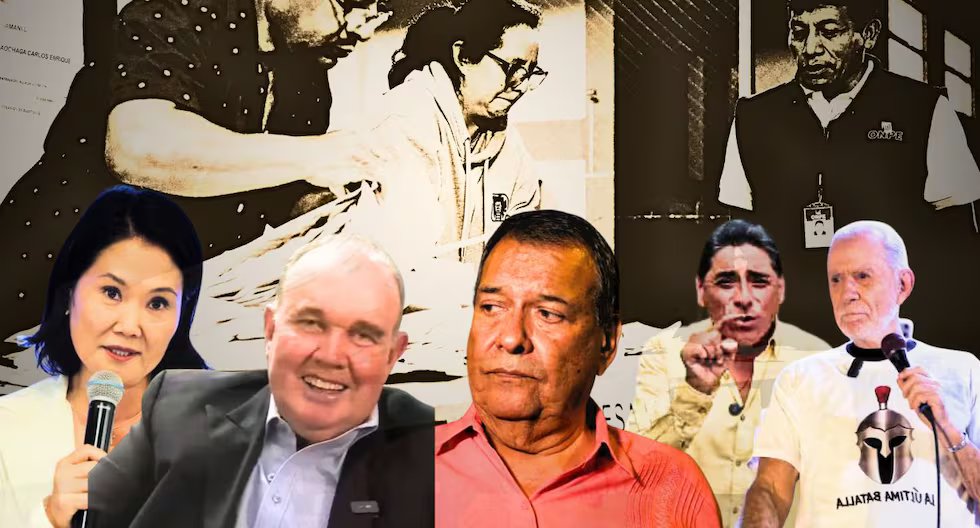
Far from the chaos of the day before, the day of Monday, April 13, progressed at a much slower pace, even with a certain lethargy, for the presidential candidates. Except for specific statements or appearances on social networks, there were no major proselytizing or political activities. Whether due to the maintenance of the bans on electoral propaganda after the splitting of the General Elections 2026 or, in any case, due to the hangover of a historic and unprecedented election day. Even so, some of the presidential candidates did begin to define positions in light of the first results; others were more cautious and some simply accepted defeat.
Towards a second round
Minutes before 9:00 am, the Fuerza Popular candidate, Keiko Fujimori, briefly declared to the press as she left her home and indicated that the first quick count “is very encouraging for Peruvians.” Likewise, he said that he took the results “with a lot of gratitude” to all the people who trusted his group.
According to the quick count of 100% valid votes carried out by Datum Internacional and América Televisión, Fujimori obtained 16.8%, which positions her towards a second round.
In addition, the official count of the National Office of Electoral Processes (ONPE), at 66% of the minutes counted, also placed it in first place with 16,934% at 09:27 pm on Monday.

“What corresponds to us, facing the second stage, is to continue dialogue, talking, listening and also understanding that there is still a lot of room to convince. There is still a lot of disappointment. And that will be my goal, to be able to make citizens trust their authorities again.”expressed the leader of the orange party earlier.
Meanwhile, a second quick count by Datum Internacional and América Televisión on Congress, broadcast this Monday at noon, projected a formation of a Senate with 22 seats from Fuerza Popular —at 80% of the count—; while, in the Chamber of Deputies, 37 seats – 60%.
| Game | Seats |
|---|---|
| Popular Force | 22 |
| Together for Peru | 10 |
| Popular Renewal | 8 |
| Good Government | 8 |
| Now Nation | 6 |
| Works | 6 |
| Game | Seats |
|---|---|
| Popular Force | 37 |
| Good Government | 22 |
| Popular Renewal | 21 |
| Together for Peru | 20 |
| Now Nation | 14 |
| Works | 14 |
Fujimori was consulted about the first projections regarding the bicameral Congress – the first to be elected after more than 30 years -, with senators and deputies, an institution that will be key to guaranteeing stability in the next five years.
The candidate also thanked those who may have been elected as senators and deputies and reiterated that “on our side, we have learned and we are going to prioritize dialogue.” He was also asked about the consensus that he will have to generate in a second round and if he would close the doors to the left.

Presidential candidate Keiko Fujimori of Fuerza Popular casts her vote at the IE Libertador San Martín in the San Borja district during the 2026 General Elections. Photo: ANDINA/ Verónica Calderón.
He pointed out that Fuerza Popular has indicated “clearly that the enemy is the left” and that the results will be waited “with the prudence of the case.” “But I repeat, we are going to prioritize dialogue; and that will be our action in the future bicameral Congress of Fuerza Popular,” he added.
Fujimori—former first lady and former congressman—managed to advance to the second round for the fourth time in the last 15 years. On the three previous occasions he lost the runoff: first against Ollanta Humala, then against Pedro Pablo Kuczynski (PPK) and, finally, against Pedro Castillo. Faced with the latter, he publicly denounced a “fraud on the table” that he could not prove.
Political analyst Enrique Castillo considered that the main factor that leads Fujimori to the second round “is the same” as in the last three general elections: “the hard vote of Fujimorism” and the party structure of Fuerza Popular, “which is one of the strongest in the country.” However, he stressed that the orange group would be in a different situation if there was no Fujimori in its ranks.
In Castillo’s opinion, the most complicated thing for the Fujimori candidate facing the second round will be to face the liability represented by Fuerza Popular’s performance in Congress since 2016. “Anti-Fujimorism is, in any case, an element that is present in Peruvian politics. But more than anti-Fujimorism, today what there is is an anti-Keikism, which depending on who happens with Keiko Fujimori will be activated (or not). Possibilities that she could win exist, but they will go up or down depending on who their opponent is,” he explained.
In turn, political analyst Gonzalo Banda maintained that, in a campaign that sought to “strengthen negative political identities,” Fujimori Higuchi “has been a political professional,” and this has been a differentiating factor compared to her adversaries.
Banda indicated that, unlike the 2011 and 2016 elections, Fujimori avoided questioning or making self-criticism about his father’s government; Rather, in this race he has been seen as “more belligerent” in defending an alleged legacy of Alberto Fujimori. He added that, in recent years, Fuerza Popular has tried to build a narrative of vindication of its decade.
“Time goes by and all the anti movements, as happened (with those who opposed) Odría, all the movements that arose against presidents are gradually disappearing from the public scene,” he expressed.
Questions and exits
For his part, the candidate Rafael López Aliaga (Popular Renewal) did not have public activities. However, it was only at night that an interview was broadcast on the party’s social networks, in which he reiterated that “there has been a very serious fraud.”
In addition, he mentioned the complaint raised by the National Elections Jury (JNE) against the head of the ONPE, Piero Corvetto, the arrest of the Electoral Management Manager, José Samamé Blas – which occurred on Monday morning at the organization’s headquarters –, whom he described as a “right arm.”

Rafael López Aliaga formalizes a criminal complaint against the head of ONPE, Piero Corvetto, for flagrant omission of duties. Photo: Cesar Bueno @photo.gec
“Yesterday (Sunday) there was a very serious fraud. (…) What is coming is that the head of Peru’s electoral system will be taken prisoner. The issue is very serious because, in Lima, it has been completely desperate, obviously, to go against the tables,” said López Aliaga.
He questioned that tables have been opened even in the border areas and on time, while in Lima, a short distance from the ONPE headquarters, electoral material has not been able to arrive, even in areas where there were “very clear pockets” for Renovación Popular. He also questioned whether the material should have been delivered to law enforcement in advance.
The day before, López had also filed a complaint against the head of the ONPE, for which he also requested his immediate arrest.
For his part, candidate Jorge Nieto (Good Government Party) pointed out that “the distances are getting shorter as time goes by” and that there were regions in which they had obtained an important vote. Likewise, he took the opportunity to thank Arequipa, where he is from. “Let’s see what happens, the coin is still up in the air,” he remarked. He added that “serious people wait, calmly and patiently.”

(Photo: Antonio Melgarejo/ @photo.gec)
Precisely, the one who did not wait for the formal closing of the day to establish a position was the presidential candidate Carlos Álvarez (País para Todos). In a video broadcast on his social networks, he thanked, as he said, from the depths of his being, those who accompanied him throughout the electoral process, to whom he said: “what I learned from you is something that I will never get out of my mind.”
He continued by pointing out that the objective was not achieved, and then extended his congratulations to the candidates who will go to the second round in an election that he described as “quite strange.” However, he also indicated that there were things that he could not understand.
“For years we have been complaining, protesting and we continue with the same thing. A joke says that, if the Peruvian in a second round would have to choose between a dinosaur and the meteorite, the Peruvian chooses the meteorite,” he said.
It was then that he hinted at his departure from politics and also pointed out that “politics is a dirty world of betrayal.” “I want you to know that I will continue by your side, not as a politician, but as the person who will be there fighting against crime, denouncing what we have to denounce, supporting health and education, as I always did,” he commented.
For his part, when asked about a possible passage to the second round with Fujimori, the candidate Roberto Sánchez (Together for Peru) maintained – in a press conference – that they were making “a call for a new pact” among all Peruvians, for – as he said – for “a new agreement between all, we say: new Constitution.”
He added that they were already organizing and that, starting this Tuesday, they would begin to tour “all of Peru,” visiting farmers, mining areas, transporters and teachers. “We are going to tour all of Peru, all the towns, to summon them to the refoundation of the homeland,” he asserted.
Likewise, Ricardo Belmont (Partido Cívico Obras) made a live broadcast at mid-morning, lasting more than 40 minutes, in which he highlighted that his group had managed to surpass 30 parties and that they already had, as he said, 18 deputies and six senators, “of those who can come.” And he stressed that this had been his “last battle.”
He also insisted that there was “a planned campaign” against him and that Keiko Fujimori “is going to lose in the second round.” Furthermore, without showing further evidence, he reiterated that “money has flowed on the tables that is scary; this has been a fraud that I announced, unfortunately, I was right.”
“I told them that this was my last battle; and I have kept my word. I will continue to communicate hope, philosophy, in the time I have left in my life,” he expressed.

Candidate Carlos Álvarez exercises his right to vote at the San Isidro polling station. (Photo: GEC)
It did draw attention that, after the chaos recorded on Sunday, the head of the ONPE, Piero Corvetto, nor the president of the JNE, Ricardo Burneo, made a statement this Monday.
Only the ONPE issued a statement at night, in which it called on political organizations and citizens to “wait for the conclusion of the electoral process with serenity and keeping in mind full respect for democratic institutions.”
In addition, the entity assured that, on election day, 99.8% of the planned voting tables throughout the country were installed and that, since then, “the transfer of minutes, the counting of votes and the publication of results are being carried out normally.”
Likewise, the ONPE indicated that it was aware of its responsibility to guarantee that all polling stations have the electoral material in a timely manner, and recognized that the delay reported in various areas of Metropolitan Lima affected the exercise of the right to vote.
At the end of the day
At the close of this edition, the last ONPE count (with cutoff at 10:37 pm), with 67.961% of the minutes counted, showed Fujimori in the lead with 16.926% of valid votes. Behind was Rafael López Aliaga (Popular Renovation), with 13,306%, followed by Jorge Nieto (Good Government Party), with 12,215%.
Further down, with 9,928%, was Ricardo Belmont (Partido Cívico Obras), and with 9,269%, Roberto Sánchez (Together for Peru). Next were Carlos Álvarez (País para Todos), with 8,315%, and Alfonso López Chau ( Ahora Nación), with 7,637%.