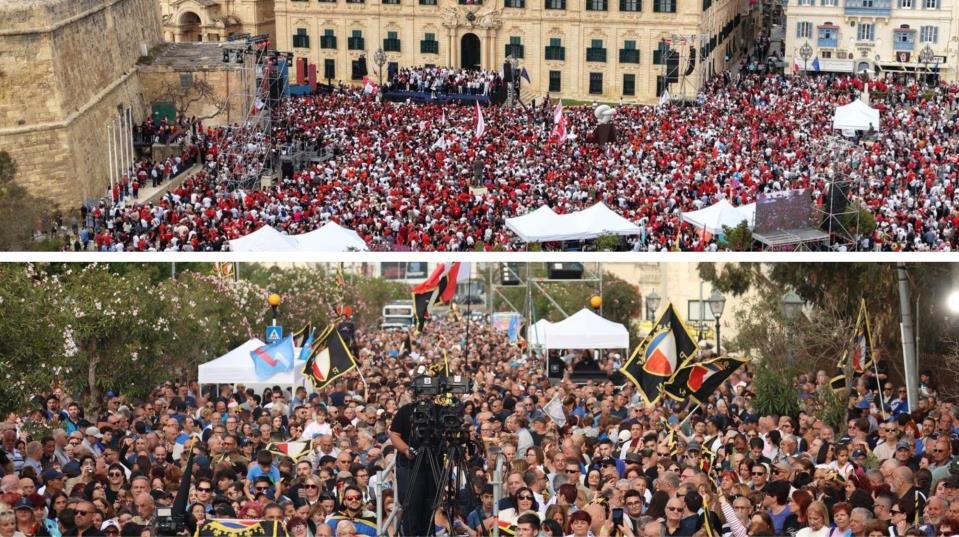
The fourth day of the electoral campaign offered a clearer view of the contrasting frameworks guiding the two main parties, even as both leaders converged on a familiar set of themes: workers’ income, quality of life, and long-term social investment. Prime Minister Robert Abela and Nationalist Party leader Alex Borg each used their first mass rallies to reinforce their narratives – one rooted in continuity and expansion, the other in structural reform and redirection.
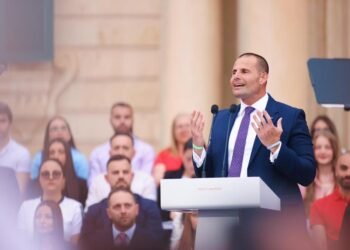
Abela’s address in Valletta was forward-looking but anchored in a strong defence of Labour’s track record. His central message was one of momentum: that Malta is already performing well and is now positioned to take a “next step” towards higher levels of prosperity and wellbeing. His proposals on flexible working arrangements – granting employees the right to request remote work, flexi-time, or compressed weeks – fit within this broader framing. They were presented less as a disruption and more as a natural evolution of a labour market that, in his telling, is already delivering results.
This emphasis on continuity was reinforced by fiscal measures aimed at increasing disposable income, such as raising tax-free thresholds for part-time work. Even new initiatives, like the Individual Learning Account for children, were framed as extensions of an existing social model rather than departures from it. Abela also repeatedly stressed that Labour’s proposals are costed and measurable, signalling an attempt to project fiscal discipline alongside ambition.
At the same time, his speech retained a strong rhetorical dimension. References to Malta becoming a top ten country in human development and surpassing EU median income levels by a significant margin underscored an aspirational tone. The inclusion of large-scale projects – such as transport reform and energy investment – further reinforced this sense of long-term national transformation, though without detailed engagement on implementation challenges at this stage.
Borg, by contrast, adopted a more segmented and policy-heavy approach, with a clear prioritisation of healthcare as the central pillar of his campaign, as has been evident in this first week. While he also focused on workers’ income – proposing tax exemptions on the first €10,000 of overtime and part-time earnings – his broader narrative was less about continuity and more about correction. His repeated references to healthcare infrastructure, workforce shortages, and preventive care suggested a diagnosis of systemic gaps requiring targeted intervention.
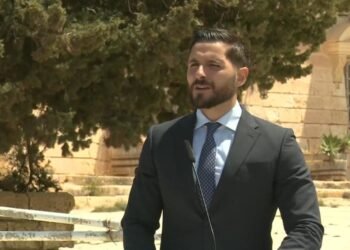
The scale and specificity of Borg’s healthcare proposals stood out more in a press conference he gave at Selmun. Multiple hospital projects, a National Health Park, and expanded rehabilitation services were presented as part of a comprehensive restructuring. This was complemented by workforce incentives, including stipends for students and tax breaks for returning professionals, indicating a dual focus on infrastructure and human capital.
Where Abela spoke of wellbeing in broad, aspirational terms, Borg attempted to operationalise it through concrete policies, particularly in mental health and preventive care. His proposal for state-funded health screenings and tax incentives for workplace mental health programmes reflected an effort to link public health outcomes directly to economic productivity and daily life.
On family policy, both leaders introduced long-term financial instruments for younger generations, but with different designs and implications. Labour’s Individual Learning Account is incremental and conditional, tied to educational use and spread over time. The PN’s Child Trust Fund, by contrast, is a lump-sum investment aimed at wealth accumulation, accessible at adulthood. The distinction reflects differing philosophies: one prioritising gradual support within existing systems, the other focusing on capital-building for future independence.
Transport also emerged as an area of overlap, though again with divergent framing. Both leaders endorsed large-scale mass transport solutions, but while Abela integrated this within a broader national transformation narrative, Borg presented it more directly as a remedy to current inefficiencies and quality-of-life pressures.
Overall, the day highlighted a campaign taking shape along two axes. Labour is positioning itself as the steward of a successful model, offering refinement and expansion with an emphasis on stability and measurable progress. The Nationalist Party is presenting itself as an agent of recalibration, focusing on sectors it argues have been underprioritised, particularly healthcare and workforce sustainability.
The convergence on issues such as taxation, work-life balance, and long-term investment suggests a shared recognition of voters’ immediate concerns. The divergence lies in diagnosis and delivery: whether Malta’s current trajectory requires acceleration or adjustment.