The first issue in 1996, with the title “Vittoria” on the cover, celebrated the first historic ruling that allowed the assignment of a registered residence for homeless people. An editorial team made up of two people. Three thousand copies printed and the first seller, Mauro Iodice from Barletta. And the new poverty of today
Three hundred numbers. Thirty years on the road traveled together with the excluded, the marginalized, the poorest. Thirty years of memory, images and faces that I do not forget. The faces of the sellers of Tennis shoes that are no longer there, lives that have slipped away in silence, as happens to those who live on the margins. The faces of those who have had a second chance. The faces of those who believed in a visionary project which, in 1996, when it took its first steps, seemed unachievable. I could stop here and celebrate this milestone with satisfaction. But that’s not our style.
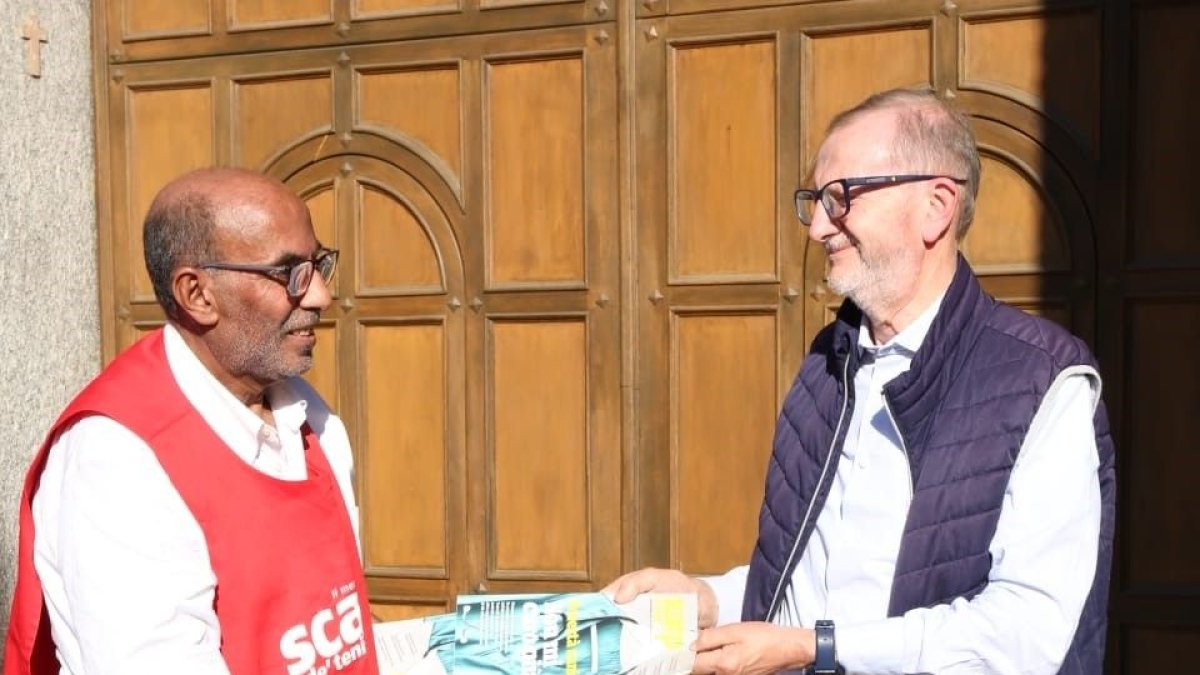
It has never been, ever since, inautumn of 1995the phone rang in that small office in the mezzanine of the headquarters Caritas Ambrosianawhere as a young editor I was together with the then director Paolo Lambruschi. Era Don Virginio Colmegna. He had just met the founders, including Pietro Greppi, of a street newspaper which, founded two years earlier, was struggling to move forward. It was called Scarp de’ tenis. Don Virginio decided to take it over. «We carry it forward, like Caritas», he told us. In March 1996 Scarp came out with the first issue. On the cover, the title “Vittoria” celebrated the first historic ruling that ruled in favor of those who asked for registered residence for homeless people. An editorial team made up of two people. Three thousand copies printed. A seller, Mauro Iodice, from Barletta. We accompanied him on his last trip a few months ago. For him, and for many other sellers who have been with us, Scarp had become his family.
A visionary project, we said. On the one hand, a job opportunity for people in difficulty and the seriously marginalized – like all street newspapers in the world, the seller keeps part of the cover price for himself – and on the other, a communication tool capable of influencing and entering the public and social debate.
I remember the beginning well, the effort of those first months. It was difficult to explain to the public what that newspaper was, to convince people that it was not about charity but about journalism. We had no role models. Thirty years later, we are still here. With the same vision, with the same objectives and with a newspaper that has grown over time. A newspaper with investigations, reports, interviews, poems, biographies. A newspaper that has published popes and poets, which hosts important names in Italian journalism. And which together is something different: it is an instrument of dignity.
And over the years the road has proven to be an extraordinary observation point. From there you see the cracks in the system, the lives that slip away in silence, the faces that the mainstream doesn’t find photogenic enough to deserve a front page. In these thirty years of Scarp we have experienced different seasons. Reforms announced and promises dissolved, social policies often incapable of providing concrete answers and always insufficiently. We have seen an increase in the number of people living in poverty. Thirty years during which the number of homeless people has grown. And during which the word poor was transformed to include those who today have a job, a home, those who – until yesterday – believed they were safe.
In all these years we have met people who have slipped into marginality due to an illness, a dismissal, a separation, a debt, a wrong gesture. I learned firsthand — and this is perhaps the greatest gift Scarp gave me — that the distance between us and the road is shorter than we might think.
All this, finally, thanks to Caritas who immediately understood and confirmed in thirty years of support, that Scarp is not only a springboard for redemption and an act of denunciation, but is also a pedagogical tool: those who read understand that the task of justice, inclusion and peace building cannot be delegated to others. It is everyone’s responsibility. Today the catalog of poverty has not diminished. It has transformed, expanded, taken new forms. The road continues to wait for anyone who stumbles upon it. But he also continues – and this is the miracle of Scarp – to offer a point of view.
The wind always makes its rounds. He returns, and brings with him the stories that seemed lost. And it shows the faces of those we have met on the road in these thirty years alongside the last. Alongside those who ask for help. Of those who just want a hug. The eyes of those who still walk alongside us today are the same eyes as then. The same eyes as Jannacci’s barbùn. Oeucc de bun.
*Director of Scarp de’ tenis