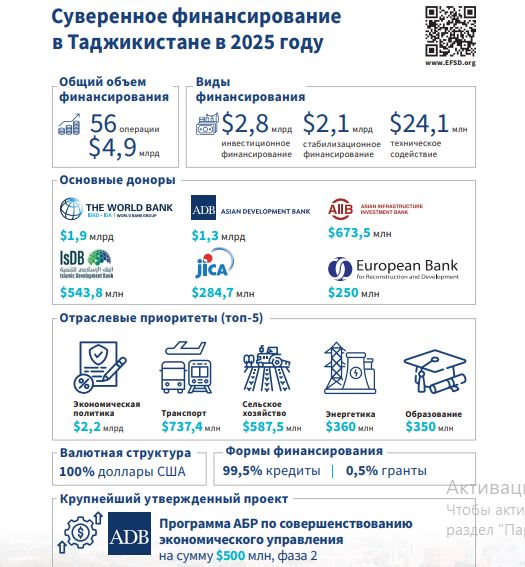
In 2025, Tajikistan attracted a record $4.9 billion in sovereign financing. This was a significant achievement for the country and confirms the growing interest of international financial institutions in the republic’s economy. The funds are aimed at developing infrastructure, implementing reforms and supporting sustainable economic growth.
This is stated in new report Eurasian Fund for Stabilization and Development (EFSD) “Sovereign financing in the Eurasian region: Regional projects and initiatives of international financial institutions” for 2026.
Main donors and sources of funding
The importance of international financial institutions for the economy of Tajikistan is emphasized. Among the largest donors that have provided financing are the World Bank (WB), the Asian Development Bank (ADB) and the Islamic Development Bank (IDB). These organizations support Tajikistan through various forms of financing, including investment loans, technical assistance, and stabilization financing.
Key projects and priority areas
The report “Sovereign Financing in the Eurasian Region: Regional Projects and Initiatives of International Financial Institutions” notes that one of the largest projects was the ADB Program.
She received $500 million for the second stage. This project aims to reform public administration, improve fiscal transparency and improve the efficiency of the public sector. The program includes measures such as the introduction of new methods of program budgeting, improved monitoring of fiscal risks, and improved management of state-owned enterprises.
The main priorities for sovereign financing in 2025 were economic policy and transport infrastructure.
The Turkish Cooperation and Coordination Agency (TİKA) continues to be an important partner of Tajikistan in the field of health and education. Since the start of its activities in Tajikistan, the agency has implemented about 500 projects aimed at developing key social sectors.
Climate finance is a priority for Tajikistan
In 2025, climate finance has become a top priority for Tajikistan. The country is actively working to adapt to climate change and develop renewable energy sources. International financial institutions continue to support Tajikistan in implementing projects aimed at reducing the impact of climate change and increasing the sustainability of the economy.
Solar energy and other renewable energy projects are actively supported. Innovations are being introduced in agriculture aimed at sustainable use of water resources and improving agricultural practices taking into account changing climatic conditions.
In 2025, $10.3 billion in funding was approved across the region, much of it for climate projects.
World Bank Project on Sustainable Landscape Management
One of the significant climate projects is the World Bank project on sustainable landscape management in Tajikistan under the RESILAND CA+ program. The project received $45 million in funding from the International Development Association (IDA). Funds support sustainable landscape management, natural resource restoration and climate-smart farming and grazing practices.
As a result of the project, more than 20 thousand hectares of land were covered, where agroforestry methods and other environmental practices were introduced aimed at increasing the resilience of rural areas to climate change and improving the quality of soil and water resources.
Large regional projects: Rogun HPP and CASA-1000
In 2025, Tajikistan also received funds for the implementation of two large energy projects – the construction of the Rogun hydroelectric station and the CASA-1000 power transmission line.
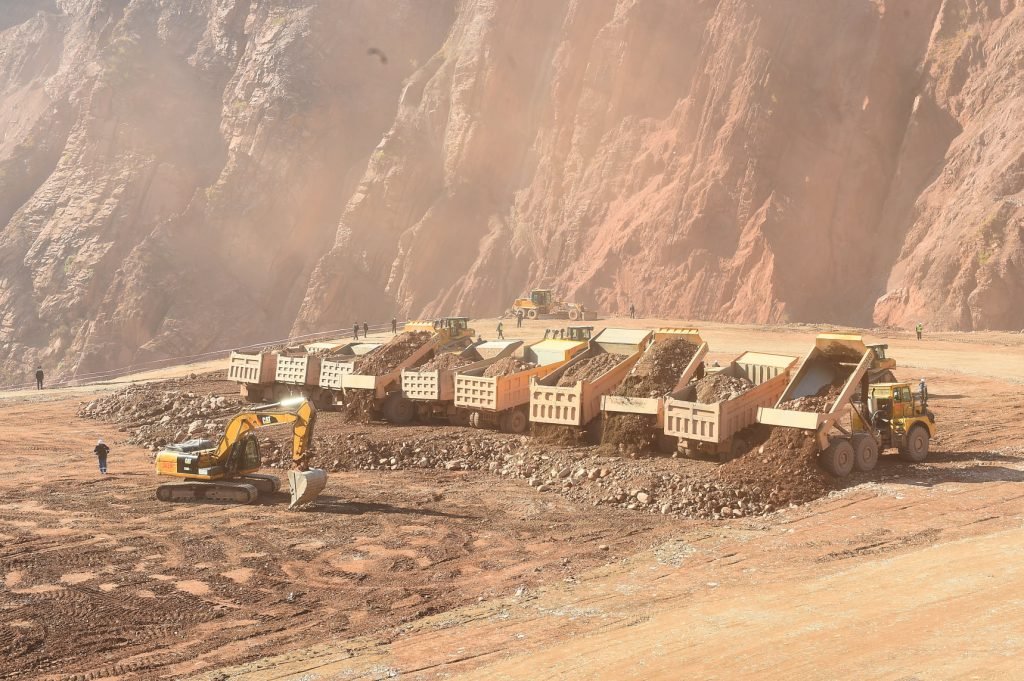
The Rogun HPP project is one of the largest infrastructure projects in Central Asia. Construction of the dam and reservoir began in 2017, and full completion of the project is expected by 2033. Once completed, the Roghun hydropower plant will provide a capacity of 3,780 MW and improve access to reliable electricity for 10 million people. The project contributes to regional decarbonization by being powered by renewable energy and helps reduce greenhouse gas emissions.