155 years ago Vasily Vereshchagin created his main and programmatic painting “The Apotheosis of War”. We tell you how the medieval commander influenced her, what the military did not like about the film, and how it changed art.
1
“Apotheosis of War” was inspired by Tamerlane. In the middle of the 19th century, this medieval Asian commander and ruler, the founder of the vast Timurid empire, gained popularity, largely thanks to the lectures of the historian and convinced Westerner Timofey Granovsky. He viewed Tamerlane as a politician who had a huge influence on the formation of the eastern type of statehood, based on despoticism, violence and the supremacy of the ruler’s power.
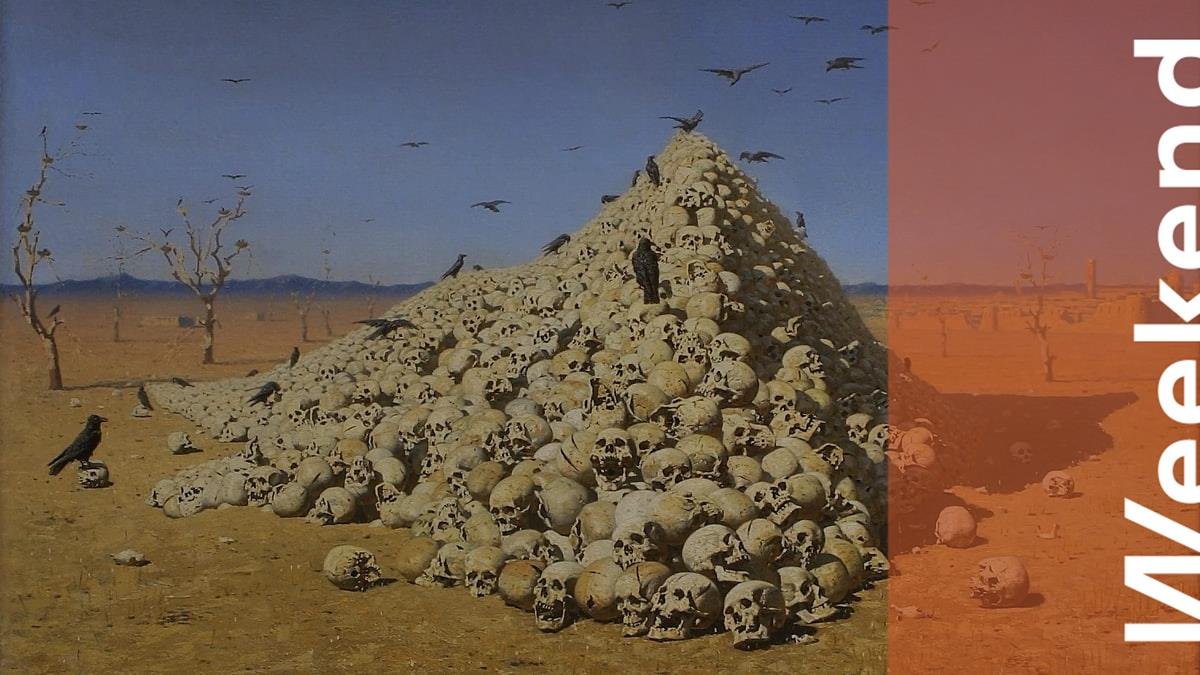
Of particular interest to the public were stories about the construction of pyramids from human heads. For example, medieval manuscripts reported that in 1387, after suppressing the uprising against his power in Isfahan, Tamerlane ordered 70 thousand heads to be placed in 35 pyramids, and having captured Baghdad in 1401, he placed 120 such structures around the city. Some sources report that this sign of the presence of a commander could also be found on Russian lands: in 1395, during the destruction of Yelets, he ordered the heads of the killed residents to be left at the entrance to the city. When starting work on “The Apotheosis of War,” Vasily Vereshchagin gave the painting the title “The Triumph of Tamerlane,” directly referring to this dark tradition of the conqueror, but then decided to abandon the direct historical reference.
2
Vereshchagin turned a private plot into a universal symbol. He painted a desert landscape with a pyramid of human skulls as one of the works of the “Turkestan Series”. The artist collected material for it while serving as an ensign under the commander of Russian troops in Central Asia, General Konstantin Kaufman. Kaufman took Vereshchagin to his headquarters as an artist who would chronicle the conquest of the region by Russian troops, and he actually returned from the campaign with a huge number of stories and sketches. However, there were few direct battle scenes in the series. The “Turkestan Series” is dominated by genre, everyday and local subjects, recording with almost documentary accuracy everything that the artist saw on this campaign: portraits of the inhabitants of the region, exotic landscapes and animals, bizarre architecture and everyday life, unusual for a Russian painter – and only a few works are devoted to the battles themselves. Having abandoned the title “The Triumph of Tamerlane”, which referred to a specific historical plot, in favor of “The Apotheosis of War” and placing the picture at the end of the “Turkestan Series”, Vereshchagin turned it into the epilogue of his picturesque report on a specific military campaign – and at the same time into a general statement about the universal result of any military action: thousands of wasted lives. To support this idea, he made a frame for the painting with a sarcastic message carved into it: “Dedicated to all great conquerors – past, present and future.”
3
Skulls became a running motif in Vereshchagin even before The Apotheosis of War. The legends about the atrocities of Tamerlane, although they set the image for the future picture, were not the only source of this motif. Firstly, the death of the German geologist and explorer Adolf Schlagintweit made a strong impression on the artist. Despite warnings about the harshness of the local authorities, he went to explore Kashgaria, was arrested as a spy and beheaded by the ruler Vali Khan. There were rumors that, in imitation of Tamerlane, he had his own “mountain” of skulls, where the remains of Schlagintveit were thrown. Secondly, while traveling around Central Asia, Vereshchagin found himself in Chuguchak, a city that several years earlier had been almost completely destroyed during the uprising of the Muslim population against the power of the Qing Empire. There were thousands of scattered and unburied bodies left there. These impressions formed the basis of two of his works – “The Ruins of Chuguchak” and “The Ruins of the Theater in Chuguchak” (1869–1870). The latter has already outlined the shape of a pyramid, which will later become central in “The Apotheosis of War.”
4
The city in the background of Apotheosis of War has no specific prototype. Its ruins simultaneously resemble real places that Vereshchagin saw during the Turkestan campaign—primarily Samarkand, in the defense of which he took part—and at the same time are devoid of individual features. This is a generalized image of the destroyed space characteristic of the region. In it you can recognize both the cities taken by Russian troops and those that in medieval chronicles were associated with the campaigns of Tamerlane. But, like the pyramid of skulls, this city works not as a geographical point, but as a symbol: a place where the war ended, but which keeps and will keep traces of violence and destruction for a long time.
5
In the Russian Empire, “Apotheosis of War” was not accepted by everyone. For the first time, Vereshchagin showed the entire “Turkestan Series” at a personal exhibition in St. Petersburg in 1874. Almost 30 years later, the artist and art critic Alexander Benois described the reaction of the first viewers as follows: “When the public saw the paintings of Vereshchagin, who suddenly so simply, cynically exposed the war and showed it as a dirty, disgusting, gloomy and colossal villainy, they screamed at the top of their lungs and began to hate and love such a daredevil with all their might.” This is an accurate description of how the series in general – and Apotheosis of War in particular – polarized Russian society. The exhibition became a sensation; contemporaries recalled that the police had to forcefully restrain the crowd of people who wanted to visit it. For many viewers, Vereshchagin’s works, as the liberal newspaper Golos wrote, turned out to be something “ennobling, sobering their mind and soul.” However, for those for whom war was their life’s work, service and calling, the paintings turned out to be almost a personal insult, and Vereshchagin’s passion for oriental motifs was perceived as dangerous sympathy for the “other side.” This position was shared by the conservative Moskovskie Vedomosti: “The poet-artist Vereshchagin sang the exploits of the Turkmens and crowned them with an apotheosis of human heads.” One of the works in the series, “Forgotten,” depicting a Russian soldier abandoned on the battlefield, caused a particularly harsh reaction. The artist’s former commander, General Kaufman, and his entourage perceived it as a direct accusation. Vereshchagin took this criticism hard: he removed the painting from the exhibition and destroyed it along with two other works, which also displeased the military authorities.
6
Foreign military personnel also reacted to the film with caution. At the end of the 1870s, the “Turkestan Series” went on a European tour: after Paris it was shown in Vienna and then in a number of German cities. Everywhere it enjoyed unprecedented interest, attracting tens of thousands of spectators, and quickly turned Vereshchagin into an international star. However, as in his homeland, the artist’s anti-war views caused irritation in the military community. In Berlin, the exhibition was visited by Field Marshal Helmuth von Moltke the Elder, a supporter of the idea of the inevitability of war. Vereshchagin personally walked him through the exhibition and stopped him at the “Apotheosis of War,” several times drawing attention to the inscription: “Dedicated to all great conquerors – past, present and future.” Moltke, according to the recollections of witnesses, was at a loss, and soon after his visit, the military disappeared from among the visitors to the exhibition. It turned out that the field marshal strongly discouraged his subordinates from visiting the exhibition, apparently believing that the paintings could affect their morale. In Vienna, a similar ban was issued by the War Ministry of the Austro-Hungarian Empire in response to Vereshchagin’s generous offer to make entry free for officers.
7
Vereshchagin changed the battle genre. In general, he did not aspire to be a military painter and said that “all his life he loved the sun and wanted to paint the sun,” but the Turkestan campaign left an indelible impression on him: “The fury of war haunts me again and again.” So the war became the center of his work. But, unlike many of his colleagues – Russian and foreign battle painters – he showed it without heroic pathos: without stately war horses, without elegant officers, without enthusiastic greetings and without the usual glorification – as an unattractive affair, the main result of which, regardless of the goals and reasons, remains death and blood. The crowning achievement of this view was, of course, “The Apotheosis of War.” Vereshchagin died in 1904 while studying yet another war, this time the Russian-Japanese one, leaving painting as a legacy the right not to glorify or justify the massacres.