Text and image Ivan Cairo
PARAMARIBO — The Surinaamsche Bank (DSB) has registered strong growth in its lending to both companies and private individuals in 2025. Investment credits for companies in particular increased sharply. According to the bank, this credit category increased by 54 percent compared to 2024, while the total corporate loan portfolio grew to SRD 1.755 billion. According to DSB, the development is closely related to investments made in the run-up to the expected growth of the Surinamese oil and gas sector.
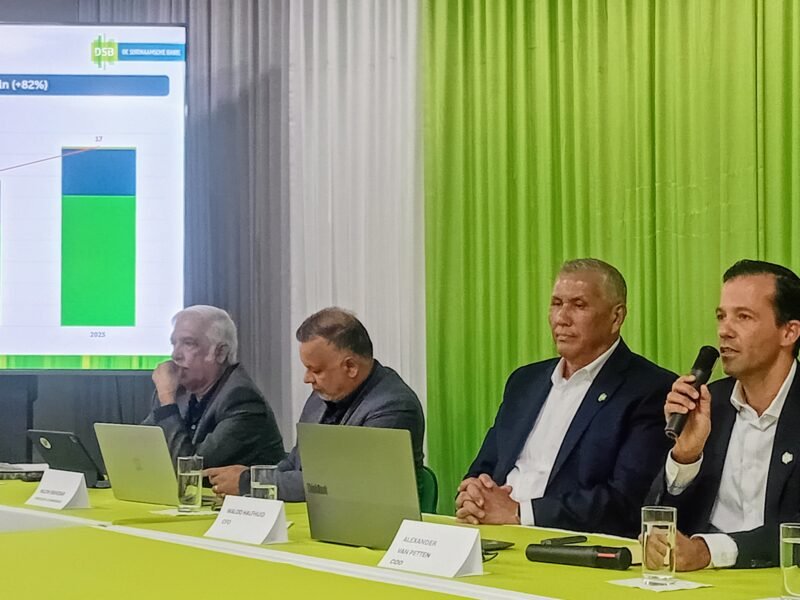
The figures were presented on Wednesday during a press conference following the bank’s annual results, which were presented to shareholders during a shareholders’ meeting the evening before. According to financial director Waldo Halfhuid, SRD 161 million was paid out in dividends. DSB saw its market share within Corporate Banking increase by 5.3 percent.
“We also looked at where this growth came from. This was mainly investment credits from companies preparing for the oil and gas sector.”
Director Alex van Petten
Growth through oil and gas sector
The growth in lending to businesses was related to actual investments. Commercial director Raveen Koelfat indicated that the increase mainly comes from investment credits. “We have seen growth, especially in investment credits. These all have to do with companies that will contribute to the oil and gas sector,” says Koelfat.
Director of Operations, Alex van Petten, also confirmed that image. “In 2025, we showed a growth of 40 percent compared to 2024 and an increase of 5.3 percent in market share. We also looked at where that growth came from. This was mainly investment credits from companies preparing for the oil and gas sector. Think of hotels, office space and other facilities needed to support that sector,” Van Petten said.
In addition to the growth in investment loans, DSB also saw an increase in other business credit products. The car loan portfolio grew by 40 percent, overdrafts for businesses increased by 88 percent and investment loans increased by 54 percent.
Strong growth in private loans
Strong growth figures were also achieved within retail banking. The retail loan portfolio increased to SRD 746 million, an increase of 54 percent compared to a year earlier. The car loan portfolio grew by 78 percent, while personal loans increased by 72 percent.
According to the bank, the growth in private lending was accompanied by a significant improvement in services. The average processing time for personal loans was reduced from 26 days to four days, an acceleration of 85 percent. At the same time, the delinquency rate for this credit category fell from 85 percent to 16 percent, an improvement of 69 percentage points.
Chairman Nitesh Bishesar emphasized during the press conference that the annual accounts are more than an overview of financial performance. “It is also an accountability document that provides shareholders and other stakeholders with insight into how carefully the bank has handled its results, capital and continuity,” he said.
According to Bishesar, the annual report shows that DSB is not only becoming financially stronger, but also wants to further improve its services. The bank will focus on further growth, digitalization and sustainability in the coming years. It wants to play a prominent role in the financing of activities resulting from the expected economic boost from the oil and gas industry. Koelfat pointed out that the strategic plan for the period 2024-2028 focuses on growth, sustainability, optimization of services and strengthening initiatives in the field of environment, social responsibility and good governance (ESG).
Focus on digitalization
The decrease in the number of ATMs in the country was also discussed during the press conference. Van Petten acknowledged that the bank is committed to further digitalization of payment transactions by encouraging the use of payment terminals (POS) and online banking. However, he emphasized that DSB itself has not removed any ATMs and that all branches still have an ATM.
Regarding the reduction of BNETS ATMs, Van Petten stated that this organization has made strategic choices based on the use of the machines. This would include locations with the highest visitor numbers, so that the available vending machines could be managed and stocked more efficiently.
With the strong growth of both business and private lending, DSB increasingly sees itself as a bank that wants to respond to the economic opportunities expected in Suriname in the coming years. Increasing investments in sectors related to the oil and gas industry in particular are an important driver of growth.