After the first election of President Luiz Inácio Lula da Silva in Brazil in 2003, the regional geopolitical map became strongly progressive along the lines of ‘South America for South Americans’. But the planned second round of Brazil’s presidential election on October 25 puts highly polarized Brazil at a crossroads. Lula loses and Flávio Bolsonaro wins (son of former president Jair Bolsonaro,… ed.) then this almost completes a rightward shift of the South American continent. A win for Lula means that Brazil will continue its position as ‘guardian’ of South America and the Amazon rainforest.
Text Jack Menke
Image Plant for the Planet
After the first round of the Brazilian presidential election on October 4 this year when Bolsonaro surprisingly trumped Lula with 45 percent of the votes with approximately 47 percent, many polls for the second round of elections on October 25 indicate a lasting lead for Bolsonaro.
“Even if Lula were to become president for the fourth time, Brazil and the rest of South America would find themselves in deep geopolitical turmoil again in a riotous world.”
In 2022, Lula won the presidency with 50.9 percent at the expense of then-incumbent head of state Jair Bolsonaro (49.1 percent of the votes). The upcoming election round on October 25 will not be an easy ride for incumbent President Lula, as Brazil is now more divided and conservative than when Lula became president for the third time in 2022.
Amazon rainforest
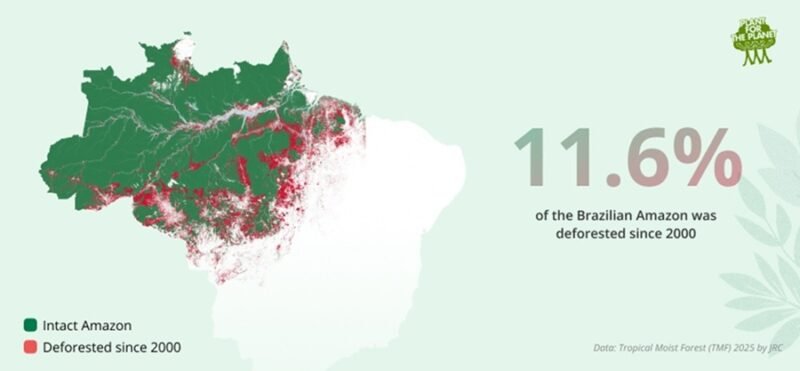
The Amazon rainforest covers approximately 40 percent of South America and is spread over nine countries, including Suriname. This area is crucial for life and climate in the world. When the forest is cut down or burned, carbon is released into the air, which negatively affects the climate, the amount of rainfall, plant and animal species and especially the habitats of indigenous and tribal peoples. The deforestation of the Amazon region amounted to 11.6 percent in the period 2000-2025 (see figure 1).
About two-thirds of the Amazon rainforest is located in Brazil. During governments of the Workers’ Party (Lula/Dilma Rousseff), deforestation showed a downward trend and during governments of Michel Temer and Jair Bolsonaro (2016-2022) there was an increase (see figure 2). Ongoing deforestation of the Amazon has increased rapidly since 2012, peaking in 2021 at approximately eight thousand square miles. Afterwards, annual deforestation fell to 5,731 square kilometers in 2025.
In the upcoming elections on October 25, much more than just the presidency is at stake. The political course of the next government will have consequences not only for the Amazon rainforest, but also for Brazilian social and geopolitical relations, international cooperation and the role of the United States (US).
In addition to electing a president, what is at stake in these elections are electing the governors of states and legislators of the federal government and states, all seats in the Chamber of Deputies and two-thirds of the Senate. These institutions also determine the political preconditions for the protection of the Amazon rainforest in the coming years.
Economic interests, media, religion and security
The soy and meat interest groups (agribusiness entrepreneurs lobby) play a huge role in the deforestation of the Amazon region. This is fueled worldwide by the increasing demand for beef and cheap soy cattle feed. These sectors are the direct driving force behind the clear-cutting of the Amazon rainforest.
Brazil’s economic elite, including agribusiness entrepreneurs, have the most access to major media and social media outlets where mud campaigns are spread. The powerful Silicon Valley (United States/US) also plays a role in subjugating societies and governments worldwide through social media, crypto currencies and artificial intelligence (AI).
This happens in Brazil through Movimento Brasil Livre (MBL – Free Brazil Movement), which is connected to various Atlas Network conservative networks and think tanks. This means that Silicon Valley – an entrepreneurial group, including the Trump administration – has great influence on parts of the Brazilian population that are targeting the Lula government. The evangelical churches have also become very influential among the poor with a growing following of the radical right.
Earth metals and strategic minerals
Brazil has strategic resources, including rare earth metals and 23 percent of the world’s strategic minerals. This puts this country in the middle of the battle between the US and China to gain control over these minerals.
In addition to rare earths, Brazil has more than 90 percent of niobium as well as lithium, nickel, cobalt, graphite and manganese. These (raw) materials are important for the global energy transition and technology (such as electric cars, microchips and jet engines).
Because China currently dominates the extraction and refining of these metals, the US is trying to catch up for its national security. In this context, Brazil is a possible strategic supplier and the October 25 presidential elections are crucial for greater access to these raw materials. The Trump administration is already increasing pressure for access to these resources, including strategically positioning itself for the acquisition of the commercial Brazilian mineral mine, Serra Verde, by USA Rare Earth.
Shield of the Americas
Geopolitically, the Trump administration is seeking to gain control of South America through the Shield of the Americas security and cooperation initiative. This is already happening partly by tackling drug cartels, trade routes and raw materials in Latin America.
Ultra-conservative presidential candidate Flávio Bolsonaro has previously said that if Brazil wins an election, Brazil will join the Shield of the Americas. This greatly strengthens the influence of the US in South America.
Lula criticizes and opposes this threat and American interference, which he regards as colonization of Brazil. If Bolsonaro wins, Brazil’s role within the eleven Brics countries as an independent international economic bloc will also come under great pressure and Brazil will probably withdraw. The member countries are Brazil, Russia, India, China, South Africa, Egypt, Ethiopia, Indonesia, Iran, Saudi Arabia and the United Arab Emirates.
Bolsonaro dynasty
The first round of the Brazilian presidential election on October 4 meant not only the larger percentage of votes of 47 percent for Flávio Bolsonaro compared to 45 percent for Lula, but also a win for the Bolsonaro dynasty with the election of many people from the Bolsonaro family dynasty. For example, Michelle Bolsonaro (wife of Jair Bolsonaro) and Carlos Bolsonaro (son of Jair Bolsonaro) were elected to the Federal Senate.
The youngest son, Jair Renan Bolsonaro, and Jair’s brother Renato have been elected to the House of Representatives. As a result, the right-wing conservative party of the Bolsonaro family has increased its hold on the Brazilian parliament and Senate. One of the most important spearheads of Flávio Bolsonaro’s presidential campaign is granting amnesty to his father Jair Bolsonaro, who is currently serving a 27-year prison sentence.
“Evangelical churches have become very influential among the poor with a growing following of the radical right”
Final thoughts
The Brazilian presidential elections on October 25 will have far-reaching consequences for the Amazon region, South America and international geopolitical relations. With gains for an ultra-conservative government under Flávio Bolsonaro, deforestation of this rainforest will increase enormously. It is expected to weaken the effectiveness of forest protection agencies and encourage illegal deforestation.
On the other hand, a government under Lula will want to combat deforestation. However, its drive to reduce deforestation to zero by 2030 will have to overcome many hurdles, such as halting agribusiness deforestation and protecting native habitats. But even if Lula were to become president for a fourth time, Brazil and the rest of South America would find themselves back in the throes of geopolitics in a riotous world.