Loading Text-to-Speech…
The initiative for joint production of naval drones (USV) between Greece and the Ukrainewith the recent Lefkada incident be described by competent sources as an “aggravating factor”. From the beginning, the ambitious plan faced several complications, mainly of a bureaucratic nature, making the Greek side wary of its effectiveness. Although not publicly expressed, Ankara’s discomfort seems to have affected the initial stage of the negotiations as well as the reluctance of the Ukrainian side in everything to do with the transfer of know-how to Greek shipyards.
However, the negotiations between Greek and Ukrainian officials continue, but not with the same dynamics, the same sources report, and they estimate that there are still chances to bear fruit, while in other ways of cooperation with Kyiv are also on the table. Besides, Athens has already collected significant funds from the concession of unnecessary weapons systems to Ukraine through the Czech Republic, Germany and the USA, thereby financing the modernization of the Greek Armed Forces.
At the same time, Athens is moving towards the development of a national USV for surveillance and unorthodox warfare operations, while the acquisition of mine hunting drones by the Navy is also being considered.

National USV
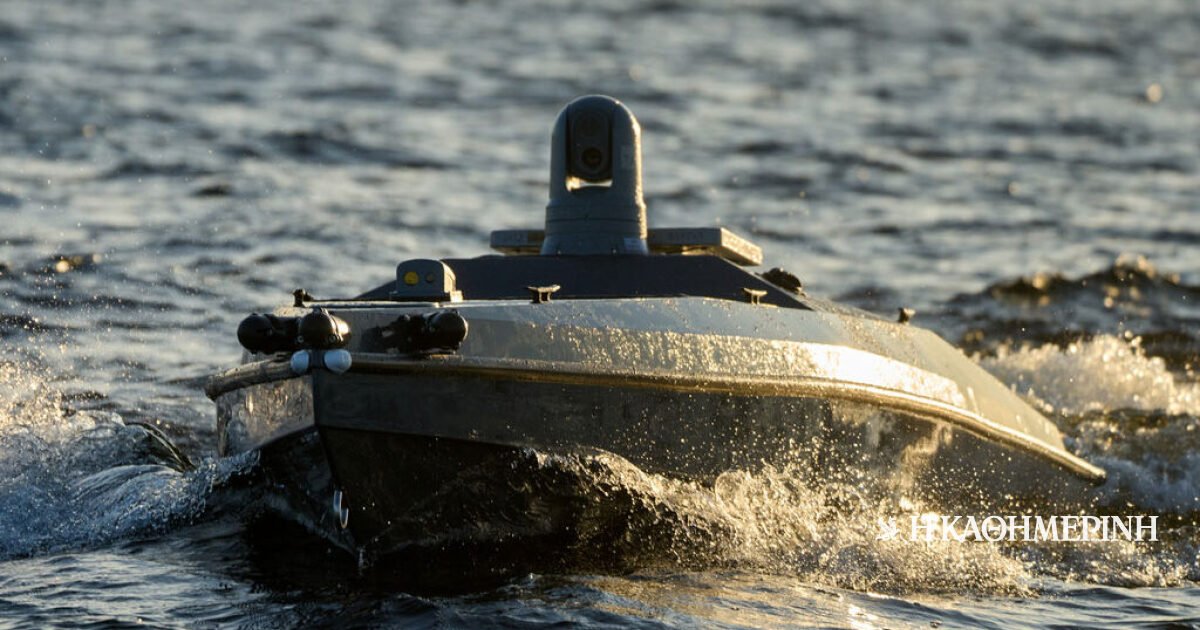
Military sources tell “K” that Greek interest is now turning to domestic development unmanned naval systems and surface drones. ELKAK published a relevant announcement a few months ago which has gathered proposals from companies in the Greek defense ecosystem. However, Athens now has a significant advantage in its hands, the Ukrainian-origin Mamai kamikaze drone which was identified and collected by fishermen in Lefkada and then transferred to Navy facilities to study its structure.
A competent source tells “K” that Greece will try to “take advantage” in the best possible way the Ukrainian USV. He also notes that, as expected, the fuselage as well as the firing mechanism do not present any particularity as they are relatively simple structures. The “juice”, as the same source says, is in the ship’s communication system with its operator, the encryption protocols and the code it uses. These systems will be carefully examined by specialized engineers of the Armed Forces and since it is a technology of interest to Athens, it will be used in future Greek programs through reverse engineering.

According to military sources, the data that will be obtained from the examination of the Ukrainian drone-kamikaze, could offer important solutions to the development of a Greek USV, in the event that it is decided to “copy” the technology of the Ukrainian Mamai.
USV minesweepers
At the same time, the opening debate on demining the Straits of Hormuz brings to the fore a Navy requirement for the procurement of USV minesweepers to locate, classify and neutralize sea mines. It is a modern and above all safe solution that significantly reduces staff exposure to risk.
The Navy has two types of drug huntersthe Osprey-class ships acquired by the United States in 2007 and the British Hunt-class ships launched in the 1980s and delivered to the Navy in 2000. Although these are specialized ships, their capabilities are multiplied when they operate together with autonomous systems, such as mine-hunting USVs and advanced underwater systems.
Autonomous minesweeping systems are mainly used by the US Navy, however, according to well-informed sources, the Greek staff has recommended the acquisition of corresponding systems either from abroad or from the domestic defense industry, in case the initiatives to develop a national program come to fruition.