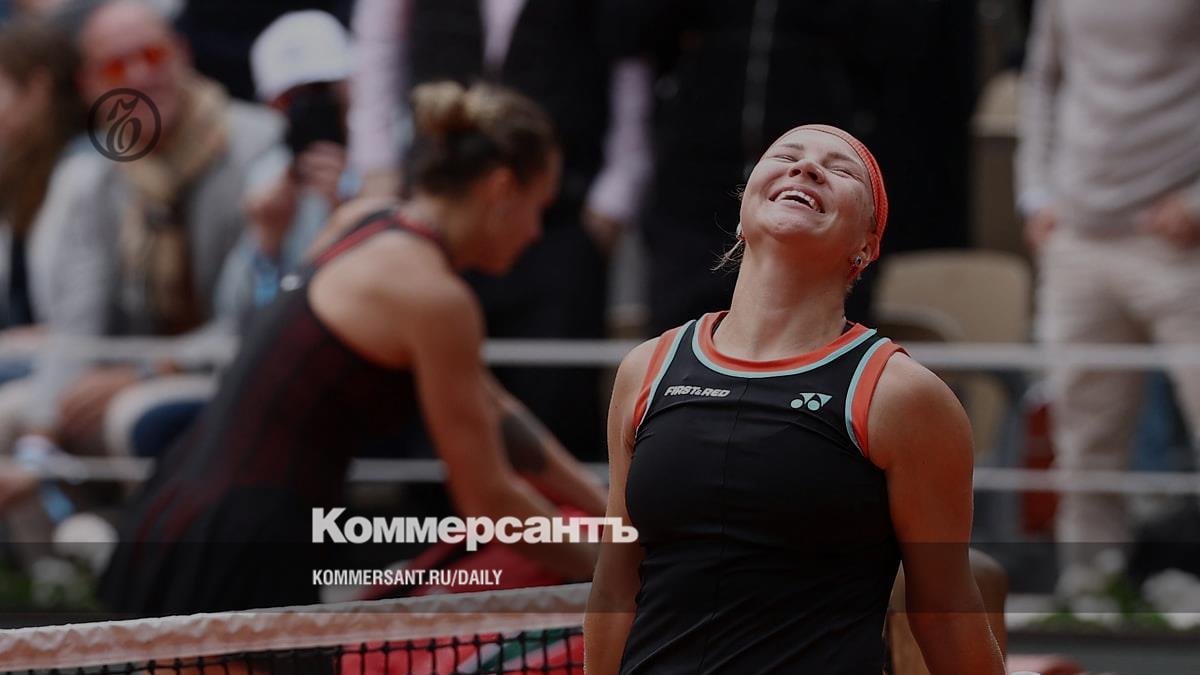
Both women’s semi-finals of the French Open will be held with Russian participation. Following Mirra Andreeva, who will now play with Ukrainian Marta Kostyuk, Diana Schneider reached this stage, sensationally taking the last ten games from the world ranking leader, Belarusian Aryna Sabalenka. Schneider’s next opponent will be Polish tennis player Maya Chwalinskaya, who made her way into the main draw through qualification, and beat Russian Anna Kalinskaya in two sets. With the latest events from Paris from the Philippe Chatrier court – Kommersant correspondent Evgeny Fedyakov.
On this cool, windy day in Paris in June, there was no happier person than Diana Schneider. During the twenty minutes of the press conference after her victory over Aryna Sabalenka, the smile almost never left her face. “Today it will be difficult to calm down before going to bed. But the tournament is not over. We need to breathe out and have time to recover,” the Russian woman, who an hour and a half earlier managed to take ten games in a row from the world ranking leader and now will play in the semi-finals of a major for the first time, shared her feelings with a Kommersant correspondent. There, where Mirra Andreeva, her partner in doubles, had made her way the day before, in which this time they decided not to compete together.
Two years ago, when Schneider first announced herself and in just seven months she went from the bottom of the top hundred to the top twenty, it was noticed: if this young tennis player is playing, it’s not easy to stop her.
True, in confrontations with star opponents, the Russian almost always lacked something. Having won five titles at mid-level tournaments, Schneider only once, in the summer of 2024 in Toronto, defeated a top 10 player – the second world racket at that time, American Coco Gauff. And in this quarterfinal, with the score 6:3, 5:3 in favor of Aryna Sabalenka, it seemed that nothing could change. After all, the Belarusian tennis tigress could already smell the blood of her next victim, who in the next game had to serve against the wind.
But it was then that another sensation of the current tournament was born on the Philippe Chatrier court. Realizing that she had nothing more to lose, Schneider played the tennis of her dreams, perfecting tight attacking shots with high-quality spin. And things went well. With every minute Sabalenka was losing control of the situation and her emotions. And when in the middle of the twelfth game, with the score 6:5 in favor of the Russian left-hander, the ball, after her defensive hit in a high arc, fell under the very back line, the Belarusian openly trembled. She failed the Schneider move twice and lost a set for the first time at this Roland Garros.
The vulnerable nature of the most physically gifted and titled tennis player of the current world elite could not bear this failure. And Schneider, who suddenly turned from a victim into a merciless hunter of the favorite, rushed to finish off at full speed. The grimace on the face of Sabalenka, who hit the ball with her fist out of helplessness in the pauses between plays, was reminiscent of the drama that happened to her in last year’s Roland Garros final against Gauff, which took place in similar windy weather. As a result – 3:6, 7:5, 6:0 in 2 hours 12 minutes. It got to the point that at a press conference the Belarusian angrily announced her desire to quit tennis, which, however, no one took seriously. And answering the question of how she would recover from this fiasco in the coming days, with a sad smile she repeated four times: “I don’t know.”
And before that, another left-hander scored on the Philippe Chatrier court, and that was also quite unexpected.
For a dozen Polish journalists working for Roland Garros, the brilliant performance of Maia Chwalinska at this tournament became compensation for the failure of the former undisputed prima of this tournament, Iga Szwiatek, who lost to the Ukrainian Marta Kostyuk in the fourth round. But such compensation for losses based on nationality sometimes happens at majors. Another similar example can be considered the presence of three Italians at once – Flavio Cobolli, Matteo Berrettini and Matteo Arnaldi – in the two quarterfinals of the upper half of the men’s draw, where at first Jannik Sinner was considered the undisputed favorite.
The highest-rated opponent of the short 24-year-old Polish player at the current tournament so far has been the Belgian Elise Mertens, the 21st racket in the world, whom she beat in the second round. Although for a tennis player who had never made it past the second round at a major and was never in the top 100, the very fact of getting into the top eight in Paris should have been considered a major achievement.
Anna Kalinskaya suffered one of the most disappointing defeats in her career.
She may not have another chance to be in the semi-finals of Roland Garros, where she had previously won only one match. Clay is not the best surface for the 2024 Australian Open quarter-finalist, although in this case she looked like a favorite both in terms of rating and play. True, before the meeting with Khvalinskaya, the Russian woman needed to recharge her batteries after a difficult victory over Anastasia Potapova, adapt to the wind and rebuild her tactics, taking into account the fact that in this case she had to deal with a left-hander.
By and large, Kalinskaya and her coach, Argentinean Patricia Tarabini, failed to solve any of these three problems. Moreover, the main factor that predetermined the Russian woman’s failure, apparently, was fatigue – not so much physical as psychological. In the first game, losing 1:5, Kalinskaya temporarily adjusted her aim and took four games in a row. But in the tiebreaker with the score 3:3, she made an offensive mistake, and then, according to her, at some point she mixed up the score and, instead of playing more reliably, lost another point with an active blow.
In the second game, Kalinskaya was behind, 1:4, and again tried to give chase, but it was too late. The result was 6:7 (3:7), 3:6, and her opponent became the first Roland Garros semi-finalist in the last six years to start from qualifying. The previous time, in 2020, Argentine Nadia Podoroska achieved such success.