An increasing number of prefectures and municipalities in Japan are enacting ordinances to help businesses combat “customer harassment.” But while some businesses say such ordinances have made it easier for them to take a firm stand against abusive customers, such behavior has not been completely eradicated.
Experts are calling for further efforts to make the ordinances more widely known.
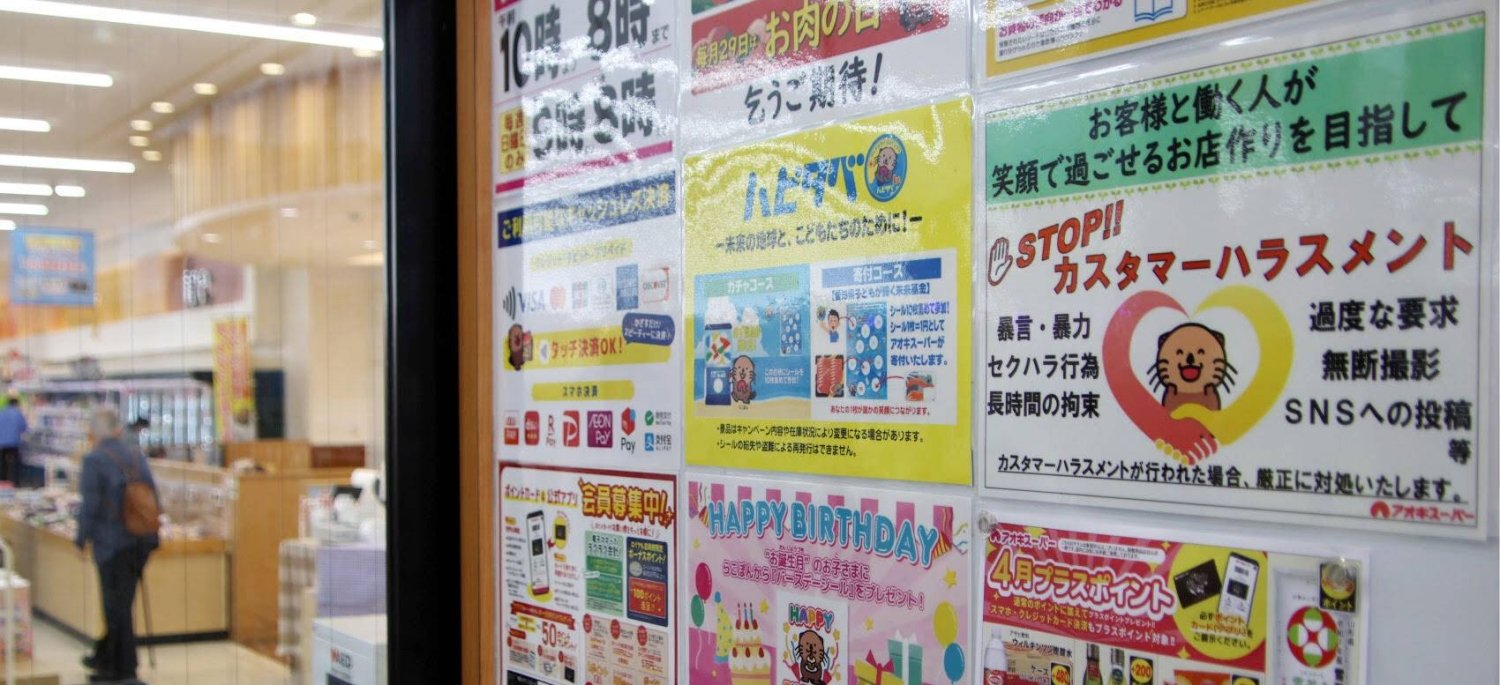
A 40-year-old manager of Aoki Super, a supermarket chain operating 50 stores in Aichi Prefecture, remembers being yelled at by a customer after the prefecture enacted an ordinance on abuse by customers in October last year.
The customer was trying to use a self-checkout but was having trouble paying with her credit card.
She said to the manager, “I have money at home. Can you come to my home to pick it up?”
The manager repeatedly refused the request and told her to contact her credit card company.
Then, she raised her voice: “This place is giving me terrible service.”
The manager stood firm, however.
Reflecting on the incident, the manager said, “The ordinance clearly states customer harassment is not allowed, and it serves as something we can draw on. It has become easier for us to say, ‘We can’t.’”
Customer harassment cases have been experienced across sectors.
The Aichi Prefectural Government set up a customer harassment consultation counter in September, prior to enacting the ordinance. It received a total of 110 inquiries by March.
The inquiries included one from a medical and healthcare services operator that said its employees were feeling uneasy about patients and their families who use violent language and threaten them, as well as from a restaurant operator that said one client refused to pay commissions.
Others asked for advice on how to create an in-house system to cope with customer harassment.
In response, the Aichi Prefectural Government dispatched labor and social security attorneys to 13 companies in fiscal 2025 as advisors to support the creation of manuals.
In fiscal 2026, the prefectural government plans to dispatch the attorneys to between 20 and 30 firms, as well as holding seminars for industry associations.
According to a survey conducted by the Aichi Prefectural Government in 2024, roughly 60% of the 234 firms that responded said they don’t have a particular set of measures to deal with customer harassment.
“The need for such measures has not been fully publicized at that time,” said Mitsuo Saito, 43, an official from the prefectural government’s labor welfare division.
The prefectural government plans to conduct a similar survey again this summer.
“We hope to get an idea of how much the ordinance has prompted companies to take action,” Saito said.
Aichi is not the only prefecture to enact such an ordinance.
Tokyo and Hokkaido, as well as Gunma and Shizuoka…