Havana/One month after announce it unofficiallyas reported 14ymediothe Government has confirmed the increase in the price of gas, both liquefied gas – balitas – and manufactured gas – cooking gas. It does this through a Official Gazettepublished this Thursday, in which he also credits the end of the cap on the cost of rice.
For the latter, the document annuls the sole annex of the agreement taken in the Council of Ministers on March 5, 2025, regarding “regarding the maximum collection and retail price of rice for consumption, for its controlled and released sale.” Although the Gazette It does not indicate it, these are resolutions derived from the 176 “economic reforms” presented by the Government last month.
Two weeks before, a new price table for manufactured gas was circulating in several WhatsApp groups in Havana that practically doubled the current rate, and that coincides with values included in the Gazette today.
A household that consumes 30 cubic meters per month, for example, stops paying 75 pesos and must pay 149.10
In both places it is recorded that the cubic meter now costs 4.97 pesos, compared to the 2.50 established since January 2021. A household that consumes 30 cubic meters per month, for example, stops paying 75 pesos and must pay 149.10.
The increase is equivalent to 98.8%, but, as this newspaper warned, the blow is greater for the so-called non-metered customers, whose bill does not depend on actual consumption, but on a number of cubic meters assigned according to the number of residents in the home.
The Gazettehowever, establishes a somewhat cheaper price for the “budget sector” that provides “social services”, that is, hospitals, homes for the elderly, orphans or similar: 4 pesos per cubic meter.
The legal text does not include the table that did circulate on social networks, which established a monthly payment of 99.40 pesos for groups of one or two people, corresponding to 20 cubic meters. Households with between three and five residents would have to pay 298.20 pesos for 60 cubic meters, while homes with six or more people were assigned 80 cubic meters and a bill of 397.60 pesos.
Nor does it indicate what the June informal document offered, a cost of 370 pesos for the cutting and reconnection service, well above the 50 pesos established in the regulations approved during the Ordering Task, as of January 2021.
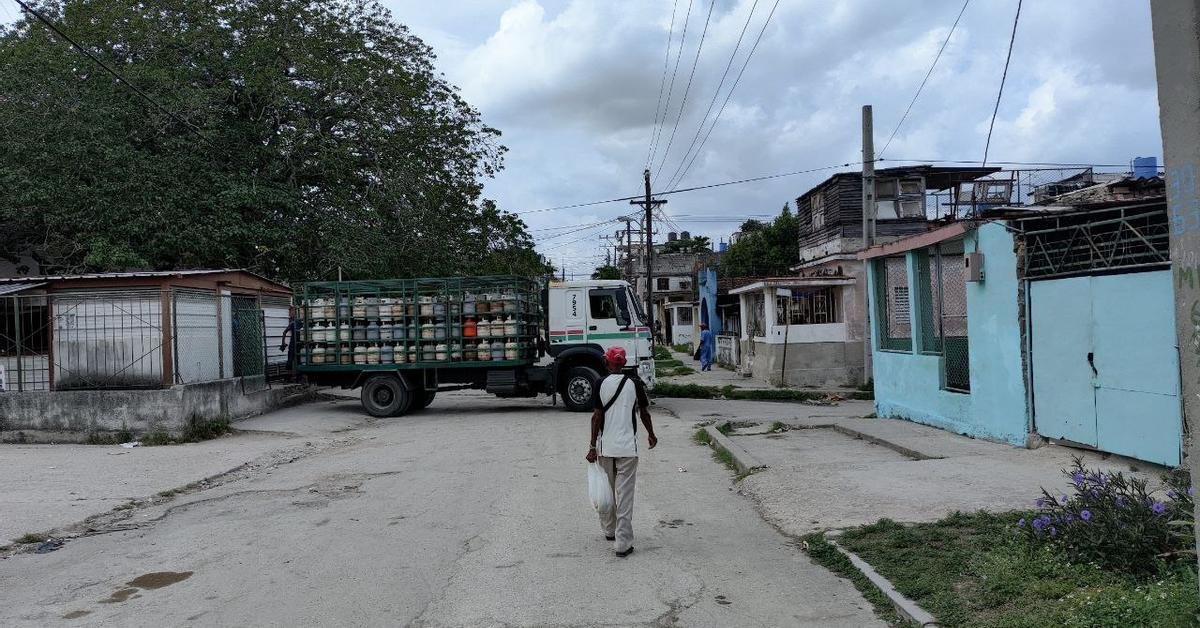
Yes fix this Gazette the price of LPG (liquefied petroleum gas) balitas, 35 pesos per kilogram. Taking into account that the cylinders are usually 10 kilograms, each one of them costs 350 pesos, instead of the 213 pesos that were paid until now.
That, of course, if they meet. As this newspaper has documented, in recent months, given the worsening of the energy crisis and the long lines to buy the product in the rationed market, a market has been consolidated in dollars of gas bales. These are sold on pages like Kmcero or Supermarket23, between 24 and 30 dollars per unit.
Presented as private businesses, however, the cylinders are distributed through the state circuit, which is why they have raised the annoyance of Cubans.
Taking into account that the cylinders are usually 10 kilograms, each one of them costs 350 pesos, instead of the 213 pesos that were paid until now
To justify the new resolutions on gas, the Gazette – brief, for the rest –, assures that “it is necessary to update the retail price without subsidy in Cuban pesos” of liquefied and manufactured gas – it divides them into two different resolutions – “taking into account the complex reality of energy siege that the country is experiencing, the scarce fuels in particular, with regard to the import of oil and the sustained increase in costs.”
Although in principle they are measures that liberalize the economy, on the street, the common Cuban perceives them with a single word: inflation.
In June, the consumer price index (CPI) rose 2.8%the largest increase so far this year, surpassing the previous record of 2.6% in February. Interannual inflation is already almost four points higher than in June 2025 (18.3%) and that accumulated since January is 12.24%, compared to 8.26% a year ago.
This with regard to the official market. In the informal sector, the American economist Steve Hanke has detected an increase of ten points in one month – from the 66% year-on-year that he diagnosed in June to 76% just a few days ago.
The publication of the Gazette matches a note in Granma which announces the approval of two new decree laws – which, however, have not been published in the official State bulletin – associated with the package of 176 measures to liberalize the economy.
Without many details, ‘Granma’ mentions the decree law “On the Cuban State Business System” and the “Amendment of Decree Law No. 76 on Agricultural Cooperatives”
Without many details, the Communist Party newspaper mentions the decree law “On the Cuban State Business System” and the “Amendment of Decree Law No. 76 on Agricultural Cooperatives,” approved in “an extraordinary session of the Council of State.”
The first of these rules says Granma“seeks to regulate the general principles of organization and operation of the state business system for its transformation and development under the leadership of the National Institute of State Business Assets (Inaee).” As for the second, it will regulate “the constitution, organization, integration and operation” of agricultural cooperatives.
The Inaee was created a few weeks ago, according to the Official Gazetteas “a budgeted institution” and “subordinate to the Council of Ministers” (the highest Cuban government body), for “the improvement of the state business system.”
Among its powers are “advise, propose, implement and control policies and regulations aimed at the state business system.” In this regard, the president of the National Assembly of People’s Power of Cuba, Esteban Lazo, pointed out that with the approval of this decree law, the socialist state company is “ratified as the main subject” of the Island’s economy.